Blog

  • Simple Ways to Reduce Nighttime Wake-Ups and Improve Sleep Quality!

    Simple Ways to Reduce Nighttime Wake-Ups and Improve Sleep Quality!

    Most people know the feeling: slipping into bed exhausted, only to find themselves wide awake at two or three in the morning, staring at the dark ceiling with a restless mind. It’s frustrating, it’s draining, and it can make even the simplest morning tasks feel heavier than they should. Yet these nighttime interruptions often have simple, fixable causes—subtle habits, environmental triggers, or natural body rhythms we rarely think about. When you understand what’s pulling you out of sleep and how to gently guide yourself back into it, those midnight wake-ups lose their mystery and start becoming far easier to handle.

    A good night’s rest actually begins long before you close your eyes. The space around you sets the tone for how deeply your body can settle, and the smallest details can either support your sleep or sabotage it. A room that’s a few degrees too warm, a crack of streetlight slipping through the curtains, or the hum of a TV in another room can be enough to nudge your brain awake again in the middle of the night. Creating a sleep-friendly environment isn’t about perfection; it’s about comfort. Cooler temperatures help your body maintain its natural sleep rhythm. Soft, breathable bedding supports deeper rest. Heavy curtains or blinds shield you from headlights, early-morning sun, or the glow of neighborhood porch lights. Even reducing small background noises—an inconsistent fan, a vibrating phone, or hallway chatter—can make a meaningful difference. When your surroundings stay steady and calm, your body has a much easier time drifting back to sleep after an unexpected wake-up.

    But your environment is only one piece of the puzzle. Your mind plays its own part, often louder and far more stubborn. Worries have a way of swelling in the quiet hours. Thoughts that barely matter during the day suddenly feel urgent at night: unfinished tasks, upcoming deadlines, conversations you overanalyzed, small concerns that somehow turn into giant spirals in the dark. This mental noise is one of the most common reasons people wake up and stay awake. The trick is not to fight your thoughts but to soften them. Slow, deep breathing can calm the nervous system in minutes. Gentle stretching releases tension your body holds without you noticing. Some people find relief in keeping a small notebook by the bed—writing down whatever’s on their mind so it stops looping in the background. A simple nighttime ritual that signals “it’s time to wind down” can also make a huge difference. When you consistently prepare your mind for rest—without phones, bright screens, or late-night multitasking—your brain learns to shift gears more smoothly and stay anchored in deeper sleep.

    Daily habits can either support your rest or quietly disrupt it. Many nighttime wake-ups come from choices made hours earlier. Eating heavy meals too late can send your digestive system into overdrive, keeping your body too active to stay asleep. Caffeine hides in more places than people realize—coffee, tea, chocolate, energy drinks, certain sodas—and even an afternoon dose can linger long past bedtime. Alcohol, while it might make you feel drowsy at first, often leads to shallow, fragmented sleep and early morning awakenings. And drinking too many fluids late in the evening has an obvious consequence: waking up repeatedly just to go to the bathroom. Paying attention to these simple patterns helps your body maintain a smoother sleep cycle from the moment you lie down to the moment you wake.

    Still, not all sleep disturbances come from habits. Sometimes the body itself is giving signals that something deeper needs attention. If you find yourself waking up frequently night after night—gasping, sweating, overheating, aching, or unable to breathe comfortably—it might be worth talking to a healthcare professional. Things like sleep apnea, hormone shifts, anxiety, blood sugar fluctuations, or even chronic pain can quietly affect sleep without you fully realizing it. Understanding the cause can open the door to solutions that make you feel like you finally have your nights back.

    When a nighttime wake-up does happen—and it will, because everyone experiences them—how you respond in the moment matters. Many people make the mistake of sitting up, turning on bright lights, checking the clock, scrolling on their phone, or walking around the house. All of these cues tell your brain that it’s time to be awake, making it much harder to fall back asleep. A gentler approach works better. Keep the lights dim. Avoid screens. Breathe slowly. Relax your shoulders, unclench your jaw, soften your hands and feet. Sometimes the simplest actions help your body slide back into sleep naturally, without forcing it.

    As you build healthier routines, you may notice your nights beginning to feel more stable. Your sleep becomes a rhythm instead of a gamble. You drift off more easily, stay asleep longer, and—when you do wake up—you return to rest with less struggle. Morning feels different too. Instead of starting the day groggy, foggy, and worn out, you rise with a sense of clarity and steadiness that carries you into your work, relationships, and responsibilities.

    Better sleep is rarely about one dramatic change. It’s the result of small, consistent adjustments—tiny shifts that work together to create nights that feel peaceful instead of chaotic. When you learn what your body needs, protect your time, and treat sleep as something worth tending to, the difference becomes unmistakable. Rest starts to feel like something you can rely on, not something you hope for.

    With a supportive environment, calming routines, mindful habits, and a willingness to listen to your body’s cues, you can reclaim your nights and wake up feeling more refreshed, grounded, and ready for whatever the day brings.

  • Breaking – Wheel of Fortune host dies at 76! More below!

    Breaking – Wheel of Fortune host dies at 76! More below!

    Mayra Gómez Kemp may not be a household name in every corner of the world, but within the history of television, she holds a place that few can match. Her death at 76 marked the loss of a true pioneer — a woman who broke barriers long before conversations about representation were mainstream. She wasn’t just another TV personality; she was, as Pop Culture noted, the first woman anywhere in the world to host a game show. That distinction alone cements her as a trailblazer, but her influence didn’t stop there. She became the face of Spain’s version of Wheel of Fortune, La ruleta de la fortuna, and brought a warmth, wit, and charisma to the role that made her unforgettable to Spanish audiences.

    Before she stepped under the bright lights of a studio set, Gómez Kemp had already built a creative life for herself. She was a singer, an actress, and a performer who understood the rhythm of an audience — how to read it, how to charm it, and how to keep people engaged. Those skills carried her effortlessly into television, where she mastered one of entertainment’s most deceptively challenging jobs: hosting.

    Hosting a game show looks easy until you understand what it demands. You need timing sharp enough to keep the energy moving, but gentle enough to let contestants shine. You’re expected to banter, improvise, stay focused, and turn even the dullest moments into something worth watching. On top of all that, you’re carrying the weight of ratings, consistency, and audience connection. The greats — people like Pat Sajak, Alex Trebek, and Bob Barker — made it look effortless. Gómez Kemp belonged in that league. She knew how to guide a show without overpowering it, how to navigate unpredictable contestants, and how to deliver exactly the tone viewers tuned in for. She became the heartbeat of the set, the thread holding every episode together.

    But her influence reached beyond the screen. For women in Spanish television, she represented possibility — proof that hosting wasn’t just a man’s arena, that audiences would embrace a woman leading one of the most popular formats in the world. Her presence challenged long-held industry assumptions, showing that charisma, intelligence, and stage presence weren’t tied to gender. She didn’t have to shout about breaking barriers; she broke them simply by showing up, excelling, and earning the affection of millions.

    In Spain, her run on La ruleta de la fortuna became a cherished part of pop culture. Families sat around their televisions, cheering along as contestants spun the wheel, guessed letters, and celebrated wins. And standing at the center of it all was Mayra — smiling, steady, full of life, and truly at ease in a job she had made her own. She brought humor when the moment called for it, empathy when contestants stumbled, and professionalism every single time she stepped in front of the camera.

    Her death triggered waves of nostalgia across Spanish-speaking communities. People shared stories of watching her on warm evenings, their parents shouting guesses from the couch, their grandparents laughing at her jokes. Others remembered her earlier work as a performer — her voice, her energy, her willingness to take on any role with full commitment. She wasn’t just a host; she was a symbol of a television era built on heart, connection, and personality.

    In an age before social media magnified every celebrity’s every move, Gómez Kemp became beloved simply by being present and authentic. She didn’t need viral moments or controversy to draw attention. Her talent did the work for her. And in an industry that often overlooks the women who paved the way, her story stands as a reminder that trailblazers come in many forms — and that some of the most influential ones never get the global recognition they deserve.

    Her legacy also throws a spotlight on the art of hosting itself. People often underestimate the skill behind guiding a game show. It isn’t just reading cue cards and smiling on camera. It’s carrying an entire production on your shoulders while making it look effortless. It’s listening more than talking, shining a light on others without letting your own fade. It’s performance, management, communication, and adaptability rolled into a single role. Gómez Kemp embodied that balance with remarkable ease.

    While the modern television landscape is crowded with personalities, influencers, and rotating hosts, few possess the grounded presence she brought to her work. She knew how to let a show breathe and how to give contestants the space to be the stars of their own moment. She respected the format, respected the audience, and respected the job.

    Her passing is not just the loss of a former host — it’s the end of a chapter in television history. A chapter defined by bright studio lights, simple games that drew entire families together, and hosts who didn’t need gimmicks to earn loyalty. She was part of that era, and she elevated it with grace and talent.

    What remains now is a legacy that continues through the countless hosts who followed her path, knowingly or not. Every woman who has stood behind a podium, read from a card, guided a game, or led a televised audience in laughter owes a quiet part of her opportunity to figures like Gómez Kemp.

    She didn’t just host a game show. She shifted expectations. She opened doors. She proved that charm and leadership don’t come from fitting a mold — they come from showing up as yourself and doing the work with pride.

    Mayra Gómez Kemp leaves behind a legacy of talent, resilience, and groundbreaking achievement. She built a career that deserves to be remembered, celebrated, and taught to the next generation of performers who hope to stand where she once stood — under the lights, guiding the moment, shaping the show, and connecting with millions through the simple, powerful act of presence.

    Her chapter may have closed, but her influence echoes on.

  • Breaking – Serious accident leaves 9 dead, among them was our dear beloved singer! See more

    Breaking – Serious accident leaves 9 dead, among them was our dear beloved singer! See more

    The news broke just after midnight, carried first by panicked eyewitness posts and shaky cellphone videos before official confirmation arrived. A violent collision on a crowded highway had taken nine lives, and among them was a singer whose voice had woven itself into the soundtrack of an entire generation. Within minutes, shockwaves rippled across social media, radio stations interrupted programming, and fans everywhere found themselves staring at their screens in stunned silence. It didn’t feel real — talent like that wasn’t supposed to disappear overnight, certainly not in such a brutal, senseless way.

    The accident happened on a stretch of highway known for heavy truck traffic and narrow lanes. According to early reports, a large transport truck veered slightly across the center line at the same moment a passenger vehicle carrying the singer and members of their team was approaching. What followed was catastrophic. The impact crushed the smaller vehicle instantly, leaving twisted metal scattered across the asphalt and debris sprawled in every direction. Witnesses described a “scene of chaos,” headlights shattered across the pavement, and the overwhelming weight of silence that comes after a tragedy no one can undo.

    Emergency crews arrived within minutes, racing against time as they assessed the wreckage. Firefighters cut through mangled doors, medics worked under harsh flashing lights, and officers redirected traffic away from the devastation. But for nine souls — including the artist at the center of it all — there was nothing left to save. Their journey had ended on that highway, suddenly and without warning.

    Word spread quickly through the entertainment community. Colleagues, collaborators, and longtime friends began posting tributes before the news even hit the morning broadcasts. Some shared photos from backstage moments, laughing between shows. Others shared memories of quiet conversations, late-night studio sessions, or the gentle kindness the singer was known for offstage. More than a few posts simply said, “I don’t have words,” because grief doesn’t always translate into sentences — sometimes it’s just a hollow ache that sits heavy in the chest.

    Fans reacted with a level of heartbreak that told the world exactly how deeply this artist had connected with people. The comments poured in by the thousands: messages about songs that helped someone through a breakup, a performance that brought joy during a dark time, or an interview that showed the singer’s sincerity in a way that felt rare in the entertainment world. Their voice had been a companion to so many — through car rides, heartbreaks, victories, and long nights when music was the only thing that made the world feel bearable.

    This wasn’t the kind of celebrity death people brushed past. This one felt deeply personal.

    Authorities are still working to determine the exact cause of the crash. Investigators are reviewing traffic camera footage, analyzing tire marks on the road, and speaking with witnesses who saw the moments before the collision. Mechanical failures, driver fatigue, roadway conditions — every possibility is on the table. And while the investigation will eventually uncover the technical truth, answers rarely erase the emotional aftermath. Families have been shattered, futures cut short, and an entire fandom is left grieving a loss that cannot be quantified.

    The singer’s family released a brief statement early this morning, asking for privacy as they process an unimaginable tragedy. They referred to their loved one not as the star seen on billboards and award shows, but as the person behind the fame — someone who laughed loudly, loved deeply, and carried a warmth that only those closest to them truly knew. It was a reminder that behind every public figure is a private life full of relationships, routines, dreams, and vulnerabilities none of us ever see.

    Plans are already underway for a memorial, though details will come later. Industry insiders hint at a large tribute performance — something worthy of the legacy left behind. There’s talk of other artists coming together to honor the voice that once shared the stage with them. But for now, everything is paused, suspended in the stillness that follows heartbreak.

    What makes this loss sting even more is how much the singer still had ahead of them. They had hinted in recent interviews about new music, talked about a tour in development, and mentioned personal projects they were excited to share. Fans were waiting — not just for the next song, but for the continued evolution of an artist who never stopped growing or pushing boundaries. Now, those plans remain frozen in time, reminders of a future that will never unfold.

    As the world processes the news, people are turning back to the one thing the singer left behind in abundance: the music. Streams have surged as fans revisit their favorite tracks — the ones that hit hardest, the ones that made them feel seen, the ones that carried raw emotion wrapped in melody. In each song, there is a piece of the artist still alive, still resonating, still speaking.

    That is the bittersweet truth of losing someone whose art reached millions. They may no longer be here, but their voice continues to echo. Every lyric holds a memory. Every chord carries a piece of their soul. And even though they’re gone, they aren’t silent.

    The entertainment world will move forward, as it always does, but it will move differently now. One more light has gone out — one that cannot be replaced. The nine who died in that collision leave behind nine separate stories, nine families grieving, nine lives intertwined for one tragic instant. And at the center of it all, a beloved singer whose final journey ended far too soon.

    For now, fans mourn. Friends remember. Tributes continue to rise with every passing hour. And somewhere out there, the last song the singer ever recorded plays softly for someone who needs it — a voice preserved, a legacy unbroken, even in the shadow of loss.

  • Simon Cowell earned millions from American Idol, now get to know his only child!

    Simon Cowell earned millions from American Idol, now get to know his only child!

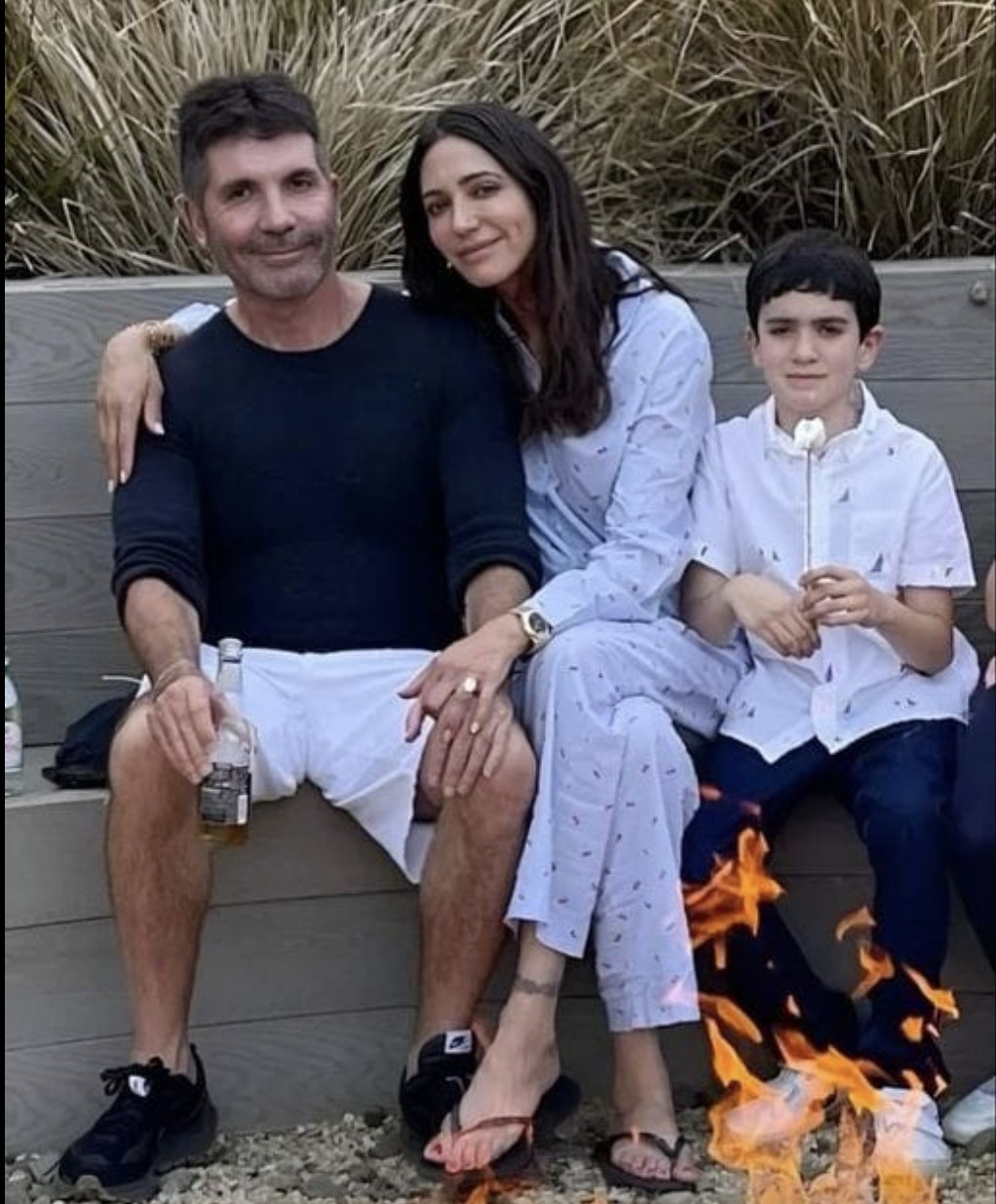
    Simon Cowell’s life looks like a highlight reel to anyone watching from the outside — the sharp-tongued judge who turned talent shows into global juggernauts, the multimillionaire who shaped the careers of some of the biggest stars on the planet, the man whose name became synonymous with blunt honesty and massive success. But behind that polished image is a story that began far more humbly, twisted through failure, reinvention, personal upheaval, and eventually landed somewhere Cowell never expected — fatherhood, purpose, and a legacy he refuses to measure in dollars.

    His journey started quietly. After dropping out of school, Cowell was hardly the music titan he is today. He worked as an assistant at EMI, thanks mostly to his father’s connections, learning the business from the bottom up. His attempts to leap into entrepreneurship were not instant wins — his first two record labels collapsed, dragging his finances with them. By his late twenties, he’d lost his apartment, his car, and almost everything he owned. He moved back home, humbled, bruised, but oddly relieved. “I was quite happy, really,” he later admitted — a rare moment of honesty about hitting rock bottom.

    But Cowell wasn’t wired to stay down. He regrouped and launched S Records, gathering an eclectic mix of pop acts. He signed 5ive, Westlife, and the crooner whose cover of “Unchained Melody” unexpectedly climbed the charts. But everything changed in 2001 when Cowell and Simon Fuller created Pop Idol. Overnight, Cowell went from a behind-the-scenes executive to the brutally honest judge viewers loved to hate — and couldn’t stop watching.

    Then came American Idol, the show that turned him into a household name. His blunt critiques, sarcastic expressions, and signature line — “I don’t mean to be rude, but…” — became cultural staples. When Kelly Clarkson won the first season, nearly 30 million people were watching. Cowell saw the power of the format immediately and cashed in by releasing Idol-themed compilation albums. They sold by the millions, launching him into a different financial stratosphere.

    The momentum never stopped. He co-created The X Factor in the UK, then brought it to America. He co-created and judged America’s Got Talent and Britain’s Got Talent — both blockbuster franchises. By 2006, he’d inked a massive deal to stay on American Idol. His yearly earnings soared into the tens of millions. By 2020, reports put his net worth around $600 million — a staggering fortune built not on luck, but on instinct, work ethic, and an unfiltered personality viewers couldn’t turn away from.

    Yet with the massive success came personal changes. Cowell became known for his appearance as much as his sharp tongue. For years, he experimented with Botox, facials, even a sheep placenta treatment. He joked about it at times, but eventually admitted he’d gone too far. It was his young son who made him step back from the cosmetic treadmill, telling him he “looked weird.” That was enough for Cowell — he scaled back and learned to laugh about it.

    Eric changed more than just his father’s grooming habits. When Cowell and Lauren Silverman announced their pregnancy in 2013, Cowell was hesitant. He’d always pictured himself as the career-driven bachelor, not someone reading bedtime stories or building Lego towers. But the moment Eric arrived on Valentine’s Day 2014, everything shifted. Cowell described the feeling simply: “It’s the most amazing thing that ever happened to me.” His world reordered itself, and for once, work wasn’t the center.

    But life didn’t stay smooth. In 2017, Cowell collapsed at home from low blood pressure, a scare that pushed him into a dramatic lifestyle overhaul. He cut out red meat, dairy, sugar — even alcohol — and lost 60 pounds. Then, in 2020, he suffered a brutal electric bike accident that fractured his back. A six-hour surgery, a metal rod implanted, and strict doctor’s orders to rest would have sidelined most people for months. Cowell ignored that timeline completely. Two days later, he was walking — slowly, painfully, but determined.

    Today, he walks more than 40 miles a week, holds daily business meetings, and maintains a routine sharper than ever. The setbacks didn’t derail him; they recalibrated him. They reminded him that even empires require maintenance.

    But perhaps the most surprising twist in his story is the one involving his wealth. Despite being one of entertainment’s richest figures, Cowell doesn’t plan to leave his fortune to Eric. “Your legacy has to be that you gave others a chance,” he explained. Instead, his money will go toward charities, especially those supporting kids and animals — causes he believes deserve long-term investment.

    Cowell understands something many wealthy figures don’t: money fades, but opportunities last. And that, he believes, is what makes a real legacy.

    In the end, Simon Cowell’s life isn’t just about fame, money, or acerbic one-liners. It’s about reinvention. It’s about failing twice, rebuilding twice, and creating a global empire because he refused to let setbacks define him. It’s about becoming a father at an age he never expected and letting that soften edges he spent decades sharpening. It’s about giving back instead of clinging to wealth out of fear of what happens when the cameras eventually go quiet.

    He has become more than a judge — he’s a mogul, a survivor, a philanthropist, and a man who understands that the most meaningful things in life don’t come with contracts or ratings.

    So if you had $600 million, what would you do? The question lingers, not as a fantasy, but as a prompt — a reminder that sometimes the biggest legacy isn’t wealth itself, but what you choose to do with it.

  • My Son Handed Me a Key and Said, Dad Gave It to Me 6 Years Ago Before That Surgery

    My Son Handed Me a Key and Said, Dad Gave It to Me 6 Years Ago Before That Surgery

    Rain was still falling in thin, cold sheets the day we buried Harold. The sky looked just as unforgiving as the man we were laying to rest. I kept one hand on my son’s shoulder, the other gripping a flimsy umbrella that did little to stop the water soaking through my coat. I can’t say I felt grief. Harold had never made room for me in his life, and after Michael died, he made sure the distance between us stayed permanent. But for my son, Kiran, the loss was real. Harold had let him in when he shut everyone else out.

    We were leaving the cemetery when Kiran tugged at my sleeve. His expression stopped me in my tracks—soft, unsure, but carrying a determination that didn’t match his age. He held out a small rusty key.

    “Mom,” he said quietly, “Dad gave this to me. Before the surgery. He said to keep it safe until Grandpa died.”

    I stared at the key, then at my son. Memories of that hospital room came back sharp and painful—Michael pale, weak, and braver than I ever knew him to be. That surgery had been our last hope, and when it failed, it wrecked more than just our lives emotionally. I was drowning in medical debt, working double shifts just to keep us afloat, selling anything of value—including a bracelet Michael once gave me. Kiran never complained. He grew up faster than he should have, shouldering silence when I should’ve carried everything for him.

    But now he was holding a secret his father trusted him with—something he’d protected for six years.

    “Why now?” I asked.

    “Because Dad said we’d need to go to Grandpa’s house after he was gone.”

    Those words were like stepping into a storm all over again. Harold had banned me from his property years earlier. A stash of roughly $200,000 had vanished from the house shortly after a family visit, and despite zero proof, he accused me and Michael. It torpedoed any remaining relationship we had with him. The only exception he ever made was for Kiran. Our son was the one bridge he never burned.

    And now that bridge was leading us straight into Harold’s house.

    By the time we pulled up to the old colonial, night was creeping in. The place looked as cold as I remembered—curtains drawn, paint peeling, front step cracked right down the middle. Kiran walked straight to the porch, reached under the railing, and retrieved the hidden spare key. It jolted me a bit, realizing how familiar he was with a house I’d never been allowed to enter.

    Inside, the air was stale and bitter, as if the walls themselves were still holding onto Harold’s distrust. The house was cluttered but lived-in—half-empty glasses, old newspapers, signs he’d been moving through life the same way he always did: closed off, secretive.

    The rusty key wasn’t for a door. Kiran led me toward the basement, speaking with the calm of someone following a plan rehearsed long ago.

    “Dad said it opens something behind the wardrobe.”

    The basement was cold enough to raise goosebumps on my arms. A dim bulb washed the room in an orange haze. Boxes lined the walls, and in the far corner stood a wardrobe that didn’t belong—too big, too heavy, too deliberately placed.

    Together, we pushed it aside.

    Behind it was a small recess in the wall. And inside that recess was a safe—old, rusted, and unmistakably important. The key slid in cleanly. My heart thundered. When the lock clicked open, it echoed through the room like the final crack of a long-kept secret.

    Inside was a black pouch.

    Inside the pouch… stacks of $100 bills. Bundles of them.

    “Mom,” Kiran whispered, “there’s… there’s so much.”

    My hands trembled. There had to be at least $200,000—maybe a little more. Exactly the amount that had “gone missing.”

    Then I found a velvet box. Inside was my bracelet—delicate gold, the same one I’d sold during our darkest year. Seeing it again cracked something inside me.

    And beneath everything was a thick envelope addressed to me.

    I unfolded the letter, and Michael’s handwriting pulled me under instantly.

    “Jen, if you’re reading this, then I didn’t make it. And Dad is gone. I’m sorry. This wasn’t how it was supposed to go.”

    He explained it all in heartbreaking detail.

    His mother—quiet, gentle, patient—had been secretly removing small amounts of money from a savings account Harold didn’t know about. She moved the cash into the safe because Harold was burning through money faster than she could protect it. One day, he found the shoebox she originally hid it in and assumed the worst when we showed up to visit. She let him believe it, because stopping him would have put everything at risk. The plan was simple: when Harold died, the money would be ours. A safety net for Michael, for me, and for Kiran.

    “We couldn’t tell you,” the letter said. “It was the only way to protect it.”

    By the time I reached the end, tears were rolling down my face.

    Kiran placed a hand on my shoulder. “Mom… he never abandoned us. He was taking care of us the whole time.”

    There was another envelope—this one for Kiran. His voice shook as he read his father’s words, a mixture of fatherly advice and raw love. Michael had trusted him in a way that suddenly made perfect sense. He knew Kiran would keep that promise.

    We left the house different people than when we walked in. We were carrying money, yes—but we were also carrying clarity. Understanding. Closure. Harold’s bitterness had covered a truth I never could’ve guessed: Michael and his mother had been fighting for us behind the scenes, even when their silence broke our hearts.

    Within a month, every debt was paid. The fear of financial ruin evaporated. I fixed the car. Kiran and I planned the college tour we’d skipped. Choices returned—actual choices, not survival strategies.

    One night, I found the rusty key on my nightstand. I held it between my fingers, realizing it symbolized far more than access to a safe.

    It was trust.

    It was love sealed in silence.

    It was a father believing in his son.

    And it was Michael’s final gift—a way to make sure we’d rise again, even if he couldn’t be there to see it.

  • I Raised My Twin Sons All Alone – but When They Turned 16, They Came Home from Their College Program and Told Me They Wanted Nothing More to Do with Me

    I Raised My Twin Sons All Alone – but When They Turned 16, They Came Home from Their College Program and Told Me They Wanted Nothing More to Do with Me

    When I found out I was pregnant at 17, it didn’t feel like one of those dramatic teenage crises you see in movies. It felt quieter, heavier. Shame was the first thing that wrapped around me, not because of the babies growing inside me, but because I’d already learned how to make myself small long before that morning. I knew how to fold myself into corners at school, how to pretend not to exist when girls my age talked about prom dresses or weekend parties. They floated through hallways with bright eyes and simple dreams. I drifted through them clutching a stomach full of morning sickness and fear, trying to breathe through the nausea during third-period algebra.

    Meanwhile, Evan—the boy who swore he loved me—still walked through the world like it bowed for him. The varsity starter with the messily perfect hair, the boy whose smile earned him passes from every teacher. He used to kiss me behind the auditorium and whisper that we were meant to be. He said it so convincingly I believed him. So when I told him I was pregnant, and he vowed to stand by me, I soaked up every word like sunlight.

    By sunrise the next day, he was gone.

    His mother stood at her doorway wearing a polite mask stretched too tight across her face. She claimed he’d gone out west to stay with relatives. She closed the door before I could even ask where.

    Blocked on everything. No goodbye. No explanation.

    That was the day I realized my kids would only have one dependable parent—and it would be me.

    The ultrasound showed two tiny heartbeats, side by side, pulsing like they were already in sync. I remember thinking, If no one else shows up, I will. That was my promise.

    My parents weren’t thrilled. Disappointed was putting it lightly. But then my mother saw the sonogram, pressed her hands to her face, and something softened. She promised to help. She wasn’t perfect, but she stayed.

    Noah and Liam arrived wailing and furious at the bright hospital lights. They were warm, perfect, and instantly mine. The early years were a blur of exhaustion that coated everything I did. Nights where I cried into stale bread and peanut butter because I had no time or money for proper meals. Days full of double shifts, diapers, fevers, tantrums, laundry that never seemed to end.

    They grew up quickly. One moment they were curled together in matching pajamas watching Sesame Street, and the next they towered over me, arguing over whose turn it was to unload groceries. Liam was the fire—restless, stubborn, always pushing. Noah was the calm—quiet, observant, carrying a steadiness that kept us from toppling over on our hardest days.

    We built a small life: pancakes on exam mornings, movie nights on Fridays, and always a hug before they left the house—even when they pretended they hated the ritual.

    When they got accepted into a dual-enrollment college program at sixteen, I sat in the car afterward and cried until my vision blurred. After everything, they were stepping into a future I once feared they’d never reach.

    Then came the Tuesday everything broke.

    I came home drenched from rain after a long double shift. My socks squished in my shoes, my uniform clung to my skin, and all I wanted was a hot shower. Instead, I walked into a suffocating silence.

    They sat side-by-side on the couch, stiff and solemn like two young men bracing for impact.

    “We need to talk, Mom,” Liam said.

    Nothing good ever follows those words.

    Noah’s voice was softer but worse. “We met Dad.”

    My heart jerked. Evan. The ghost of a boy who ran from responsibility now had the nerve to reappear.

    “He’s the program director,” Noah said. “He found our files. He told us he’s been looking for us.”

    “And he said,” Liam added, jaw clenched, “that you kept him away. That you shut him out.”

    It felt like the room tipped sideways.

    “That’s a lie,” I said, the words scraping out. “He disappeared. He abandoned us.”

    They didn’t move. Didn’t blink. Evan had struck exactly where we were weakest—our missing piece.

    Then Noah delivered the blow no mother deserves.

    “He said if you don’t cooperate, he’ll get us kicked out of the program. Ruin college for us. He wants you to pretend to be his partner at some banquet, make him look like the father of the year while he campaigns for some education board appointment.”

    My whole body burned. Not with fear—fury.

    “Look at me,” I said. “I will never let that man decide our future. If he wants a show? Fine. We’ll give him one. And then we’ll tear his perfect little narrative apart.”

    We agreed. A temporary performance. A setup. Nothing more.

    The day of the banquet, Evan walked into the diner I worked at like he was stepping into a movie scene. Shiny shoes, overpriced jacket, smirk sharp enough to cut glass. He sat across from the boys like he wasn’t the man who abandoned us. He talked like a politician rehearsing lines.

    We played along. We pretended. He bought a muffin and strutted out as if he’d won.

    Let him think it.

    That evening, I dressed in a navy dress I’d borrowed from a coworker. My sons wore borrowed ties. When we walked into that banquet hall, every head turned. Evan was glowing with self-importance. Cameras flashed. He placed his arm behind my waist, guiding me forward like a trophy.

    During his speech, he lied effortlessly about dedication, fatherhood, redemption, family. And then he invited the boys to the stage. He wanted the world to applaud the reunion he had fabricated.

    He didn’t expect what happened next.

    Liam stepped up to the microphone.

    “I want to thank the person who raised us,” he said.

    Evan leaned closer, smiling.

    “And it’s not this man.”

    Silence sliced the room open.

    Noah stepped forward. “He abandoned our mother. Threatened us. Tried to use us to boost his career.”

    Gasps rippled through the hall. Phones came out. Whispers turned into outrage. Evan paled, rattled, suddenly exposed under the very spotlight he craved.

    He tried to regain control, but the crowd was already turning. By morning, he was removed from his position, and an investigation was underway.

    The following Sunday, I woke to the smell of pancakes and bacon. Noah was peeling oranges. Liam was flipping pancakes. They looked up with shy smiles, the weight gone from their shoulders.

    “Morning, Mom,” Liam said.

    I leaned against the doorway, watching my boys move through our kitchen—safe, home, ours.

    They had almost slipped away. But they came back. They chose me.

    And I realized that even the deepest lies can’t break the kind of love built through years of sacrifice, grit, and showing up—every single day.

  • Sally Field, Now 76 Years Old, Has Never Had Plastic Surgery Despite Facing Ageism In Hollywood!

    Sally Field, Now 76 Years Old, Has Never Had Plastic Surgery Despite Facing Ageism In Hollywood!

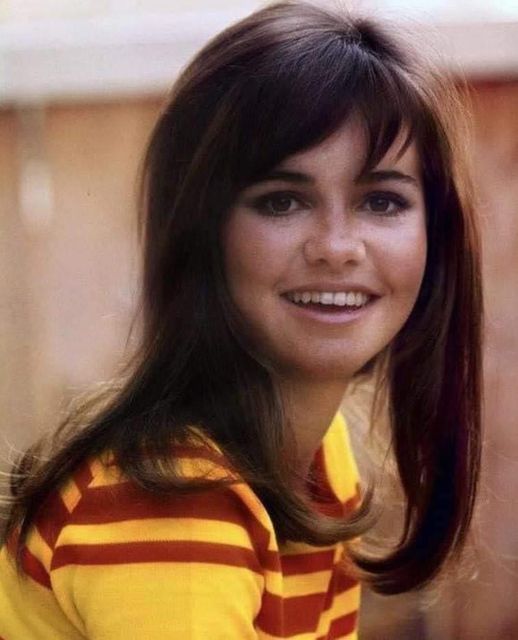
    Sally Field has spent her entire career defying expectations, and she’s still doing it at 76. In an industry obsessed with pretending time doesn’t move, she’s chosen the opposite — she lets the years show. No surgical shortcuts. No frantic attempts to look 30 forever. Just an honest woman aging in front of the world, holding her ground in a business that often punishes women the moment they start looking their age. Her refusal to play along has turned her into something rare in Hollywood: someone who isn’t trying to fool you.

    Long before she was celebrated as one of the most respected actors of her generation, Field started small. In the 1960s, she stepped into America’s living rooms as the spirited teenager in “Gidget” and then as the airborne novice nun in “The Flying Nun.” Those roles didn’t just make her famous — they made her familiar, the kind of presence people instinctively rooted for. But the bubbly sitcom era didn’t define her. She pushed past the limits the industry tried to place on her, clawing her way into dramatic roles that demanded depth rather than charm.

    That leap paid off. Her performance in “Norma Rae,” clenched fist raised high in a moment that became iconic, proved she wasn’t just a sitcom sweetheart. She was a force. “Steel Magnolias,” “Mrs. Doubtfire,” “Smokey and the Bandit,” “Places in the Heart,” “Forrest Gump” — she stacked up a résumé most actors couldn’t dream of, collecting Oscars, Emmys, and Golden Globes along the way. Decade after decade, her work stayed sharp, honest, and brave. She never faded, never stumbled into self-parody, never drifted into the background. She simply continued being good — consistently, relentlessly good.

    In 2023, the Screen Actors Guild honored her with the Lifetime Achievement Award. Onstage, she spoke with the same unvarnished sincerity that made audiences love her in the first place. There was no ego in her words, no desperation to cling to relevance. Just gratitude, humility, and a clear-eyed understanding of what it means to survive nearly sixty years in a business that discards women like expired products.

    What sets Field apart now isn’t just the work she’s done. It’s how she has chosen to exist in a culture built on illusions. As movie sets and red carpets filled up with unnaturally smooth faces, Field stayed Still Field — lines, texture, gray hair, all of it. She’s admitted to feeling the same insecurities everyone else does, but she never let fear push her toward procedures she didn’t want. She’d rather look like herself at 76 than like someone fighting a losing battle against biology. Her stance isn’t loud or self-righteous. It’s steady. It’s self-respecting. And it’s a reminder that there’s dignity in letting life show.

    She’s talked before about the pressure in Hollywood to remain eternally youthful, especially for women whose value is often tied to appearance more than ability. But she never bought into that economy. Instead, she turned aging into a kind of rebellion. She made space for older women to be seen without apology. She proved that confidence is a better beauty treatment than any needle. She embraced her hair turning silver, her face gaining the stories of a lifetime, and her own evolution as a human being who’s lived, worked, parented, struggled, fought, and survived.

    Field understands the strange contradictions of Hollywood because she’s lived through all of them — the highs, the humiliations, the comebacks, the droughts, the acclaim. She’s been underestimated, typecast, dismissed, and then celebrated all over again. Through it all, she has carried herself with the kind of grounded perspective that doesn’t come from fame but from endurance.

    Her honesty about aging isn’t performative. It’s not a branding move. She doesn’t preach about “aging gracefully” while secretly booking appointments. She simply allows herself to be real, and people respond to that. Her authenticity cuts through the noise. It’s a relief in a world where filters distort reality and even the most admired faces come with disclaimers.

    Part of what makes Field so compelling today is that she hasn’t stopped evolving. She brings emotional depth to every role, never phoning it in. Even as she takes on fewer projects, she stays present. Her interviews feel thoughtful rather than rehearsed, her reflections sharp rather than nostalgic. She talks about her career with a clear view of the road behind her and a calm acceptance of whatever lies ahead.

    At 76, Field stands as proof that talent doesn’t evaporate with age. It doesn’t soften. It doesn’t need to be lifted or tightened or erased. Her presence on screen is still magnetic, not in spite of her years but because of them. She carries the history of her life in her face, in her posture, in the weight of her performances. That’s what audiences connect to — not an illusion, but the truth.

    In an industry that values youth more than wisdom, her example is a quiet rebellion. She isn’t trying to be the exception; she just refuses to lie about who she is. And that honesty has made her more admirable than any red carpet glow-up ever could.

    Sally Field isn’t just aging — she’s aging on her own terms. She reminds people that real beauty doesn’t require a surgeon, a filter, or a desperate scramble to stay relevant. It requires courage. It requires self-respect. It requires the willingness to let the world see you as you are.

    And at 76, she remains unforgettable not because she’s untouched by time, but because she’s unafraid of it.

  • Heroic Rescue! Goat Saved from Python Attack

    Heroic Rescue! Goat Saved from Python Attack

    A python had wrapped itself around a small goat, squeezing the life out of it in the way only a large constrictor can: methodical, silent, and terrifyingly patient. Most people would have kept their distance or called for help that would arrive too late. But one person didn’t freeze. One person didn’t wait. They jumped straight into the chaos.

    The python had come out of the underbrush near a rural settlement where people and wildlife overlap more than anyone would like to admit. Encounters like this are unpredictable. One moment everything is calm, the next a predator has seized an opportunity. The goat had wandered just a bit too far from the grazing path, and that tiny miscalculation put it directly in the snake’s line of attack. The python struck quickly, looping its heavy coils around the animal before it even understood what was happening. By the time the alarm was raised, the goat was already on its side, bleating weakly as the coils tightened.

    The would-be rescuer rushed over after hearing the commotion. They weren’t a trained wildlife handler. They weren’t wearing protective gear or carrying special tools. They were just someone standing in the right place at the right time who refused to let panic dictate the outcome. As others backed up, horrified and uncertain, this person stepped toward the writhing mass on the ground and assessed the situation in a handful of seconds.

    The python was large, thick-bodied, and fully committed to its meal. Once a snake like that starts constricting, it doesn’t stop unless something shocks or disrupts it. Undoing those coils by hand is risky. A python can shift instantly and redirect its grip toward a new target. The rescuer knew the danger but also understood that hesitation would doom the goat.

    They grabbed the snake near its midsection, digging their hands under one of the coils and pulling with everything they had. At first, the python didn’t budge. These animals are pure muscle, and when they anchor themselves, they feel like living steel cables. The rescuer adjusted their stance, braced their legs, and heaved again. This time, a section of the coil loosened—just slightly—but enough to break the rhythm of the constriction. The goat let out a raspy bleat, proof that it wasn’t too late.

    Adrenaline kicked in. The rescuer forced their hands in deeper, prying the snake off inch by inch. Sweat mixed with dust, breath grew ragged, and every second felt stretched thin. The python twisted violently, trying to regain control, but the rescuer didn’t back off. They kept pulling, shifting, repositioning, and using their weight to counter the snake’s strength. A small crowd watched, murmuring in shock, unable to look away from the raw physical struggle unfolding in front of them.

    Finally, the python gave way. Its coils unraveled enough for the rescuer to drag it aside, separating the predator from its prey. The snake thrashed, clearly frustrated, but without the leverage of a trapped animal, it eventually turned and retreated into the grass, disappearing with the same eerie silence it had arrived with. The danger was over, at least for that moment.

    The goat lay on the ground trembling, exhausted and oxygen-deprived, but alive. The rescuer knelt next to it, checking for injuries and gently helping it sit upright. Someone brought water. Someone else called out in relief. The tension broke, replaced by gratitude and disbelief at what they had just witnessed. Acts like this don’t come from training manuals or rehearsed procedures. They come from instinct and courage—the kind that shows itself only under pressure.

    A spokesperson familiar with the incident later summed it up bluntly: “The rescuer’s quick thinking and courage prevented a tragic outcome.” That wasn’t exaggeration. A few more minutes, even seconds, and the story would have ended very differently. Constrictor attacks don’t leave much margin for error.

    This moment is a reminder of the complicated relationship between humans and wildlife in places where their worlds overlap. People share land with animals capable of incredible force and instinctive aggression. Most of the time, coexistence works. But every now and then, lines cross, and instinct collides with daily life. Goats wander. Snakes hunt. And sometimes, fate tosses both into the same clearing.

    It also highlights something else: bravery isn’t always about spectacle or grand gestures. More often, it’s a single decision made without overthinking—stepping forward instead of stepping back. Plenty of people would have chosen caution, and honestly, no one would have blamed them. Facing down a python is not on anyone’s list of reasonable afternoon activities. But every rescue story depends on someone who refuses to be a spectator.

    The goat, shaken but recovering, became the symbol of the entire incident: vulnerable, ordinary, and lucky that someone nearby valued its life enough to intervene. In a world where most wildlife encounters end in predictable patterns—predator wins, prey loses—this one shifted the script. It proved that outcomes aren’t always inevitable. Sometimes the arc bends because a human decides to interfere, risking their own safety to rewrite the ending.

    Witnesses later replayed the moment again and again, trying to process the intensity of it. The blur of motion, the weight of the snake, the desperate bleating of the goat, the tension in the rescuer’s shoulders as they strained to free the animal—all of it stayed vivid in people’s minds. The story spread quickly, partly because of its drama, but mostly because of its clarity: a life-or-death struggle resolved through sheer determination.

    This wasn’t a sanitized, controlled environment. It wasn’t a staged encounter. It was raw nature intersecting human instinct in its purest form. There’s something grounding about that, a reminder that even in modern life—with all its technology, structure, and convenience—moments still exist where survival boils down to strength, timing, and courage.

    The video captured the chaos, the tension, and the final release when the python slipped away. But it didn’t capture everything. It couldn’t record the split-second decision-making, the pounding pulse, or the risk calculation happening behind the rescuer’s eyes. Videos show actions. They never quite show the weight of the choice behind them.

    What matters is that someone stepped up. A vulnerable animal survived. And a python, startled but unharmed, returned to its natural world. The balance restored itself through one person’s refusal to let fear dictate the outcome.

    The incident stands as a sharp reminder of the unpredictable nature of wildlife encounters, especially in places where human and animal paths cross without warning. It also stands as proof that individual courage can flip the script in moments where everything seems predetermined.

    Not every day produces a story like this. But when it happens, it leaves a mark—on the witnesses, on the rescued animal, and on anyone who hears about it.

  • My Future MIL Told My Orphaned Little Brothers They Would Be Sent to a New Family Soon – So We Gave Her the Harshest Lesson of Her Life

    My Future MIL Told My Orphaned Little Brothers They Would Be Sent to a New Family Soon – So We Gave Her the Harshest Lesson of Her Life

    After my parents died in the fire, everything I thought I knew about life evaporated in a single night. One moment I was asleep in my room, the next I woke up choking on smoke, heat burning across my skin. I remember the panic, the way the floor groaned under me, and the sound that cut through everything — my six-year-old twin brothers screaming for help. I wrapped a shirt around my hand, yanked the door open, and then everything turned into a blur of terror and instinct. Somehow, I dragged Caleb and Liam out of that burning house, stumbling into the cold night while firefighters swarmed behind us. That was the night our family ended and began at the same time.

    From then on, the boys became my whole world. Every meal, every school form, every tear-filled night — all of it landed on me, and I didn’t question it for a second. My fiancé, Mark, was the only reason I didn’t fall apart. He was there for every breakdown, every therapy appointment, every long night when the boys couldn’t sleep alone. He treated them like sons from day one, and they adored him so much they still call him “Mork.” We were building something stable again, something real. But one person refused to accept that — Mark’s mother, Joyce.

    Joyce didn’t just dislike the situation. She loathed it. From the moment she learned the boys would live with us permanently, she acted like I’d dumped a pile of responsibilities onto her precious son. She had this polished, poisonous way of speaking — smiling while she stabbed with her words. When she looked at my brothers, she didn’t see children who lost everything. She saw obstacles. She saw “baggage.”

    She made snide comments constantly, claiming Mark needed “his own family” and shouldn’t “waste himself raising someone else’s kids.” She doted on Mark’s sister’s children while pretending mine didn’t exist. At one birthday party, she passed out cake slices to every child except the twins and claimed she had “miscalculated.” I gave up my slice. Mark handed over his. That was the moment we both understood she wasn’t just difficult. She was cruel.

    But nothing prepared me for how far she’d go.

    I left for a short work trip — two nights, my first time away from the boys since the fire. Mark stayed home and kept everything running smoothly. When I walked in the door, the twins ran toward me hysterical, gripping my legs, crying so hard they couldn’t breathe. It took everything in me to get them calm enough to talk.

    Then they told me.

    Joyce had shown up with “gifts” — two small suitcases, one blue and one green. Inside were clothes, toothbrushes, a couple of toys. Pre-packed bags. She told my brothers, “These are for when you move to your new family. You’ll be leaving here soon.” She told them I only kept them out of guilt. That Mark deserved “real kids.” She told two traumatized six-year-olds they were being shipped away like unwanted furniture, then left them crying while Mark was cooking dinner, completely unaware.

    By the time I finished hearing what she’d done, my rage was so sharp it felt physical. Mark was destroyed when I told him. He called Joyce on speaker. She denied it until the guilt cracked her voice and she snapped, “I was preparing them for the inevitable. They don’t belong with you.” That was it. That was the moment we decided she would never get near them again. But before we cut her off, she needed to face what she’d done.

    Mark’s birthday was coming. She never missed a chance to show up looking like the perfect mother. So we invited her to a “special dinner” with “big news.” She arrived dressed to impress, acting sugary sweet, fully expecting us to grovel for her approval. After dinner, we stood together to make the fake announcement.

    I told her, with all the shakiness I could muster, “We’ve decided to let the boys go. To let another family take them.” Joyce lit up like a Christmas tree. Her whole face transformed into pure, triumphant bliss. She whispered “Finally,” like she’d been waiting to exhale for months. She didn’t ask why. Didn’t ask how the boys were taking it. She just celebrated.

    Mark let her bask for a moment before he dropped the hammer.

    “There’s one detail, Mom,” he said. “The boys aren’t going anywhere.” She froze. Confusion scrambled across her features. She tried to backpedal, claiming she’d been “misunderstood.” Mark didn’t let her. “You heard what you wanted to hear because you want them gone. You terrified two grieving little boys. You told them they were being sent away. You crossed a line you can’t come back from.”

    I stepped in then, shaking with fury. “You never asked if they were okay. You never considered their feelings. You saw a chance to get what you wanted, and you took it.”

    Mark reached under the table and lifted the two little suitcases. The same ones she gave the boys. Her face drained white. He set them in front of her like evidence. “We packed bags tonight,” he said flatly. “But not for them. For you.”

    He handed her an envelope — the legal notice removing her from every emergency contact, family list, and school form. A written declaration that she was barred from the boys entirely. “Until you get therapy and sincerely apologize to them — not us — you are no longer part of our family.”

    Joyce broke then. But not with remorse. With self-pity. She demanded loyalty. She screamed about being “his mother.” Mark didn’t flinch. “And I’m their father now,” he told her, voice hard as steel. “My responsibility is to them. Not you.” She stormed out, slamming the door behind her like she wanted the whole house to feel her anger.

    The boys peeked around the corner, scared from the noise. Mark immediately scooped them into his arms, holding them tight. “You’re never going anywhere,” he whispered. “You’re safe. We love you.” I cried then, watching him protect them with everything he had.

    Joyce tried to come back the next morning, of course. We filed for a restraining order the same day. Mark blocked her everywhere. He started referring to Caleb and Liam exclusively as “our sons.” He bought them new suitcases — ones associated with vacations, not fear — and filled them with clothes for the trip we planned to the coast.

    Next week, we file the adoption papers.

    We’re not just surviving anymore. We’re building a future where the boys never again have to question whether they belong. Every night when I tuck them in, they ask softly, “Are we staying forever?”

    And every night, I answer with the only truth they’ll ever need: “Forever and ever.”

  • I Gave Food to a Hungry Veteran and His Dog – a Month Later, My Boss Dragged Me into His Office, Furious, and My Whole Life Flipped Upside Down

    I Gave Food to a Hungry Veteran and His Dog – a Month Later, My Boss Dragged Me into His Office, Furious, and My Whole Life Flipped Upside Down

    I was dragging myself through another exhausting day at the insurance office — the kind of cramped little place where fluorescent lights buzz louder than the employees and where people only remember you when something goes wrong. I was behind on everything, running late picking up groceries, already picturing my kids bouncing off the walls at home while my mom tried to keep up.

    My mom had stepped in again that evening because our nanny couldn’t make it. She’d already pulled a long shift at the hospital, and I heard the fatigue in her voice when she called earlier asking if screen time was okay for the kids. Of course it was. She’s held my life together ever since my ex-husband walked out two years ago declaring he “wasn’t built for family life.” He left, and she filled his place without blinking.

    By the time I hit the grocery store, the sky was dark and winter-cold. I grabbed the essentials — mac ’n’ cheese, chicken tenders, apples, juice boxes — the standard single-mom survival rations. My arms were loaded with bags when I stepped into the biting wind outside.

    That’s when I saw him.

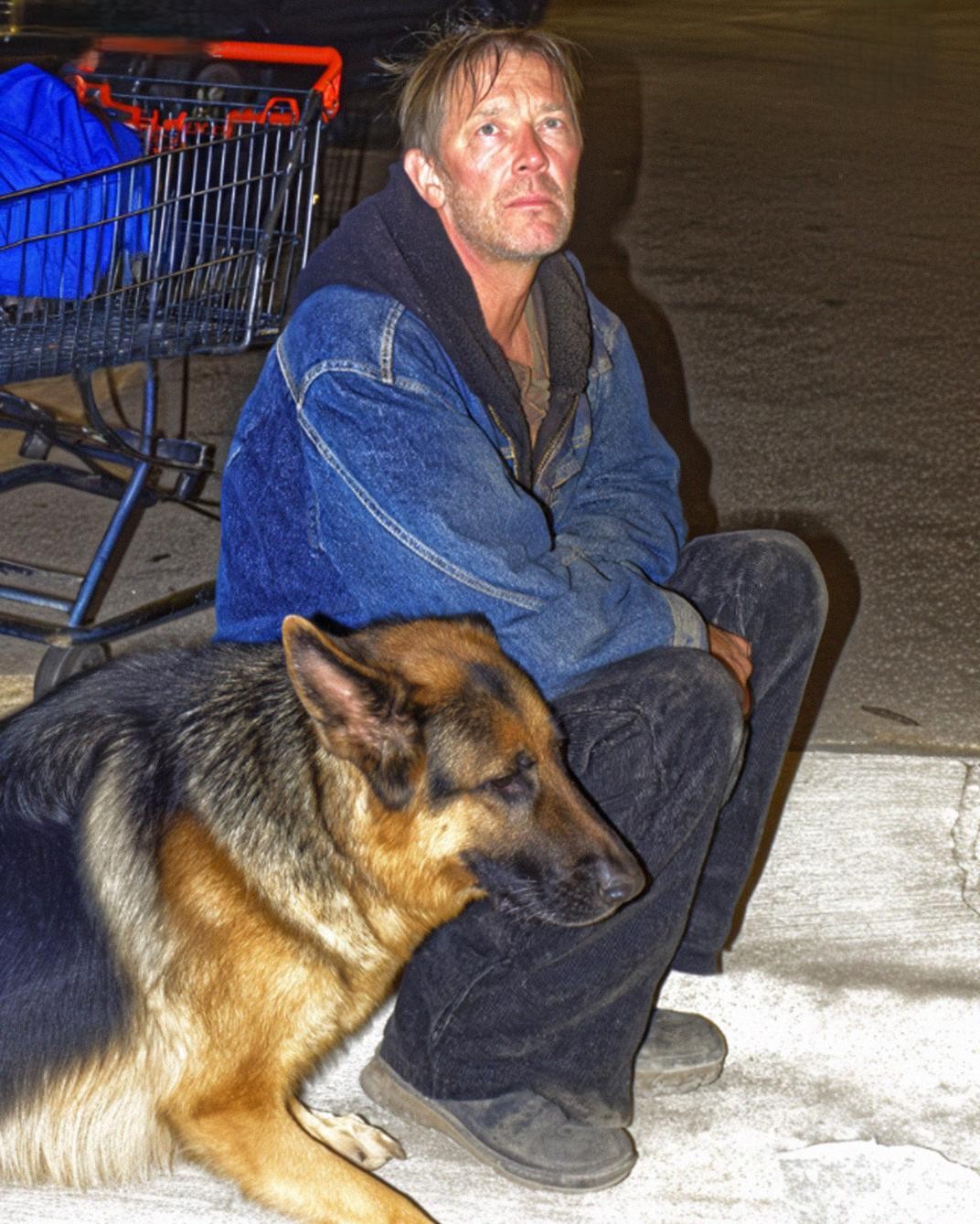
    A man in his late forties sat on the curb near the cart corral, hunched into himself like he was trying to disappear. Curled against him was a German Shepherd, watchful and calm. The dog looked cared for. The man didn’t. His coat was too thin, and his face carried the hollow strain of someone trying to keep going on fumes.

    He cleared his throat when he noticed me looking. “Ma’am… I’m sorry to bother you. I’m a veteran. We haven’t eaten since yesterday. I’m not asking for money, just… if you have anything extra.”

    Every instinct in me said keep walking. Alone in a dark parking lot, weighted down with groceries, is not the setup for wise decisions. But there was something in the way he rested his hand on the dog, like that creature was the last steady thing in his world.

    Before I could overthink it, I told him, “Hold on,” turned back into the store, and went straight to the deli. I bought a hot dinner — real food, the comforting kind — plus a big bag of dog kibble and water. When I brought it out, his eyes went soft and wet, like he couldn’t believe the bags were meant for him.

    “You have no idea what this means,” he whispered.

    “It’s nothing,” I said. “Just take care of your friend.”

    He thanked me again and again, the dog thumped its tail, and I drove home thinking it was just another anonymous moment of kindness in a long, exhausting life.

    A month passed. I barely remembered that night between juggling appointments, emails, and the endless treadmill of housework. Then one afternoon, while I was wrestling with a stubborn policy renewal on my computer, my boss — Mr. Henderson, a man who always seemed moments away from declaring war on the copier — walked out of his office looking paler and angrier than usual.

    “Come here, Michelle,” he snapped.

    Something in his tone sank straight into my gut. I followed him into his office, and he pushed a cream-colored envelope across his desk toward me like it was contraband.

    “You need to read this.”

    Inside was a formal commendation from a veterans’ organization. It praised me for helping a veteran in need and suggested my company promote me or at least give recognition for “exceptional integrity.”

    I was stunned. I hadn’t told a single soul what I’d done. “I just bought them dinner,” I said. “That’s all.”

    His face twisted like he smelled something rotten. “Don’t play innocent. This is a stunt. You set this up to force my hand.”

    I blinked. “What? I didn’t—”

    He cut me off. “I will not let outside groups dictate my decisions. I know manipulation when I see it. You’re fired. Immediately.”

    My whole body went cold. “Mr. Henderson, please — I have two kids. I need this job. I swear I didn’t—”

    But he was already pointing at the door. I packed my things with shaking hands and left feeling like the ground had been yanked out from under me.

    That night, after the kids went to bed, I opened the letter again and read it slowly, really absorbing the words. The organization was legitimate. I searched them online. Real people, real work, real recognition.

    The next morning, I called the number on the letter. A woman named Stephanie answered, and her tone changed the second I said my name.

    “Oh my God,” she breathed. “Are you okay?”

    I told her everything — the man, the dog, the groceries, the letter, the way my boss exploded like I’d orchestrated a corporate coup. When I finished, she said, “Can you come into our office tomorrow? We want to speak with you in person.”

    Their building the next day was bright and warm, decorated with photos of veterans they’d helped. They treated me like someone important, not like a replaceable office widget.

    In a conference room, they told me the whole story.

    A few days after I fed him, the veteran walked into their office for help. He told them he’d hit a point where he genuinely felt invisible — like people saw through him. The hot meal, he said, made him feel human again. It reminded him that he still mattered. That one small act pushed him to seek help.

    They got him medical care, clothing, temporary housing, and eventually job placement. He was stable now, safe. And he wanted to thank me properly. He’d remembered my name from my work badge and asked them to send a letter of commendation to my employer.

    When they learned my boss had fired me over it, they were furious.

    And they had lawyers.

    They offered to take my case for free.

    Two months later, after legal back-and-forth that felt like a second job, I was vindicated. Mr. Henderson was removed for wrongful termination. I received compensation for lost wages and emotional distress.

    But the best part came next.

    The veterans’ organization offered me a job.

    The director told me, “We need people who don’t look away. People like you.”

    It wasn’t just a better salary — though it absolutely was. It wasn’t just the benefits. It was the meaning. For the first time in years, I’d be doing work that mattered, work that helped people rebuild their lives.

    I accepted.

    Now I talk to veterans every day — people fighting quiet battles — and I help them get the support they deserve. My days aren’t something I try to escape anymore.

    A hot meal in a cold parking lot changed two lives that night. His. And mine.

    And it reminded me of something simple and powerful: kindness doesn’t disappear. It circles back. Every time.