Blog

  • My In-Laws Helped Us Buy This House—Now They Act Like They Own Me

    My In-Laws Helped Us Buy This House—Now They Act Like They Own Me

    They never knocked. That was the thing that always got me—the quiet click of a key in our front door and the sudden presence of my in-laws in my kitchen, like the house itself had invited them. Aarav would murmur,

    “Be nice. They helped us buy this place,” and I’d swallow whatever I was about to say because thirty percent of a down payment felt like thirty percent ownership to everyone but me.

    Yesterday, I came home early and walked straight into a nightmare wearing good manners. His mother had my mail spread open on the coffee table—insurance statements, a specialist bill with my name bolded at the top.

    My journal sat in her lap like a borrowed library book. His father had our internet provider on speaker, pretending to be Aarav—“Yes, this is him”—and asking for a list of “recent device connections.”

    They froze when I stepped into the room. I didn’t yell. I didn’t even put my bag down. I just stood there, keys biting my palm, listening to the roaring in my ears. Aarav tried to bridge the silence with, “They were just helping organize—” and I looked through him. That night I didn’t sleep, not from fear, but from a fury so bright it kept the dark away.

    I should’ve seen it long before. Priya and Rajan came with the house, like a very involved home warranty. They rearranged my kitchen “for better flow,” brought curtains they “knew would look nicer,” and installed a security system without asking, complete with a lecture on how “families look out for each other.” They’d stop by with bags of groceries and re-stock my fridge like a pantry manager. If I asked for a heads-up next time, Priya would say, “You’re welcome,” and move on. Aarav would tell me they meant well. I kept trying to believe him.

    After the mail, belief stopped being an option. I started clocking their visits and leaving before they arrived. Let them play house with their son if they wanted; I needed oxygen.

    Then my friend canceled brunch, and the universe sent me home at 1 p.m. to find my mother-in-law elbow-deep in my spice cabinet, tossing out jars while narrating the dates aloud like a judge. Rajan sat at the table with a laptop open to a spreadsheet I didn’t recognize, tapping numbers with the confidence of a man who’d never asked permission. Aarav stood nearby, arms crossed, eyes on the floor.

    “What are you doing?” I asked.

    “We noticed expired items last time, so we’re helping,” Priya said, like it was her house. “And your spending has been a bit high, so Rajan is creating a budget.”

    “My what?” I turned to Aarav. “Did you give them access to our account?”

    Silence. He didn’t have to answer. My stomach did it for him.

    I packed a bag and texted Soraya. I didn’t throw anything or slam a door. I just left, because the person I had to protect in that moment was me. I told Aarav I needed time to think. He didn’t fight me. That said more than anything else.

    A week later, I asked him to meet me at the café where we’d once argued about which side of town had better coffee. He showed up with tired eyes and an apology ready. “I’m sorry,” he said. I nodded.

    “Sorry’s not enough,” I said. “I want to buy them out.”

    He blinked. “What?”

    “I want to pay back every cent of the down payment. With interest if they want it. We’ll sell the car. I’ll take a second job. We’ll cut everything we can. But I’m done living like a tenant with chaperones.”

    He stared at me for a long time, then said, “Let me talk to them.”

    It went exactly how you’re imagining. Priya called me ungrateful. Rajan gave a speech about duty and sacrifice. They were offended by the suggestion that money could be returned, like generosity had to be permanent to count. And then something unexpected happened. Aarav didn’t fold.

    He told them their constant presence was suffocating us. He said their contribution didn’t buy a say in my mailbox or my pantry, and that if they couldn’t respect boundaries, we’d build our own—brick by brick, paycheck by paycheck. It was the first time I’d seen him keep his voice steady when his parents pushed back.

    We became the kind of couple with lists taped to the fridge. We sold the car. I picked up weekend shifts at a boutique. Aarav took on late-night consulting gigs. We turned off the AC during the heatwave, canceled subscriptions, and learned how to make three meals from a bag of lentils and a stubborn zucchini. It wasn’t glamorous. It was exhausting. But each transfer chipped away at a weight I’d been pretending not to feel.

    The afternoon we sent the final repayment, I sat on our secondhand couch and cried. Not the ugly, hopeless kind—just a quiet release that felt like an exhale I’d been holding since we closed on the house. Aarav changed the locks that week. We didn’t tell them. We didn’t owe them a press release. When they tried the key and it didn’t turn, we let the silence be the explanation.

    The house was too quiet for a while. No surprise footsteps, no unsolicited advice, no curtain rods appearing unannounced. I rearranged my spices the way I like them. I bought fresh flowers because I wanted to see something alive on the table. I played music while I cooked and danced badly and nobody corrected the volume. One evening I came home to find Aarav hanging a painting I’d picked up from a local artist. He stepped back, handed me the hammer, and said, “It finally feels like our home.” It did.

    Six months later, a letter arrived addressed in Priya’s careful handwriting. It wasn’t an apology, not exactly. It was an explanation dressed as a confession. She wrote about growing up in a house where involvement meant love, where privacy didn’t exist, where control was a kind of caretaking. She said she hadn’t realized how much she’d overstepped. It wasn’t everything I needed, but it was a start.

    We started seeing them again—restaurants, holidays, short visits with notice. We kept the house sacred for a while. When we finally invited them back in, it was to a home with rules that weren’t negotiable. Knock. Ask. Respect no. If the ground felt shaky, we ended the visit. It’s amazing how quickly people learn when access isn’t guaranteed.

    Aarav learned how to say no without apologizing. I learned that swallowing my discomfort doesn’t make me gracious; it makes me a ghost in my own life. We both learned that help with strings is just a lease written in fine print.

    People talk a lot about generational support—down payments, wedding funds, training wheels for adulthood. Less about the invisible invoices that sometimes follow. Here’s what I know now: gifts aren’t ownership. Silence isn’t peace. And love that needs a spare key to feel real isn’t love—it’s control.

    Our house is simpler now. No fancy upgrades. The couch is thrifted. The AC goes on without a committee vote. When I turn my key in the lock, the door opens to quiet and to choices we made ourselves. It’s not perfect. It’s ours.

    If you’ve ever had to take your space back—your home, your voice, your breath—I hope you know this: you are allowed to change the locks. You are allowed to draw the line. You are allowed to build a life that answers only to the people who live in it.

  • Teen told he just had ‘growing pains’ dies one day after diagnosis

    Teen told he just had ‘growing pains’ dies one day after diagnosis

    A teenage boy in the UK died just one day after he was given the heartbreaking news that he had leukemia.

    According to the Daily Mail, 16-year-old Harley Andrews was admitted to Royal Bolton Hospital in Lancashire, England, on November 8. Weeks before that he had visited his doctor after feeling under the weather, but was told he was likely suffering from nothing more serious than a viral infection.

    A close family friend claimed Harley was informed he might be experiencing “growing pains”.

    Just shy of two weeks ago, however, the teenager – reportedly a keen soccer and rugby player – from Leigh, Greater Manchester, noticed blood in his urine.

    His father then made the decision to take him to hospital, where doctors delivered the devastating news that he had stage four luekemia, an aggressive form of blood cancer.

    “She had only taken him to the doctor a few weeks ago and said they put it down to growing pains or a viral infection,” Harley’s former elementary school teaching assistant, Kaylee Jackson, who is also a close friend of Harley’s mother, told the Mail.

    Harley Andrews was just 16 years old. Credit / GoFundMe
    “Obviously, you don’t think that at 16 they could be seriously unwell. I don’t think he showed any real signs and symptoms to either of his parents.”

    The leukemia had caused internal bleeding within Harley’s brain and several organs. He was admitted to hospital on the Saturday, and just a few hours later – in the early hours of Sunday, November 9 – Harley passed away.

    “She hadn’t even processed he had leukemia before she was told he had passed away,” Kaylee said.

    A family friend has since organized a GoFundMe page to help the teen’s family with the funeral expenses.

    “His warm heart, bright smile, and love for football touched everyone who knew him. Whether he was on the field or cheering from the sidelines, the game brought him so much happiness and brought people together,” the fundraiser reads.

    Harley was the second of six children and a beloved member of his the local community.

    Rest in peace, Harley Andrews.

  • The Red Cardigan, A Hidden Message of Love Across Generations!

    The Red Cardigan, A Hidden Message of Love Across Generations!

    When I turned eighteen, my grandmother gave me a gift she had spent months working on — a hand-knitted red cardigan. It wasn’t store-bought or expensive, but she had poured her time, energy, and love into every single stitch.

    At that age, though, I didn’t fully understand what that meant. I was too wrapped up in my own world — college applications, friends, parties, plans that all seemed so much bigger than a piece of yarn and wool. I smiled politely, said a half-hearted “Thanks, Grandma,” and moved on. I didn’t notice how her eyes softened when I didn’t hug her or how she held my hand just a moment longer before letting go.

    A few weeks later, she passed away unexpectedly. The news shattered something inside me, but like most eighteen-year-olds, I didn’t know how to process grief. I went through the motions — the funeral,

    the condolences, the polite nods — all while feeling hollow. The red cardigan ended up folded neatly at the back of my closet. I couldn’t bring myself to wear it. It reminded me too much of what I’d lost — and of how little I had appreciated her when I still could.

    Years went by, and life moved forward, as it always does. I went to college, fell in love, got married, and had a daughter of my own. The cardigan remained untouched, carefully preserved but unseen, tucked away like a time capsule of guilt and love I wasn’t ready to face. Occasionally, when I cleaned out my closet, I’d catch a glimpse of it — that bright red color standing out against a sea of muted clothes. I’d run my hand over the soft wool and then quietly put it back. It was too painful.

    My daughter, Emma, is fifteen now. She’s full of life — curious, emotional, and with that same streak of stubbornness I once had. A few weeks ago, we decided to do a little spring cleaning together. She loves helping me go through old boxes and uncovering “treasures,” as she calls them. That day, she pulled out the old cardboard box that had sat untouched for decades.

    “Mom, what’s this?” she asked, holding up the cardigan.

    I froze for a moment. The sight of it brought a flood of memories — the smell of my grandmother’s tiny kitchen, her warm laughter, the way she’d hum softly while knitting. I took the cardigan from my daughter’s hands and held it close.

    “That,” I said softly, “was a gift from your great-grandmother.”

    “It’s beautiful,” Emma said, slipping it over her shoulders. The sleeves were a little long, but it suited her. The red color looked stunning against her dark hair. She twirled in front of the mirror, smiling. Then she stopped suddenly and frowned. “Mom… there’s something in the pocket.”

    I looked up, startled. “Really? After all this time?”

    She reached in and pulled out a small, crumpled piece of paper. My heart began to pound. My grandmother was a woman of little means but deep sentiment. She often left small notes in birthday cards, lunch boxes, and gifts — her way of staying close, even when apart. I took the fragile note carefully and unfolded it.

    Inside, in her delicate, looping handwriting, were the words:

    “For my sweet girl, may this keep you warm when I no longer can. Always remember how deeply you are loved.”

    For a moment, I couldn’t speak. My throat tightened, and tears blurred the ink on the page. The years between that day and this moment seemed to collapse — eighteen-year-old me standing beside the woman I had lost too soon. My daughter stood quietly, watching me, her hand resting gently on my arm.

    “Mom?” she whispered.

    I looked at her, at the cardigan that now belonged to her shoulders, and at the note that had somehow waited decades to be found. The emotion I’d buried for years came rushing back all at once — grief, guilt, love, gratitude. I pulled Emma into a hug, holding her as tightly as I wished I had held my grandmother.

    We stood like that for a long time, both of us crying. It wasn’t just sadness; it was something deeper — a bridge between generations, a silent message that had finally been delivered.

    Afterward, I told Emma about her great-grandmother — how strong she was, how hard she worked, and how she always gave more than she had. She had grown up during hard times, with little money but an abundance of love. When I was little, she’d make me soup from scratch and tell me that the secret ingredient was “a dash of love.” I used to roll my eyes. Now I understood exactly what she meant.

    From that day on, the cardigan didn’t go back into the closet. It became something of a family heirloom. Emma started wearing it often — to school, on walks, even on chilly nights at home. Every time I saw her wearing it, my heart swelled. It felt like my grandmother was with us again, woven into every thread.

    One evening, as I tucked Emma into bed, she asked me quietly, “Do you think Great-Grandma knew I’d find the note?”

    I smiled through tears. “I think she hoped someone would — someone who needed to hear it.”

    The truth is, I did need to hear it — even after all these years. The note wasn’t just meant for eighteen-year-old me. It was meant for every version of me that had come since — the woman who learned what real love looks like, who learned that family isn’t just about the moments we share, but the memories we carry.

    Love like that doesn’t fade. It changes shape. It moves through time, tucked into pockets, whispered in lullabies, woven into sweaters, passed from hand to hand.

    Now, every time Emma wears the cardigan, I see three generations of women connected through it — my grandmother’s hands that made it, my own that once neglected it, and my daughter’s that now cherish it. That little piece of red wool holds a lifetime of love — silent but powerful, ordinary but eternal.

    Sometimes I still take out the note and read it again. The paper is fragile, the ink fading slightly, but the message remains clear. My grandmother’s handwriting has become shaky with age, but the warmth in her words feels alive. It’s as though she’s still whispering to me: I’m still here. I never left.

    The cardigan has become more than just a piece of clothing. It’s a reminder that love outlives us. It lingers in the smallest things — a photograph, a recipe, a song, or a knitted sweater. It waits quietly until we’re ready to feel it again.

    Now, when I watch my daughter wrap herself in that red cardigan, I don’t see loss anymore. I see continuity. I see love that survived the years, that skipped a generation but never truly left. My grandmother’s gift wasn’t just wool and thread — it was comfort, connection, and memory, waiting patiently to be rediscovered.

    And sometimes, on quiet nights, when I catch my daughter curled up on the couch wearing it, I swear I can almost hear my grandmother’s soft laugh — the sound of love, still wrapping around us, warm and unbroken.

  • From prison birth to Hollywood fame: The journey of a TV icon

    From prison birth to Hollywood fame: The journey of a TV icon

    She entered the world under extraordinary circumstances. Born while her mother was serving time in a federal prison and with a father entangled in criminal activity, most would assume her life would be defined by hardship.

    Yet, from the very beginning, she proved that circumstances do not define destiny.

    Grandmother took care of her
    Becoming a Hollywood star is no easy feat. It takes grit, patience, talent, and maybe just a touch of luck. The young woman we’re talking about today had a rough start in life, but now she’s one of the most recognizable faces in Tinseltown.

    She was born while her mother, Constance, was serving a sentence in a Texas federal prison for drug trafficking. After she was born, her mother spent just three months with her in a facility near the prison before returning to complete her sentence.

    Her father was also involved in a drug operation, reportedly smuggling more than 1,200 pounds of marijuana from Jamaica into the U.S.

    Her parents later went their separate ways, divorcing in 1992.

    This future star and TV icon spent her first few months in a halfway house before being cared for by her grandmother. Growing up, she navigated a chaotic world—moving between apartments, attending school, and learning from an early age that life often demanded resilience far beyond her years.

    “I look back now and I see it in a nice light. It wasn’t uncomplicated, but I played outside, I went to the beach. There were happy, fun times,” she later reflected about her unusual childhood during an interview with Net-a-porter.

    During the first time of her life, the future actress was cared for by her paternal grandparents. Later, she has emphasized that her parents provided her with a normal upbringing, despite their criminal history.

    A leap toward her Hollywood future
    By the age of ten, she had already taken a leap toward her future. A modeling convention in Atlanta recognized her potential, and soon she moved to New York City to pursue work in commercials and modeling, all while still a child.

    By fourteen, she moved again, this time to Los Angeles, where she began acting classes and auditioning for television pilots.

    “‘Jimmy doesn’t like me!’ Who cares?” she once said. “I was worried we didn’t have gas money or food. Those were my concerns.”

    Her grit and determination paid off.

    She made her TV debut in the late ’90s with a guest spot on the “Law & Order” episode titled “Disciple,” and after that, a string of roles kept her firmly on Hollywood’s radar.

    Catapulting into fame
    By the age of nineteen, she had landed a role that would turn her into a household name — a glamorous, clever, and unforgettable character on a hit teen drama that captivated millions. That role? Blair Waldorf in Gossip Girl; the character that would define a generation and launch her into the spotlight.

    The show quickly gained a devoted cult following, influenced countless other teen dramas, and even spawned several international adaptations.

    With fame came its own set of pressures: grueling sixteen-hour shoots, constant public scrutiny, and the challenge of navigating young adulthood under a global spotlight.

    Photo: Jeffrey Mayer/WireImage
    “I was young when I started the show. A lot more people were suddenly around and [sic] I was being looked at,” she admitted.

    “If you don’t have the right perspective, you could definitely be confused by people being that nice to you or judging you for behavior that’s typical of a 20, 21-year-old […] I don’t know if it was the healthiest environment.”

    Yet even as the cameras rolled and the world admired her on-screen persona, she never lost herself.

    Married in private
    In a private ceremony, she married actor Adam Brody in 2014, after quietly dating following their 2011 collaboration on The Oranges. Love brought stability and the actress built a family, and focused on motherhood, describing it as “intimate and private”.

    “I consider myself lucky. I was never lied to. And I was loved,” she said, reflecting on the life lessons that shaped her resilience and perspective.

    Despite the turmoil of her early life, she has always approached her past with remarkable poise and perspective.

    “It’s made me very nonjudgmental and open-minded. I think it also helps me appreciate the things I have now,” she shared in a candid 2008 interview with Us Weekly.

    Looking back on her mother, she said, ”She’s always there for me no matter what. I swear, that woman knows everything.”

    Later, she was even more open about her childhood, admitting, ”My family has a crazy history. Probably the craziest I’ve heard of.”

    “I feel so close to that person”
    And now, it’s time t reveal the name behind this incredible journey: Leighton Meester!

    Her role as the privileged, backstabbing Blair Waldorf in Gossip Girl cemented her place in Hollywood. The series aired from 2007 to 2012, during Meester’s twenties, and she still looks back on that period with deep emotion.

    “I feel so close to that person, almost now more than any other time in my life. I feel very in touch with her, and I feel for her,” she told the LA Times in 2025.

    Shutterstock
    But did you know that Meester’s ambitions didn’t stop at acting? Alongside her TV success, she explored the music scene, briefly flirting with mainstream pop before realizing she needed a sound that truly reflected her.

    In the late 2000s and early 2010s, she released several singles, including catchy tracks like Somebody to Love and Your Love’s a Drug, which racked up millions of streams on Spotify and earned praise from fans impressed by her versatility.

    Still, she admits the experience didn’t fully satisfy her.

    “I just didn’t feel like I sang that well in those songs,” she confessed. “That’s why I stopped doing that style of songwriting, because I didn’t feel really good when I would sing it. That was something that I figured out in my 20s.”

    Instead of chasing fleeting fame through flashy brand deals or trendy collaborations, she took a step back. In 2014, she released Heartstrings, an album that better reflected her artistic identity.

    The ugly lawsuit
    Meester maintains a loyal fanbase on streaming platforms, with standout tracks like Give In to Me surpassing 34 million plays and over 176,000 monthly listeners.

    Away from the public eye, her personal life has seen its share of challenges, especially regarding her relationship with her mother.

    In 2011, she filed a lawsuit claiming that the $7,500 she had been sending each month to support her younger brother, a cancer survivor who had undergone brain surgery, was being spent by her mother on cosmetic procedures, including Botox, hair extensions, and plastic surgery.

    “Her only concern has always been taking care of her brother,” a source close to the star explained.

    Lee Celano/WireImage for Silver Spoon (formerly The Cabana)
    Her mother countersued, alleging breach of contract and claiming she had sacrificed everything to support her daughter’s acting dreams, even accusing her of physical assault, claims the actress denied.

    According to her filings, her mother was capable of working but chose not to, expecting financial support instead. Despite the tension, she continued covering her brother’s medical and educational expenses.

    The legal battle, which extended into 2012, ended in her favor. A judge ruled that no binding agreement required her to financially support her mother, effectively dismissing the claims. Meester never sought to reclaim the misused funds, she wanted clarity and peace, and in the end, she got it.

    Leighton Meester today
    Today, Leighton Meester, 38, and her husband Adam Brody, 45, are parents to a daughter and a son, and she describes motherhood as a transformative, life-changing experience.

    Both Meester and her husband have kept busy professionally, frequently taking roles in indie films or appearing as supporting actors in larger productions.

    In September 2025, it was announced she would star opposite Jared Padalecki in Netflix’s adaptation of Katherine Center’s novel The Bodyguard. Today, however, her family largely shapes the choices she makes in her career.

    “There’s been a lot of stuff that I haven’t done because I want to be with them […] I don’t like being away from them,” she said.

    Henry S. Dziekan III/WireImage
    Whether traveling for work or weighing new opportunities, she makes it clear: family comes first. “I just feel like being in the moment and figuring it out as I go along, because that’s all we can do, you know?”

    Even with the peace she’s cultivated, life has continued to challenge her. In early 2025, she and Brody were among the many residents affected by the devastating Palisades Fire, the most destructive in Los Angeles history. Their Pacific Palisades home, purchased in 2019, was destroyed, along with years of memories.

    The fire, of course, left a deep mark on the family. In an interview with the LA Times, Meester struggled to find the right words to describe the devastation. Yet she also revealed that the tragedy brought a shift in perspective — in some way, it even allowed her to feel gratitude.

    “Loving something – or someone – so much that I would hurt so badly to lose it, and then saying I wouldn’t have loved it any less. That’s what I think I’m here for. I don’t want to feel unhappy loving another human and thinking, ’Well, you could leave me tomorrow. You could die’. That’s the horrible truth of this life. But it’s also the amazing thing of the day-to-day, and most days, I’m fortunate enough to say, are pretty damn good.”

  • Put a Glass of Salt in Your Car1

    Put a Glass of Salt in Your Car1

    1. A Simple Fix for Car Humidity

    Foggy windows or musty smells? The answer may be simple—ordinary kitchen salt.

    This everyday ingredient helps reduce moisture and keeps your car’s interior fresh.

    2. How It Works

    Salt is hygroscopic, meaning it absorbs water from the air.

    Placing a cup of salt in your car can cut down on condensation,

    prevent damp seats, and improve air quality without chemicals.

    3. Odor Control and Freshness

    By removing excess moisture, salt also stops mold and bacteria from growing.

    It eliminates odors at the source, leaving your car smelling clean—not salty.

    4. Easy Alternatives

    If you’d rather skip salt, try silica gel packets or crumpled newspaper—both soak up humidity effectively.

    Tackling moisture early helps prevent damage, keeping your car dry, clear, and comfortable.

  • We Worked Hard to Secure Our Daughter’s Future — Then Came an Unbelievable Request

    We Worked Hard to Secure Our Daughter’s Future — Then Came an Unbelievable Request

    Tom and I worked hard for years to save money for our kids’ education. Each of our children had their own fund, including our eldest, Maddie.

    When she got pregnant at 16, we still kept hope alive that one day she might go back to school and build a better future.

    Recently, Maddie’s younger sister Kate got accepted to her dream college.

    While visiting Maddie, Kate mentioned her college fund.

    Maddie was shocked to learn she had one too and immediately assumed she could use it for a house or wedding. When I explained that the money was meant only for education, she became upset.

    Soon after, her fiancé Jason and his family started calling, demanding the money outright as if we owed it to them. Their entitlement was heartbreaking, especially when they began pressuring Maddie.

    Maddie was torn, but when she heard how Jason’s family spoke about her — like she was just a way to get money — something in her changed.

    She left Jason, choosing her own dignity and future over their manipulation.

    A few weeks later, Maddie enrolled in GED classes.

    Now, she plans to use the fund for education as we’d always hoped, starting cosmetology school to create a better life for herself and her kids.

    Tom and I are incredibly proud of Maddie’s courage.

    The fund that once caused so much conflict has now become a symbol of hope — proof that with love, boundaries, and determination, she can rewrite her story and build a future she truly deserves.

  • When my daughter-in-law looked me straight in the eye, handed me a single roll of toilet paper, and said

    When my daughter-in-law looked me straight in the eye, handed me a single roll of toilet paper, and said, “You’ll need to pay for what you use — this isn’t a free hotel,” I thought I’d misheard her. Surely, she was joking. I was there to babysit my grandkids — her kids — for the evening so she and my son could finally enjoy a rare night out together. It wasn’t the first time I’d offered to help; I’d done it countless times over the years without asking for a thing in return.

    But the tone in her voice told me she wasn’t joking. My son stood nearby, eyes down, silent, clearly uncomfortable but unwilling to intervene. I felt a slow burn of disbelief creep up my chest. Still, instead of arguing, I reached calmly into my purse, pulled out a few dollars, and handed them over.

    “It’s your house,” I said simply. “Your rules.”

    It wasn’t about the money — it was about what it represented. Somewhere along the way, kindness had turned into a transaction, and love had started to feel like an inconvenience.

    That night, as I drove to their house, I promised myself I wouldn’t let her pettiness ruin the evening. The moment I stepped through the door, my grandkids came running toward me — two bright, beautiful little souls shouting, “Grandma!” and wrapping their tiny arms around my legs. Every trace of irritation melted away. Their laughter was like sunlight breaking through a storm.

    We baked cookies, played board games, built blanket forts, and laughed until our sides hurt. They told me about school, about their favorite shows, about the silly things their dog had done that week. And in those moments, surrounded by their joy, I realized that I couldn’t let bitterness take root. My love for them was too deep to be dimmed by one person’s lack of grace.

    When bedtime came, I tucked them in, kissed their foreheads, and sat for a while, watching them sleep — peaceful, innocent, completely unaware of the tension between the adults who loved them. That’s when I made up my mind. I wouldn’t confront my daughter-in-law. I wouldn’t complain to my son. Instead, I would lead by quiet example.

    Before I left that night, I went into their bathroom. The cabinet was nearly bare — a half-used roll of toilet paper, an empty tissue box, and one sad, worn towel. I could have left things as they were, but something inside me stirred. Not anger — compassion.

    The next morning, I stopped by the store. I bought the softest toilet paper I could find, boxes of tissues, new kitchen towels, and even a few gentle hand soaps. Later that afternoon, while my daughter-in-law was out, I stopped by their home and quietly restocked everything. I folded the towels neatly, lined up the tissues, and left the extra rolls of paper in the cabinet. Then, I took a small notecard from my purse and wrote:

    “For my grandbabies’ home — with love, Grandma.”

    No lecture. No sarcasm. Just kindness — pure, deliberate, and wordless.

    I left before they got home, feeling lighter than I had in days. It wasn’t an act of revenge. It was a message. Sometimes generosity needs no defense, and love doesn’t need to keep score.

    The next time I came to babysit, I didn’t know what kind of reception to expect. Part of me braced for awkwardness. But as soon as my daughter-in-law opened the door, I saw something in her expression I hadn’t before — humility. She didn’t meet my eyes right away. Instead, she gestured for me to come in and quietly said, “Thank you.”

    For a second, I thought she was talking about me watching the kids. Then she added softly, “For what you left. It was… thoughtful.” Her voice caught slightly, as if she wasn’t used to saying those words.

    I smiled. “They deserve a home that feels full,” I said. “And love doesn’t run out when you share it.”

    She nodded, looking down. My son appeared behind her, and before I could say anything else, he squeezed my hand and whispered, “I’m sorry, Mom.”

    There was a lot behind that apology — guilt, embarrassment, maybe even regret for not speaking up that night. I didn’t want to make it heavier than it already was, so I just gave his hand a gentle squeeze back. “It’s done,” I told him. “Let’s move forward.”

    That evening was different. My daughter-in-law was quiet but kinder. She offered me tea, sat with me for a while, even laughed when the kids put frosting in their hair during cookie decorating. It wasn’t a full transformation, but it was a start — the kind of softening that comes when people are met with grace instead of anger.

    When I finally headed home that night, the air outside was cool and calm. I rolled down my window and breathed in the quiet. I thought about how easy it would have been to snap back, to turn that moment of insult into a fight that might never heal. But that’s not who I wanted to be — not for my grandkids, not for my son, and not for myself.

    There’s a saying I’ve always believed in: you can’t control how others act, but you can control how you respond. Sometimes, the most powerful thing you can do is stay kind when kindness feels undeserved.

    Life has a way of teaching its lessons in unexpected ways. My daughter-in-law may have taught me about the smallness of pride that night, but I got to teach her something bigger — that love doesn’t come with a price tag.

    A few days later, my son called me. He said his wife had been quiet since that evening. “She’s embarrassed,” he admitted. “She told me she didn’t realize how harsh she sounded. She said you made her think.”

    That made me smile. Growth doesn’t always happen in grand gestures; sometimes it happens in the quiet moments after reflection.

    Weeks passed, and the next time I visited, I noticed something small but meaningful. On the counter sat a bouquet of flowers with a note that read, “For Grandma — with love, from all of us.”

    It wasn’t about the flowers. It was about acknowledgment — about understanding that family isn’t a business of transactions, but a bond of giving, forgiving, and growing.

    That night, as I sat at their kitchen table surrounded by my grandkids’ laughter, I realized something: kindness may not always change people immediately, but it plants a seed. And given enough time and warmth, even the coldest hearts can soften.

    I never mentioned the toilet paper again. I didn’t need to. My point had been made without a single harsh word — and that’s the kind of victory that lasts.

    Because in the end, love isn’t about keeping score. It’s about showing up, giving without asking, and choosing grace — even when it costs you a little pride, or a few dollars, or a roll of toilet paper.

    And as I drove home under the soft glow of the moon that night, I realized something simple and true: when you lead with love, you never leave empty-handed.

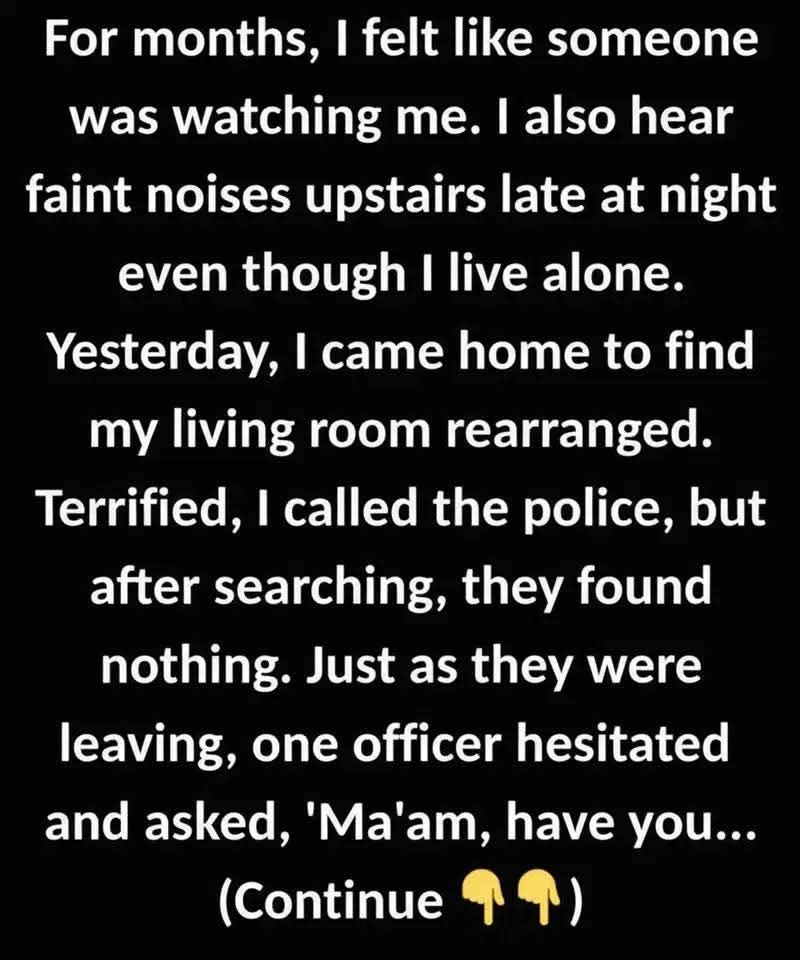
  • For months, I felt a strange presence in my home — not frightening, just… noticed.

    For months, I felt a strange presence in my home — not frightening, just… noticed.

    For months, I felt a strange presence in my home — not frightening, just… noticed.

    Sometimes I heard gentle sounds upstairs at night, even though I lived alone. I brushed it off as imagination, but the feeling lingered.

    Then, one afternoon, I returned to find my living room rearranged.

    The officers searched every corner and found nothing unusual. Just as they prepared to leave, one officer paused and asked softly,

    Confused and anxious, I immediately called the authorities for help.

    “Have you been feeling stressed or lonely lately?” His gaze was kind, not doubtful. His question caught me off guard; I hadn’t truly stopped to reflect. Life had been filled with change, solitude, and quiet days that blended together.

    After they left, I studied the room again. My favorite chair now faced the window, inviting morning light.

    A forgotten hobby — my knitting basket — sat open, as though encouraging me to begin again. Suddenly, I realized these weren’t signs of intrusion but reminders of what I had set aside.

    My life had become silent, not unsafe — simply waiting for me to return to it.

    Instead of fear, I felt a spark of gratitude. I called my sister, then an old friend, and made plans for company and conversations. I reopened my curtains, resumed my knitting, and filled my home with music again. Sometimes, life nudges us in unexpected ways to reconnect with ourselves.

    And in that quiet moment, I understood — I wasn’t being watched. I was being reminded to live.

  • “Billionaire About to Board Private Jet When Street-Smart 12-Year-Old Stops Him—The Device Found Changed Everything…

    “Billionaire About to Board Private Jet When Street-Smart 12-Year-Old Stops Him—The Device Found Changed Everything…

    “Don’t board the plane!” the boy shouted, voice cracking across the tarmac. Time seemed to slow. Cameras, crew, and journalists froze mid-step, and James Carter, billionaire businessman, felt a jolt of unease that even years of experience couldn’t erase.

    The morning had begun like any other high-stakes day. James was preparing to fly his Gulfstream to New York for a crucial meeting with investors. Every detail had to be perfect. The aircraft gleamed under the early sun as the crew ran final checks. The jet was more than a machine—it was a symbol of his empire, a tool of precision in a life built on control.

    Then came the boy.

    He couldn’t have been more than twelve, dressed in a tattered hoodie and scuffed sneakers. Dirt smudged his face, and his hair fell into his eyes, but there was fire in his gaze. He pointed at the plane with trembling fingers. “Don’t board! Something’s wrong!”

    Security quickly stepped in, attempting to usher him away. “Ignore him, Mr. Carter,” one officer said. “He’s just a street kid seeking attention.”

    But Leo, the boy, only grew louder. “I saw men near your plane last night! They were doing something—they weren’t supposed to be there!” His voice trembled, but there was a raw determination that made the room shift uneasily.

    James felt the weight of the moment. He had always trusted instincts, trained over decades in high-pressure business negotiations and critical situations. The fear and sincerity in the boy’s eyes were undeniable. Something in him told James to listen, to act, even against conventional judgment.

    “Wait,” James said firmly, raising a hand. “What’s your name?”

    “Leo,” the boy replied, teeth clenched, eyes unwavering. “Please… just check the plane.”

    The crowd murmured; journalists whispered to each other, some shaking their heads, others snapping photos, sensing a story unfolding. The crew exchanged uneasy glances, unsure if this was a prank or something serious.

    But James didn’t hesitate. He gestured to the chief of security. “Inspect the plane immediately. Every inch. Do not leave anything unchecked.”

    Time slowed as mechanics and security swarmed the Gulfstream. Leo’s words hung in the air like a challenge. The tension was palpable. Everyone waited, breaths held, for the moment when the boy’s warning would either be dismissed or validated.

    When the first discovery was made on the plane’s undercarriage, the disbelief and shock on everyone’s face confirmed what James already suspected: this boy’s warning was no exaggeration. And the decision he had made in that moment may have saved countless lives.

    The crew and security team swarmed the Gulfstream like a well-rehearsed unit, though the atmosphere was anything but routine. James stood nearby, watching, his sharp eyes scanning every movement. Leo hovered at the edge of the tarmac, still trembling, still insisting he was right.

    The mechanics began with a systematic sweep of the fuselage, tires, and undercarriage. Every panel was checked, every hinge and joint inspected. Cameras flashed, journalists murmured in disbelief, and security officers exchanged uneasy glances.

    James stayed calm, a practiced calm that hid the tension coiling in his chest. Every instinct screamed that time mattered. He had built his empire on decisions made under pressure, but this was different. This wasn’t about numbers or negotiations—it was about lives.

    A junior mechanic called out, “Sir… over here. Something’s not right.”

    James strode over. Beneath the jet, in a rarely inspected compartment near the landing gear, a suspicious device had been taped carefully to the underside. Wires protruded in a dangerous tangle, a timer blinking faintly. The crew froze.

    “What is that?” one security officer whispered, voice tight with fear.

    James’ gaze hardened. “It’s a bomb.”

    The journalists gasped, cameras capturing every reaction. Leo’s small fist clenched in triumph, but he looked terrified at the same time. “I told you!” he cried.

    Explosives experts were immediately called in, working swiftly to disarm the device. Every second felt like an hour. James held Leo close, reassuring him quietly while the technicians worked with meticulous precision.

    “You did the right thing,” James said, looking down at the boy. “You saw something others didn’t. You spoke up, and it saved lives. That takes courage.”

    Leo’s eyes widened at the praise, the first trace of relief softening his grim expression. “I just… I didn’t want anyone to get hurt,” he whispered.

    The team worked quickly, and after what seemed like an eternity, the bomb was safely removed. Relief swept across the tarmac. Security exhaled, journalists captured the historic moment, and James finally allowed himself a rare, genuine smile.

    “I’ll make sure you’re recognized for this,” James told Leo, his tone firm but kind. “What you did today… it matters more than you know.”

    The boy blinked, a mixture of awe and disbelief on his face. In that moment, he went from being a street kid dismissed by adults to someone who had prevented a tragedy on a scale most could only imagine.

    The Gulfstream remained grounded, the flight delayed indefinitely. James’ investors would wait. The press would write their stories. But for James, the important lesson had already been cemented: courage, even in the smallest form, can change everything.

    The story spread like wildfire. By midday, news outlets were broadcasting images of Leo, the determined boy who had stopped a billionaire’s jet from taking off, potentially saving dozens of lives. Headlines proclaimed heroism, bravery, and instinct.

    James didn’t seek the spotlight, but he couldn’t ignore the impact. The boy had shown a level of courage and observational skill that adults—trained, experienced adults—had overlooked. He had listened, acted, and spoken up, and that decision had altered the course of events in a monumental way.

    In the days that followed, James arranged for Leo to receive recognition, a full scholarship, and the support to leave the streets behind. He connected him with mentors, counselors, and a safe environment—one that nurtured his intelligence, bravery, and insight.

    “Leo,” James said during a private meeting, “what you did wasn’t just luck. You saw danger, you trusted your instincts, and you acted. That’s a rare quality, and I want to make sure the world knows it—and that you have a future that matches your potential.”

    The boy’s eyes brimmed with tears. “I just didn’t want anyone to get hurt,” he repeated.

    “You did more than that,” James assured him. “You saved lives, including mine.”

    Meanwhile, the investigation into the device revealed a plot targeting corporate executives on private flights, a plan that could have caused devastation and loss on an unimaginable scale. Authorities praised the swift actions of everyone involved, but it was Leo’s quick thinking that prevented disaster.

    For James, the experience was a reminder of two truths: one, never dismiss intuition—no matter the source; two, courage can come from the most unexpected places. A twelve-year-old boy, overlooked and underestimated, had outperformed seasoned professionals and altered history in a single morning.

    The billionaire returned to his office, humbled and reflective. His life, full of wealth, power, and influence, had always been about precision and control—but today had taught him that sometimes, the smallest voice, speaking the loudest truth, is the most powerful force of all.

    Leo’s life changed forever. From a boy living on the streets to a celebrated hero, he became an example of bravery, vigilance, and the courage to act when it mattered most.

    And for James Carter, the morning that began as routine ended as a lesson: vigilance, respect, and the power of speaking up can save lives—and sometimes, even a billionaire learns from a child.

  • One Day He Found His Wife1

    One Day He Found His Wife1

    Life is full of unexpected moments, but some discoveries leave a lasting impact.

    This story begins with a simple yet shocking realization—one day, he found his wife exactly where he least expected her to be: lying in their bed during the daytime. At first glance, it seemed innocent enough—perhaps she was taking a much-needed nap or indulging in some quiet relaxation. But as the hours unfolded, what he uncovered next would change everything…

    One Day He Found His Wife on Bed!!! The Shocking Truth Unveiled

    When John walked into their bedroom that afternoon, he wasn’t prepared for what awaited him. There she was, sprawled across the sheets, eyes closed, breathing softly. For a moment, relief washed over him—she looked peaceful, undisturbed, like the world’s weight had finally lifted off her shoulders.

    But then, something didn’t feel right.

    The air felt heavier, the silence deeper. A faint scent lingered—a mix of perfume and something unfamiliar. Curiosity turned to concern as John noticed small details: her clothes were rumpled, the blankets slightly askew, and an envelope resting innocently on the nightstand.

    He picked up the envelope, his heart pounding. Inside, a letter addressed to her—but not written by anyone he recognized. The handwriting was sharp, deliberate, filled with words meant only for someone intimate. His mind raced. Who could this be from? And why hadn’t she mentioned it?

    The Investigation Begins
    John tried to stay calm, rationalizing possible explanations. Maybe it was work-related, or perhaps a distant friend he’d never met. But deep down, doubt crept in. That evening, when she woke up and greeted him with a smile, he struggled to return it fully.

    “Did you have a good rest?” he asked casually, trying to mask his unease.

    “Oh, yes,” she replied, stretching lazily. “I just needed some time alone today.”

    Her answer did little to quell his suspicions. Over the next few days, John observed more closely—the late-night phone calls she avoided discussing, the sudden bursts of laughter during texts, and the way she seemed distracted whenever they spent time together.

    Finally, one night, he confronted her gently, holding the letter in trembling hands. “What’s going on, sweetheart?”

    Her reaction told him everything. She froze, staring at the paper before sighing deeply. “John… I don’t know how to tell you this…”

    The Revelation
    It turned out the letter wasn’t from a lover—or even a stranger. It was from herself, written years ago during a dark period when depression clouded her days. Back then, she feared losing control, so she penned letters detailing her struggles, sealing them away in hopes they’d remain undiscovered. Each note served as a reminder of battles fought and won, proof of strength buried beneath vulnerability.

    That afternoon nap hadn’t been about hiding; it was about healing. She’d gone to bed early because sleep offered solace, and those envelopes held secrets only she dared confront.

    Lessons Learned
    While the truth brought relief, it also highlighted gaps in communication neither realized existed. From that day forward, John made a promise: no matter the challenges ahead, he’d listen without judgment, support without hesitation, and love unconditionally.

    Because sometimes, finding your partner in unexpected places isn’t about betrayal—it’s about understanding who they truly are.

    So, the next time you stumble upon something surprising, pause before jumping to conclusions. Love often reveals itself in the quietest moments—and sometimes, in the most unexpected truths.