Blog

  • SOTD – Behind the glitter! The dark childhood of a Hollywood icon

    SOTD – Behind the glitter! The dark childhood of a Hollywood icon

    The legend of Judy Garland is often draped in the shimmering fabric of the “Golden Age” of Hollywood, a time of technicolor dreams and ruby slippers.1 Yet, beneath the sequins and the celestial voice that could command an entire auditorium into silence, lay a foundation of profound instability and systemic cruelty. To understand Judy Garland is to understand the machinery of a studio system that viewed human beings as assets to be managed, polished, and ultimately discarded once their shine began to fade. Her life was not merely a series of performances; it was a battle for autonomy that began almost from the moment of her birth in Grand Rapids, Minnesota, as Frances Ethel Gumm.

    Long before she was a household name, she was a child wandering into a storm she never asked to navigate. Born to vaudeville performers, she was pushed onto the stage before she had even reached her third birthday. While other children were learning the basics of social interaction, she was learning how to hold a note and read a crowd. Her home life offered no sanctuary from the pressures of performance. Her parents’ marriage was a volatile cycle of separations and reconciliations, fueled in part by the scandalous rumors surrounding her father’s personal life. The family’s move to Lancaster, California, in 1926 was less a pursuit of the American dream and more a desperate flight from the whispers and judgments of their small-town neighbors. In this environment of secrecy and emotional upheaval, the stage became the only place where the young girl felt a semblance of security or affection. As she would later reflect with heartbreaking clarity, the only time she felt truly “wanted” was when she was under the spotlight.

    The tragedy of Garland’s childhood was exacerbated by the woman who should have been her greatest protector: her mother, Ethel Gumm. Described by Garland in later years as the “real Wicked Witch of the West,” Ethel was the quintessential stage mother, driven by a relentless ambition that left no room for her daughter’s well-being. The stories that emerged from this period are harrowing. Ethel reportedly used threats of physical violence to ensure the young girl performed, famously telling her that she would break her “off short” if she didn’t get out and sing. More devastatingly, Garland would later claim that her mother had attempted to terminate the pregnancy while carrying her, a fact she recounted with a dark, defensive humor, joking that her mother must have rolled down nineteen thousand flights of stairs to achieve the task. This sense of being an unwanted burden followed her into her professional life, where she was traded from the control of an abusive mother to the control of an indifferent studio.

    When Metro-Goldwyn-Mayer (MGM) signed her in 1935, the exploitation moved from the domestic sphere to the corporate one. The studio, led by the formidable Louis B. Mayer, immediately began to dismantle her self-esteem to ensure she remained compliant. Despite her obvious beauty and world-class talent, she was labeled the “ugly duckling” of the lot. Surrounded by more conventional “glamour girls” like Lana Turner and Elizabeth Taylor, Garland was made to feel physically inferior. Mayer himself allegedly referred to her as his “little hunchback.”2 To keep her productive and thin, the studio implemented a regime that would be considered criminal today. She was placed on a diet of black coffee, chicken soup, and a constant rotation of pills. Amphetamines were administered to keep her awake through grueling eighteen-hour workdays, and barbiturates were given to force her into sleep so she could repeat the cycle the following morning. This chemical leash created a dependency that would haunt her until her final breath.

    The year 1939 served as the ultimate turning point, as “The Wizard of Oz” catapulted her into the stratosphere of global fame. As Dorothy Gale, she became the symbol of innocence and hope for a generation reeling from the Great Depression and facing the brink of war. Yet, the irony of her performance was that while she sang of a land “somewhere over the rainbow” where troubles melt like lemon drops, her own life was becoming increasingly fractured. During the production, she was still being subjected to strict caloric restrictions and chemical stimulants. The loss of her father to spinal meningitis during her early years at MGM had already left a void in her heart, and the studio’s refusal to allow her adequate time to grieve only deepened her reliance on the pills that numbed her reality.

    Throughout the 1940s and 50s, Garland delivered some of the most iconic performances in cinematic history. From the nostalgic charm of “Meet Me in St. Louis” to the sophisticated brilliance of “Easter Parade,” she proved herself to be a versatile and unmatched entertainer. Her partnership with Mickey Rooney became a staple of American cinema, but behind the “let’s put on a show” enthusiasm was a woman spiraling into exhaustion. By the time she filmed “A Star Is Born” in 1954, the parallels between her life and the tragic narrative of the film were impossible to ignore. She played Vicki Lester, a rising star, but she deeply identified with the character of Norman Maine—a brilliant artist destroyed by the very industry that once celebrated him.

    As she entered her thirties and forties, the industry that had raised her began to turn its back on her. Her “difficult” reputation—largely a byproduct of the health issues and addictions the studio had caused—led to her being fired from projects and labeled a liability. Yet, Garland possessed a resilient spirit. She transitioned into a legendary concert performer, breaking records at the Palace Theatre and the Hollywood Bowl. She often joked about her constant “comebacks,” famously stating that she was getting tired of having to come back so often. It was a line that masked a profound weariness. She had been working for forty years by the time most people were reaching the midpoint of their careers.

    The end of her story came far too soon. On June 22, 1969, at the age of 47, Judy Garland was found dead in her London home.3 The cause was an accidental overdose of barbiturates—the very substances she had been introduced to as a child to keep the MGM assembly line moving. Her death was not a sudden shock to those who knew her, but rather the quiet conclusion to a life that had been under immense pressure for too long. She had survived numerous suicide attempts and financial ruins, always bolstered by the love of her children—Liza, Lorna, and Joey—and the unwavering devotion of her fans.

    Ultimately, the story of Judy Garland is not just a tragedy; it is a testament to the endurance of the human voice. Despite the trauma of her childhood, the cruelty of the studio system, and the demons of addiction, she remained one of the most gifted communicators to ever grace the screen. Her daughter Lorna Luft once wisely noted that having tragedies in one’s life does not necessarily make a person a tragic figure. Garland was a woman of immense wit, warmth, and courage.4 She was a victim of a specific era of Hollywood, but she was also a victor who managed to leave behind a legacy of beauty that continues to provide comfort to millions. When we hear her sing today, we aren’t just hearing a professional vocalist; we are hearing the soul of a woman who, despite everything, never stopped searching for her own way home.

  • SOTD – My Dad Kicked Me Out When He Found Out I Was Pregnant, 18 Years Later, My Son Paid Him a Visit!

    SOTD – My Dad Kicked Me Out When He Found Out I Was Pregnant, 18 Years Later, My Son Paid Him a Visit!

    The trajectory of a life can change in the span of a single heartbeat, redirected by a few spoken words that once released, can never be pulled back. For me, that moment arrived when I was seventeen years old, standing in the middle of a living room that had always felt like a sanctuary of order and predictability. My father was a man who lived by a rigid set of blueprints. He ran his auto garages with surgical precision; every tool had a shadow on the wall where it belonged, and every minute of the workday was accounted for. He wasn’t a man of many words or explosive temper, but his silence was a heavy, tectonic force. In his world, there was no room for error, and certainly no room for the messy, unplanned reality of a pregnant teenage daughter.

    When I finally gathered the courage to tell him, the air in the room felt thick, like the humid exhaust of an idling engine. I whispered the words: “Dad, I’m pregnant.” I expected a lecture, perhaps a storm of shouting, or even a tearful demand for a solution. Instead, I received the cold, clinical efficiency of a man discarding a faulty part. He didn’t scream. He simply stood up, his face an unreadable mask of disappointment, walked to the front door, and held it open. His voice was a flat, low hum. “Then go,” he said. “Do it on your own.”

    With those five words, the door to my childhood slammed shut. I left that night with nothing but a duffel bag stuffed with clothes and the terrifying weight of the life growing inside me. The father of the child, a boy who had promised forever in the backseat of a sedan, vanished into the shadows of his own fear within two weeks. I was truly, fundamentally alone.

    The years that followed were a blur of survival and grit. I found a crumbling studio apartment where the heat was a suggestion rather than a reality and the cockroaches were the only roommates that didn’t demand rent. I learned the exhausting geometry of a life built on minimum wage. By day, I stocked grocery shelves until my back ached; by night, I scrubbed the floors of office buildings, the smell of industrial bleach becoming the scent of my independence. I gave birth to my son, Liam, in a sterile hospital room where the only hand to hold was my own. There were no flowers, no celebratory phone calls, and no one in the waiting room to hear his first cry. It was just us.

    Liam, however, was a child who seemed to sense the stakes of our life from the moment he could walk. He was observant, quiet, and possessed an innate mechanical curiosity that felt like a haunting echo of the man who had cast us out. By the time he was fifteen, he had found his way into a local garage, not through a family connection, but through sheer persistence. He started by sweeping floors and organizing tools, but within two years, regular customers were specifically asking for “the kid with the steady hands.” He was disciplined and focused, building a reputation for himself in the community that I had once lost.

    As his eighteenth birthday approached, I expected him to ask for a car or perhaps a trip with friends. Instead, he sat me down with a look of terrifying maturity. “I want to meet Grandpa,” he said. The request felt like a physical blow. I had spent nearly two decades protecting Liam from the shadow of that man, nursing the scars of my own abandonment in the dark. I told him he didn’t need that man’s approval, but Liam shook his head. “I don’t need his approval, Mom. I don’t even need his apology. I just need to look him in the eye.”

    I drove him to the old house, my knuckles white against the steering wheel. The driveway was exactly as I remembered it—cracked and swept clean of every stray leaf. The porch light hummed with the same persistent buzz. My heart hammered against my ribs as Liam stepped out of the car and walked toward the door. I stayed in the driver’s seat, a ghost watching a new chapter of my own history unfold in the rearview mirror.

    When my father answered the door, the passage of time was etched into the deep lines of his face, but that cold, distant stare remained unchanged. He looked at Liam with confusion that slowly curdled into recognition. The resemblance was undeniable; Liam had my father’s jawline and my father’s hands, but he possessed a fire in his eyes that my father had never known. Liam didn’t wait for an invitation. He reached out and handed my father a small white box.

    “Happy birthday to me,” Liam said softly. “I brought you a slice of cake so we could celebrate together.”

    My father stood frozen, the box in his hand looking like a foreign object. Then, Liam spoke the words that I had never been strong enough to form. “I forgive you,” he said. The air seemed to chill between them. “I forgive you for what you did to my mother when she was just a girl. I forgive you for every birthday you missed and every time we had to choose between heat and food because you wanted to teach a lesson in ‘doing it alone.’”

    My father’s mouth twitched, perhaps a flicker of guilt or a spark of the old pride, but he remained silent. Liam wasn’t finished.

    “But understand this,” Liam continued, his voice steady and devoid of malice. “The next time I knock on a door in this town, it won’t be yours. I’m opening my own shop across town. I’m going to outwork you, out-hustle you, and build a legacy that isn’t founded on coldness. I’m not doing it because I hate you. I’m doing it because you made us strong enough to thrive without you. You gave me the one thing a garage can’t teach: the knowledge that I am unbreakable.”

    Liam turned and walked back to the car with the gait of a man who had just set down a heavy burden he had been carrying for a lifetime. He got into the passenger seat and closed the door with a firm, final click. As we pulled out of the driveway, leaving my father standing alone on his tidy, controlled porch, the silence in the car was different. It wasn’t the heavy, suffocating silence of my youth; it was the peaceful quiet of a debt being settled.

    “I forgave him, Mom,” Liam said, looking out at the passing trees. “Maybe it’s time for you to let it go, too. He’s just an old man in a big house with a lot of tools and nobody to leave them to.”

    In that moment, I realized that my son hadn’t just grown up; he had surpassed the man who came before him in every way that mattered. My father had tried to break me by casting me out into the cold, but he hadn’t realized that the cold is where roots grow deepest. We hadn’t just survived the storm; we had become the weather. The scars I had carried for eighteen years didn’t feel like wounds anymore—they felt like armor. We were no longer defined by the abandonment of the past, but by the relentless, beautiful architecture of the future we had built with our own four hands.

  • I Secretly Fed a Lonely Elderly Woman for 3 Years, On My 18th Birthday, I Learned the Truth She Never Told Me

    I Secretly Fed a Lonely Elderly Woman for 3 Years, On My 18th Birthday, I Learned the Truth She Never Told Me

    Kindness is a quiet language, often spoken in the spaces between what is seen and what is acknowledged. For three years, my life was defined by a secret ritual that began when I was fifteen, an age when most teenagers are consumed by their own reflections. My neighborhood was a collection of modest houses with peeling paint and overgrown lawns, but one porch in particular always drew my eye. It belonged to Margaret Grey, an elderly woman whose existence seemed to have thinned out until she was almost translucent. She sat there every afternoon, a silent sentinel watching a world that had seemingly moved on without her.

    The first time I noticed the reality of her situation, it wasn’t because of something she said, but because of what I saw—or rather, didn’t see. There were no grocery bags being carried up her steps. No delivery trucks stopped at her curb. The local market was a mile away, a distance far too great for her frail frame. One evening, as the sun dipped below the horizon, I saw her through her kitchen window, staring into an empty refrigerator with a look of such profound, quiet dignity that it broke something inside me. I didn’t have much—my family lived paycheck to paycheck—but I had a bicycle, a part-time job mowing lawns, and a mother who taught me that a shared meal is a double blessing.

    I began small. I would pack an extra sandwich, an apple, or a container of leftovers from our dinner. I developed a system to avoid the awkwardness of charity, which I knew instinctively would wound a woman of her generation. I would wait until the street was dark and silent, then I would pedal my bike to her porch, leave the food in a nondescript brown bag, and disappear into the shadows before the screen door could even creak open. I never left a note. I never knocked. I became a phantom provider, a ghost in the periphery of her life.

    As the months turned into years, the ritual evolved. I began to save a portion of my meager earnings to buy fresh produce and soft breads that I knew would be easier for her to eat. I watched from a distance as she began to look slightly stronger, her posture on the porch a little more upright. She never tried to catch me, and I never tried to be caught. There was a sacred pact in our anonymity; I gave her sustenance, and she gave me a sense of purpose that the rest of my turbulent teenage years couldn’t provide. By the time I approached my eighteenth birthday, the act had become as natural to me as breathing.

    On the morning of my eighteenth birthday, I expected the usual milestones: a small cake with my mother and the arrival of adulthood. I did not expect a man in a sharp, navy-blue suit to be waiting on our doorstep. He looked out of place in our neighborhood, his presence radiating a formal gravity that made my heart skip a beat. When he introduced himself as Daniel Grey, the name didn’t immediately register. It wasn’t until he mentioned Margaret that the world seemed to tilt on its axis.

    “My mother passed away three weeks ago,” Daniel said, his voice steady but laced with a grief that felt fresh. “But she left behind a set of instructions that were very specific. She told me I had to find ‘the angel with quiet feet.’”

    He invited me to sit down, and as he spoke, the secret life I had led for three years was laid bare. Margaret had known. She had known every time the floorboards on her porch groaned under my weight. She had known the exact time of night I would arrive, and she had spent her final years sustained not just by the food I brought, but by the knowledge that someone in the world cared enough to remain nameless. Daniel explained that his mother was fiercely independent, a woman who refused to leave her home or accept “handouts” from the state or even from him. She had been stubborn to a fault, but she had found a loophole in her pride through the quiet kindness of a stranger.

    “She told me that a child made her feel human again,” Daniel whispered, his eyes glistening. “She said you reminded her that dignity can survive even in hunger, because you never asked for the credit. You just wanted her to be fed.”

    He handed me an envelope. The paper inside was thin, almost like parchment, and the handwriting was a shaky, elegant script that spoke of a different era. In the letter, Margaret wrote to “the child who fed me when the world forgot me.” She spoke of the loneliness that comes with old age, the way the world becomes a series of closed doors and silent telephones. She confessed that she didn’t know my name, but she knew my heart. She wrote that she had nothing of value left to give—except the certainty that kindness is a seed that multiplies when planted in the right soil.

    The letter was a precursor to a folder Daniel slid across the table. He explained that Margaret had sold her family home years prior in a private sale, living off the proceeds while quietly tucking away a significant portion into a trust. She had lived a Spartan life, not out of necessity in the end, but out of a desire to ensure that her “angel” would have a future. The trust was designed to cover my college tuition, housing, and a modest stipend to ensure I wouldn’t have to work three jobs just to survive, as she suspected I might be doing.

    I sat in stunned silence, the weight of the gesture pressing into me. I hadn’t sought a reward; in fact, the thought of being “paid” for those brown bags felt almost like a betrayal of the quiet moments we had shared. I told Daniel I couldn’t take it, that I just wanted her to have a meal.

    “I know,” he replied with a sad smile. “That’s exactly why she chose you. She knew you weren’t looking for a transaction. This isn’t a repayment, kid. It’s a continuation. She wanted to make sure that the kind of heart you have doesn’t get hardened by the struggle of trying to get an education or a start in life. She wanted to open the doors for you that had been closed for her.”

    That night, I walked past her house. The porch was empty now, the “For Sale” sign a stark reminder that an era had ended. But as I stood there, I realized that Margaret hadn’t just left me money; she had left me a legacy of understanding. I understood that the most powerful things we do are often the ones no one sees. I understood that a sandwich left on a porch in the dark can create a ripple that spans years and changes the trajectory of a life.

    My eighteenth birthday was supposed to be the day I became an adult, but it was actually the day I became a student of a deeper truth. Kindness doesn’t need a microphone or a witness to be valid. It leaves echoes in the lives of others, rebounding in ways we can never predict. As I walked home, clutching the letter to my chest, I knew that I would spend the rest of my life trying to be the person Margaret believed I was—someone who moves through the world with quiet feet and an open hand, proving that goodness is never truly lost, even when it’s wrapped in a simple brown bag.

  • Crunchy Pink Surprise on Wall, What is Really Going on Inside Your Home?

    Crunchy Pink Surprise on Wall, What is Really Going on Inside Your Home?

    The sensation of living in a home is often built upon the illusion of total familiarity. We believe we know every floorboard that groans underfoot, every shadow that stretches across the hallway at dusk, and every imperfection in the plaster. We treat our dwellings as static environments, curated and controlled, but the reality of an aging structure is far more fluid. Buildings are living histories, and sometimes, those histories manifest in ways that are deeply unsettling. Such was the case when a strange, crunchy pink growth appeared on my wall, a small anomaly that shattered the comfort of my routine and replaced it with a lingering, unresolved dread.

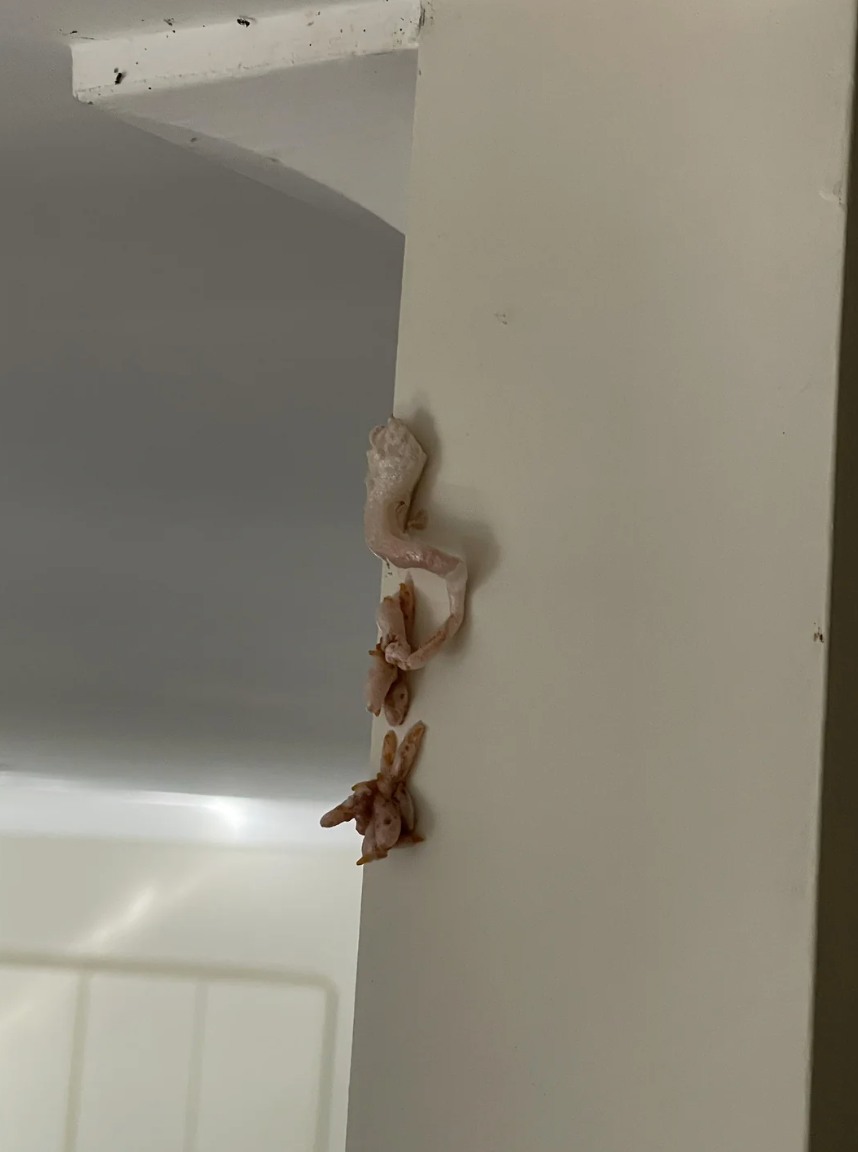
    It began on a quiet morning, the kind where the world feels small and manageable. By the time the coffee had finished brewing, filling the kitchen with its grounded, earthy aroma, the physical evidence of the mystery was already gone. It had been reduced to a nondescript gray smear on a disinfectant wipe, tossed into the trash with a casual, dismissive shrug from the landlord. He had looked at the protrusion—a vibrant, textured cluster that looked like a cross between sea coral and crystallized sugar—and called it “probably just sealing foam.” He said it with the practiced nonchalance of a man who makes a living explaining away the decay of old houses. To him, it was mundane; to me, it felt like an erasure of something significant.

    The way he dismissed it was perhaps more disturbing than the object itself. He spoke with the same hollow certainty one uses to tell a child that a bump in the night is “just the wind.” It was a redirection meant to pacify, but it only served to heighten the unease. The sound it made when it was scraped from the wall—a sharp, brittle crunch that echoed in the small room—still resonates in my memory. It wasn’t the sound of plaster or dust. It was a sound of structure, of something that had achieved a certain density and intent before being forcibly removed.

    That texture is what haunts the periphery of my thoughts. It wasn’t smooth like a spill or crumbly like ancient mortar. It possessed an organic complexity, a geometric intentionality that suggested it hadn’t just happened; it had grown. It clung to the drywall with a desperate tenacity, appearing less like an accidental chemical leak and more like evidence of a hidden process occurring behind the surfaces I trusted. In the minutes before the disinfectant wipe made the corner spotless again, the growth felt like a message from the internal machinery of the house, a symptom of a condition that remained undiagnosed.

    Logic offers several pathways to peace of mind, though none of them quite reach the destination. Perhaps it truly was ancient insulation, a volatile foam from a bygone era of construction that had finally been pushed through a microscopic hairline crack by decades of structural shifting and seasonal pressure. Materials behave erratically as they age; they expand, contract, and degrade into new, unrecognizable forms. It is possible it was the calcified remains of an abandoned nest, a relic of a creature that had long since departed, leaving behind a tomb of hardened secretions. Or, most likely, it was the “fossil” of a forgotten repair—a haphazard solution layered over a previous failure, a sedimentary record of neglect that finally reached the surface.

    All of these explanations are reasonable, yet they fail to provide comfort because they lack the weight of certainty. The unsettling nature of the event lies in the speed with which it was vanished. Within seconds, the anomaly was gone, the wall was bleached clean, and the space returned to its state of artificial perfection. There was no trace, no analysis, and no investigation. Just a clean corner and the persistent feeling that something had been silenced before it could be understood.

    This reaction highlights a fundamental aspect of the human psyche: we are far more disturbed by the unknown than we are by the unpleasant. Had a professional identified the growth as a specific mold, a known chemical reaction, or a common pest, it would have been categorized and stripped of its power. Once a thing is named, it can be dealt with; it becomes a task on a to-do list. But when it remains an unidentified “probably,” it expands within the imagination. It fills the gaps that logic cannot seal, morphing into a representative of every hidden rot and secret failure tucked behind the walls of our lives.

    The truth is that I will never know what I was living with, or for how long that pink crystallization had been reaching toward the light. That uncertainty creates a subtle, vibrating tension. It serves as a reminder that our homes, no matter how much we polish and decorate them, are merely shells over complex, hidden systems. We inhabit the surface, but beneath the paint and behind the studs, there is a world of plumbing, wiring, insulation, and occasionally, life—or its remnants—that we rarely question until it forces its way into our view.

    This experience has fundamentally altered the way I view my environment. I no longer look at a clean wall as a sign of a healthy home; I see it as a potential mask. I find myself glancing at that particular corner, half-expecting to see the pink texture blooming once more, asserting its right to exist in the open air. The landlord’s shrug was a temporary fix for a permanent curiosity. He saw a nuisance to be cleaned; I saw a mystery that demanded an answer.

    For those who find themselves facing similar anomalies in their own tiny houses or apartments, the lesson is clear: do not be so quick to reach for the disinfectant. When the house begins to grow new textures, or when the surfaces start to speak in colors and crunches you don’t recognize, document the intrusion. Take high-resolution photographs, capture the sound of its removal, and seek a second opinion. Knowledge is the only true antimicrobial for the fear of the unknown. Ask questions of people who don’t have a financial interest in the answer being “nothing.”

    In the digital age, we have the unique advantage of collective observation. If you cannot identify the stranger on your wall, let the internet help you investigate. Sometimes, a thousand eyes can see what one shrug tries to hide. Shared alarm can be a gateway to shared knowledge, and even if the answer is unpleasant, it is infinitely better than a spotless wall and a mind full of questions. We build our lives within these four walls, and the least we deserve is to know exactly what is living in them with us. Until then, I will continue to listen to the house, waiting for the next crunch, the next color, and the next reminder that the places we call home are never truly as empty or as silent as they appear to be.

  • Kindergartner hit, by school bus in front of brother, officials say! See more

    Kindergartner hit, by school bus in front of brother, officials say! See more

    The mundane routine of a school day morning is built upon a foundation of perceived safety. Parents entrust the yellow bus, a universal symbol of American education, to serve as a secure vessel for their children’s daily journey. However, that sense of security was shattered in a devastating instant when a routine stop turned into an unimaginable tragedy. In a quiet residential neighborhood, a kindergartner was struck and killed by a school bus, an accident made even more harrowing by the fact that it occurred directly in front of the child’s older brother. It is the kind of event that stops time, leaving a community grappling with the fragility of life and the heavy burden of collective grief.

    The incident unfolded during the typical morning rush, a time usually characterized by the sounds of backpacks zipping, children calling out goodbyes, and the familiar rumble of heavy diesel engines. According to local officials, the young student was attempting to board or depart the vehicle when the collision occurred. While the specific mechanical or human failures leading to the impact remain under investigation, the immediate aftermath was one of pure chaos and sorrow. Emergency responders were dispatched to the scene within minutes, navigating the quiet streets with sirens that signaled a shift from a normal morning to a community-wide emergency. Paramedics provided immediate, intensive medical assistance, but despite their most valiant efforts, the injuries sustained by the young child were too severe. The kindergartner was pronounced dead, leaving a void in a family and a school system that can never truly be filled.

    Perhaps the most agonizing element of this tragedy is the trauma inflicted upon the child’s sibling. Witnesses reported that the older brother was standing just feet away when the accident occurred. While he was not physically harmed by the vehicle, the psychological weight of witnessing such a violent and sudden loss is a burden no child should ever have to carry. He was immediately taken into the care of specialists and family members, beginning a long and difficult journey toward processing a level of grief that defies language. In the interest of compassion and out of respect for the sheer magnitude of their suffering, authorities have withheld the names of the children and their parents. This decision allows the family a small measure of sanctuary as they face the initial, most jagged edges of their mourning.

    The ripples of this loss have extended far beyond the curb where the accident took place. At the local elementary school, the atmosphere has shifted from the vibrant energy of learning to a somber, reflective silence. School district leaders were quick to respond, recognizing that the trauma of such an event affects every student who rides a bus, every teacher who greeted that child at the classroom door, and every parent who hears the news and instinctively hugs their own children a little tighter. Grief counselors and trauma specialists were mobilized immediately, stationed in libraries and classrooms to provide a safe space for students to ask questions that have no easy answers. For the staff, who often view their students as an extension of their own families, the loss is personal and profound.

    Standard legal and safety protocols have been enacted with somber precision. The school bus involved in the incident has been impounded and removed from service, undergoing a rigorous forensic mechanical inspection to determine if equipment failure played any role in the tragedy. Simultaneously, the driver of the bus—a figure who is often a beloved and trusted part of a child’s daily life—is cooperating fully with the police. The investigation is multi-faceted, involving accident reconstruction teams who are meticulously measuring skid marks, analyzing sightlines, and reviewing any available video footage from the bus’s internal and external cameras. While the legal system seeks to categorize the event and determine liability, the community is left to wonder how such a routine moment could go so catastrophically wrong.

    In the wake of the accident, the conversation has inevitably turned toward the systemic safety of school transportation. District officials have pledged a comprehensive review of all “danger zone” protocols—the areas immediately surrounding a bus where a driver’s visibility is most limited. There are calls for increased training, more sophisticated sensor technology, and perhaps a reevaluation of how pick-up and drop-off points are managed in high-traffic or narrow residential areas. Yet, even the most advanced safety measures feel like a cold comfort when weighed against the loss of a five-year-old’s future. The tragedy serves as a grim reminder that in the presence of heavy machinery, there is zero margin for error.

    The community’s response has been a testament to the power of human empathy. In the days following the accident, the site has been transformed into a makeshift memorial. A vibrant collection of plush teddy bears, colorful bouquets, and handwritten notes from classmates now marks the spot where the bus once stood. Vigil lights flicker in the evenings as neighbors gather in silent solidarity, offering a quiet presence to a family that is currently walking through the darkest valley of their lives. These gestures do not fix the unfixable, but they serve as a vital signal to the grieving that they are not alone—that their child was known, loved, and will be remembered.

    As the investigation continues, the focus remains on supporting the survivors. The brother who witnessed the event will require specialized, long-term care to navigate the complex layers of post-traumatic stress and sibling loss. The parents face a journey of grief that no one is ever truly prepared for. In their public statements, officials have urged the public to move past curiosity and toward compassion, asking for continued thoughts and prayers for the family. They emphasize that while the headlines may eventually fade and the yellow buses will continue to roll through the neighborhood, the impact of this day will remain a permanent part of the town’s history.

    The story of the kindergartner and the school bus is a tragedy of the most fundamental kind—a loss of innocence in a place where safety is supposed to be guaranteed. It serves as a call to action for every driver to remain vigilant, for every school district to prioritize safety over schedule, and for every neighbor to look out for the little ones among them. In the end, the only way to truly honor the memory of the life lost is to ensure that no other brother has to stand on a sidewalk and watch his world fall apart. For now, the community sits in the quiet, honoring a small life that ended far too soon, and hoping that “somewhere far beyond the rainbow,” a child is finally at peace.

  • She battled anorexia and was abused by someone she trusted, Yet she conquered the world with her voice and became one of the wealthiest artists ever

    She battled anorexia and was abused by someone she trusted, Yet she conquered the world with her voice and became one of the wealthiest artists ever

    The legacy of Dolores O’Riordan is one of the most poignant narratives in the history of modern rock. To many, she was the ethereal, yodeling voice of a generation, the frontwoman of The Cranberries who could pivot from the delicate vulnerability of “Linger” to the guttural, political rage of “Zombie.” But behind the shimmering guitars and the global superstardom lay a woman who was constantly negotiating a truce with her own history. Her life was a study in contrasts: she was a small-town girl from rural Ireland who conquered the world stage, an artist who achieved immense wealth but struggled with profound self-loathing, and a mother who found her greatest healing in her children while battling the ghosts of a fractured childhood.

    Born on September 6, 1971, in Ballybricken, County Limerick, Dolores was the youngest of nine children in a devoutly Catholic household. Her upbringing was steeped in the mysticism of the Irish countryside, a landscape she described as “sheltered, pure, and trippy.” Because her family was large and resources were modest—her father had suffered brain damage in a motorbike accident years before her birth—Dolores found companionship in nature. She famously remarked that she confided in birds, cows, and her dog, treating the animals of Limerick as her first confessors and therapists. This isolation fostered a unique internal world, one that allowed her talent to bloom early. By the age of five, her school principal was already placing her on desks to perform for older students, recognizing that the tiny girl possessed a voice that sounded as though it had been forged in the ancient hills of Ireland.

    However, the “pure” nature of her childhood was shattered by a trauma she would keep secret for decades. From the age of eight to twelve, Dolores was molested by someone she trusted. This betrayal of innocence became the silent engine behind much of her later art and her subsequent struggles with anorexia and depression. She would eventually admit that her “anti-girlie” phase and the aggressive, short-cropped hair she became famous for were subconscious attempts to distance herself from the femininity that had been targeted. As she grew into a teenager, her life was a rigid cycle of piano lessons, church, and homework, a discipline that provided structure but couldn’t quiet the internal turmoil.

    The world changed for Dolores in 1990 when she auditioned for a band called The Cranberry Saw Us. The band members were immediately awestruck. Here was a girl who appeared fragile and shy—sometimes performing with her back to the audience—but possessed a vocal power that was nothing short of miraculous. Rebranding as The Cranberries, the group released their debut album, “Everybody Else Is Doing It, So Why Can’t We?” in 1993. It was a staggering success. By the mid-1990s, Dolores had become the highest-paid female rock star in the UK and one of the wealthiest women in Ireland. She wasn’t just a singer; she was a cultural icon whose Celtic-inflected vocals defined the alternative rock era.

    Yet, wealth and fame proved to be poor shields against mental health struggles. As the band’s fame peaked, Dolores battled severe anorexia and suicidal ideation. The pressure of being the “face” of a multimillion-dollar entity meant she was never allowed to slip up, a demand that is impossible for any young adult, let alone one carrying the weight of childhood abuse. She sought a sense of normalcy in her marriage to Don Burton, the tour manager for Duran Duran, in 1994. They moved to Canada, and for a time, Dolores found the sanctuary she had always craved. She became a mother to three children, whom she credited as the “elemental” force in her healing. For her children, she tried to stay whole, fighting back the flashbacks of her own trauma that were triggered by watching her daughters grow up.

    The complexities of her life were mirrored in her music. Dolores was never content to write simple love songs. She pushed the band toward political relevance, most famously with “Zombie,” a song inspired by the tragic deaths of two children in an IRA bombing. She was so committed to the message of the song that she reportedly tore up a million-dollar check from her label when they tried to pressure her into releasing something more commercial. This fierce integrity was her hallmark; she was a fragile person with an iron will, an artist who refused to compromise her voice for the sake of the industry.

    The later years of her life were marked by a series of devastating blows. The death of her beloved father, Terence, in 2011 deeply affected her. At his funeral, she was forced to confront the person who had abused her as a child, an encounter that sent shockwaves through her fragile mental state. In 2014, her twenty-year marriage to Burton ended, and her subsequent arrest following an air-rage incident made headlines worldwide. It was during this period that her family revealed she was struggling with bipolar disorder. Dolores spoke candidly about her diagnosis and her battle with alcohol, admitting that she often hit the bottle to drown out memories she couldn’t control. She described her “tortoise effect”—a defensive mechanism where she would tuck herself away from the world when the pain became too much to bear.

    Despite her personal chaos, her creative spark remained. She reunited with The Cranberries, produced new music, and was making extensive plans for the future. On the night before her death in January 2018, she left upbeat voicemails for colleagues, speaking of her children and singing snatches of songs. She seemed to be in a “good space,” which made the eventual news of her passing even more shocking. At the age of 46, Dolores was found dead in a London hotel room. The coroner determined that she had accidentally drowned in her bathtub due to alcohol intoxication. It was a tragic, quiet end for a woman who had spent her life making so much beautiful noise.

    Dolores O’Riordan’s story is a reminder that brilliant art often comes at a staggering personal cost. She conquered the world with a voice that was both a whisper and a scream, articulating the pain and dreams of millions while navigating her own labyrinth of trauma. She proved that a girl from Limerick could become a global titan through sheer honesty and raw talent. Today, she is remembered not just for the millions of albums sold or the wealth she accumulated, but for the courage it took to keep singing when the world felt like it was falling apart. She left a mark that ensures her name will be spoken for generations, a haunting, melodic echo that continues to linger long after the music has stopped.

  • My Son Showed Up in a Puffy Red Dress on Graduation Night – His Reason Made Me Cry!

    My Son Showed Up in a Puffy Red Dress on Graduation Night – His Reason Made Me Cry!

    The journey of motherhood is often paved with a persistent, quiet anxiety, especially when you are navigating that path entirely on your own. For thirty-four years, my life has been a singular devotion to my son, Liam. I had him when I was barely more than a child myself, facing the world without the safety net of my parents’ approval or the presence of his father. Ryan, the man who had occupied the center of my teenage world, evaporated the moment the word “pregnant” left my lips. In the vacuum he left behind, I had to build a fortress for Liam and me. Yet, despite our closeness, I lived with the gnawing fear that I wasn’t enough—that the absence of a father figure would leave a hollow space in his character that I could never fill.

    Liam was never the kind of child who demanded attention. He was quiet, observant, and possessed a sensitivity that often made my heart ache. He felt the world with a profound intensity, but he kept his emotions under lock and key, hidden behind the steady gaze of his dark eyes. As his high school graduation approached, that habitual reserve deepened into an impenetrable secrecy. He began disappearing for hours after school, offering only vague explanations about “helping a friend.” He guarded his phone with a newfound intensity, and the air between us grew thick with the weight of things unsaid.

    One evening, shortly before the ceremony, Liam approached me with a restless energy I hadn’t seen since he was a toddler. He was fidgeting with his hoodie strings, his eyes downcast as he spoke. “Mom,” he whispered, “at graduation tonight, I’m going to show you something. I need you to just trust me. You’ll understand everything then.” I wanted to press him for details, to soothe the knot of anxiety tightening in my stomach, but the look of desperate, nervous hope on his face stopped me. I simply nodded and promised I would be there.

    Graduation night arrived with all the typical fanfare. The auditorium was a sea of buzzing energy, flashbulbs, and the rustle of polyester gowns. I found a seat near the front, my pride battling a strange sense of forethought. When the double doors finally opened and the procession began, the atmosphere changed in an instant. The rhythmic clapping faltered, replaced by a sudden, sharp intake of breath that rippled through the room.

    Liam walked through the doors, but he wasn’t wearing the traditional cap and gown. Instead, he was dressed in a vibrant, puffy red dress that shimmered under the harsh stage lights. For a moment, my world went silent. Then, the explosion happened. Laughter, cruel and unrestrained, erupted from the bleachers. “Is he serious?” a student shouted. “Look at the girl in the red dress!” mocked another. I saw parents leaning into each other, their faces twisted in smirks or masks of judgmental shock. “What is wrong with that boy?” a woman behind me hissed.

    My first instinct was a primal urge to protect. I wanted to run to him, to wrap my arms around his shoulders and shield him from the caustic derision of the crowd. I wanted to drag him away before the world could break the spirit I had worked so hard to cultivate. But as I looked at my son, I saw something that stopped me in my tracks. Liam wasn’t flinching. He walked toward the stage with his head held high, his expression calm and resolute. He didn’t look like a boy playing a joke; he looked like a soldier on a mission.

    He reached the microphone at the front of the stage, and as he adjusted the stand, the room slowly succumbed to a tense, expectant silence. He looked out at the sea of faces—the people who had just been laughing at his expense—and began to speak. His voice was steady, though it carried a slight tremor of emotion.

    “I know why you’re laughing,” he said, his words cutting through the stillness. “I know how this looks. But tonight isn’t about me. It’s about a promise.” He took a breath, his eyes finding a specific spot in the crowd. “Most of you know Emma. And most of you know that her mother passed away three months ago after a long battle with illness. What you don’t know is that they had been practicing a special dance for tonight for years. It was supposed to be their moment together.”

    The mocking smiles in the audience began to fade, replaced by a heavy, uncomfortable realization.

    “Emma told me she wasn’t going to come tonight,” Liam continued. “She said it hurt too much to be here without her mom to do that dance. This dress… it’s a replica of the one Emma’s mom was going to wear. I didn’t want Emma to be alone. I didn’t want her to lose that memory just because her mother couldn’t be here in person.”

    He turned toward the wing of the stage and held out his hand. “Emma? Will you dance with me?”

    A young girl stepped out from the shadows, her face wet with tears. She looked at Liam, then at the red fabric of the dress, and a small, broken sob escaped her. She walked toward him and placed her hand in his. The music began—a soft, melodic piano piece. As they began to move, the auditorium was transformed. Every turn, every graceful spin, was a tribute to a love that transcended the room. It wasn’t a boy in a dress; it was a display of radical empathy that defied every social convention in the room.

    The laughter was gone, replaced by an awe so thick it felt like it was pressing against the walls. Students who had been recording for social media put their phones away, their faces flushed with shame. Teachers and parents alike were openly weeping. In that dance, Liam had taken the ridicule meant for him and transformed it into a shield for someone else’s grief.

    When the music faded, the applause was deafening—a standing ovation that seemed to shake the foundations of the building. Liam walked off the stage and came straight to me. He was trembling now, the adrenaline fading to reveal the vulnerability underneath. “I just wanted her to feel like her mom was still part of the night,” he whispered as I pulled him into a fierce embrace.

    In that moment, every doubt I had ever harbored about being “enough” vanished. I realized that while I had worried about Liam lacking a traditional male role model, he had been busy learning something far more profound. He hadn’t learned how to be “tough” in the way the world expects; he had learned how to be brave in the way the world desperately needs. He had watched me struggle, survive, and prioritize kindness every day of his life, and he had turned those lessons into an act of legendary compassion.

    The aftermath was a whirlwind. Liam’s story went viral, held up as a beacon of what true heroism looks like. But for us, the real change happened in the quiet moments. Emma’s father thanked Liam with a hug that said more than words ever could. Emma herself brought over a photo of the dance, noting that Liam had given her her mother back for just one song.

    As we sat on our porch a week later, the graduation dress tucked away, I looked at my son and saw a man. Not because of his age or his strength, but because of his heart. I had spent eighteen years wondering if I was doing it right, only to realize that the best kind of parenting isn’t about following a script. It’s about showing up, being kind, and raising a human being who knows that the loudest thing you can ever do is stand up for someone else in silence. Liam didn’t need a father to teach him how to be a man; he just needed a mother to teach him how to love, and as it turned out, that was more than enough.

  • From a difficult childhood to rock fame! The pain that formed a legend

    From a difficult childhood to rock fame! The pain that formed a legend

    The legend of Axl Rose is often framed by the chaotic excess of the Sunset Strip, the screeching high notes of multi-platinum anthems, and a reputation for being one of the most volatile and uncompromising figures in music history. Yet, to view the frontman of Guns N’ Roses only through the lens of his superstardom is to miss the structural damage of the foundation upon which that fame was built. The man who would eventually command the attention of millions was forged in the silence and suppression of Lafayette, Indiana—a place geographically and culturally a world away from the “Jungle” he would later describe. Axl’s journey is not just a rags-to-riches story; it is a complex psychological odyssey of a boy who had to burn down his old identity to survive.

    Born William Bruce Rose Jr. on February 6, 1962, his life was marked by displacement before he was old enough to comprehend it. His biological father, a troubled teenager himself, exited the picture early on, leaving a void that was filled by his mother’s new husband, Stephen L. Bailey. For the better part of two decades, William believed Bailey was his biological father, taking his last name and living under his roof. The discovery of the truth in his late teens—that his real father was a different man who would later meet a violent end—was a seismic shift that shattered his sense of self. It was a revelation that meant his entire childhood had been lived under a false premise, a trauma of identity that would fuel his lifelong distrust of authority and established narratives.

    The environment in which he was raised offered no sanctuary for a sensitive or creative soul. The Bailey household was characterized by a brand of rigid, authoritarian Pentecostalism that viewed the secular world as a minefield of sin. In this home, the windows to the outside world—television, radio, and popular music—were largely shuttered. What many would consider the standard joys of a mid-western childhood were treated as moral failings. This atmosphere of strict control was, by Axl’s own later accounts, punctuated by physical and emotional abuse. When a child is told that their natural inclinations are sinful and their environment is physically threatening, the result is often a profound internal fracture. For Axl, this manifested as a volatile mixture of intense anger and extreme vulnerability, a duality that would eventually become the hallmark of his songwriting.

    Ironically, the one outlet he was permitted became the very tool he would use to escape. Because the church prioritized vocal praise, Axl was allowed to sing in choirs, where his multi-octave range and natural charisma began to crystallize. Even within the confines of a hymnal, he was learning how to project emotion to the back of a room, honing the instrument that would one day roar over Marshall stacks. However, as he moved into adolescence, the friction between his repressed home life and his burgeoning rebellious spirit became unsustainable. By the time he reached his late teens, he had become a frequent target of local law enforcement, a “delinquent” in the eyes of Lafayette who was simply a young man suffocating under the weight of his own history.

    The decision to leave Indiana for Los Angeles was more than a career move; it was an act of self-exorcism. Upon arriving in California, he legally changed his name to W. Axl Rose, effectively severing his ties to the “Bailey” name and the “William” persona. He was no longer the son of an authoritarian household; he was a self-created entity. In the gritty, neon-soaked streets of Hollywood, he found a landscape that mirrored his internal chaos. He teamed up with a group of like-minded outcasts to form Guns N’ Roses, a band that stood in stark contrast to the polished “hair metal” of the era. They were raw, dangerous, and deeply authentic, largely because Axl was singing from a place of genuine, unresolved pain.

    When “Appetite for Destruction” exploded onto the scene in 1987, it wasn’t just the riffs that caught the world’s attention—it was the palpable sense of survival in Axl’s voice. “Welcome to the Jungle” wasn’t just about Los Angeles; it was an anthem for anyone who had been hunted by their own circumstances. The lyrics of “Sweet Child O’ Mine” and “Paradise City” carried the echoes of a man longing for a home and a sense of peace that he had never actually experienced. His infamous volatility on stage—the walk-offs, the rants, the demands for perfection—can be seen through a psychological lens as a frantic attempt to exert control in an adult world after a childhood where he had none. He was a man who had been silenced for eighteen years, and once he had the microphone, he refused to let anyone tell him when to speak or how to act.

    Throughout the decades, Axl Rose has remained a polarizing figure, often misunderstood by a public that sees his intensity as mere “rock star behavior.” Yet, those close to the music understand that his brilliance is inseparable from his scars. The very trauma that nearly broke him in Indiana provided the high-octane fuel for his creative output. He transformed the “sinful” music he was once forbidden to hear into a global language of defiance. His story serves as a profound reminder that the most enduring art often comes from the deepest wounds. Axl Rose didn’t just become a legend in spite of his difficult childhood; he became a legend because he figured out how to turn his screams into songs.

    Today, Axl stands as a survivor of the industry and of his own past. While the fire that fueled Guns N’ Roses may have been sparked by the darkness of Lafayette, it eventually lit up the entire world. His journey proves that while we cannot choose where we begin, we have the power to rename ourselves, to find our own “Paradise City,” and to use our pain to build something that lasts forever. The red bandana and the defiant scowl are the armor of a man who fought his way out of a storm, proving that even the most restrictive beginnings can lead to an extraordinary, unrestrained life.

    The history of rock is filled with performers, but few are as authentically rooted in their own struggle as Axl Rose. By looking behind the glitter of the stadium tours, we see the true value of his work: it is the sound of a human being finally becoming the master of his own story. The boy from Lafayette is gone, but the voice he found in the dark continues to resonate, reminding us that there is a special kind of power in refusing to be silent.

  • The Amazing Tale of a British Airways Pilot Who Hung On Outside a Flying Plane for 20 Minutes!

    The Amazing Tale of a British Airways Pilot Who Hung On Outside a Flying Plane for 20 Minutes!

    On the morning of June 10, 1990, British Airways Flight 5390 departed from Birmingham Airport, destined for the sun-drenched coast of Málaga, Spain. It was a routine Monday morning flight aboard a BAC 1-11, a sturdy workhorse of the era. The eighty-one passengers on board settled into their seats, expecting nothing more than a few hours of quiet transit. However, as the aircraft climbed through 17,000 feet over the lush greenery of Oxfordshire, the mundane reality of commercial air travel was shattered by a sound like a gunshot. What followed was an ordeal of such visceral terror and physical impossibility that it remains, decades later, one of the most legendary chapters in the annals of aviation survival.

    The catastrophe was triggered by a sudden, explosive decompression in the cockpit. Without warning, the left-hand windshield—directly in front of the captain—blew out of its frame, hurtling into the slipstream. The pressure differential was instantaneous and violent. Captain Tim Lancaster was immediately jerked out of his seat by the rushing air. His shoulder straps, designed to protect him from turbulence, were no match for the vacuum created at nearly 350 miles per hour. Within a fraction of a second, the captain was sucked halfway out of the aircraft. His torso and head were pinned against the exterior fuselage by the relentless force of the wind, while his legs remained jammed beneath the control column inside the cockpit.

    The scene inside the flight deck was one of absolute pandemonium. Flight attendant Nigel Ogden, who had been entering the cockpit to offer the pilots a beverage, witnessed the captain disappear into the sky. Acting on pure, unadulterated instinct, Ogden lunged forward and grabbed Lancaster’s legs just before they slipped entirely through the window frame. Had it not been for Ogden’s lightning-fast reflexes, Lancaster would have been lost to the atmosphere instantly. For the next twenty minutes, Ogden became a human anchor, his muscles screaming under the strain as the sub-zero gale-force winds tried to tear the captain from his grasp.

    Outside, the conditions were unsurvivable by any traditional medical standard. At 17,000 feet, the air is thin and dangerously low in oxygen. The temperature was approximately -17°C, made exponentially worse by a wind chill factor that could freeze skin in seconds. Lancaster was being battered against the side of the plane, his eyes wide and unblinking, his body subjected to a pummeling force that the crew believed had already killed him. Inside the cockpit, the door had been blown inward, blocking the throttle controls and filling the space with a deafening roar and swirling debris. Papers, manuals, and loose equipment whipped through the air like shrapnel.

    While Ogden held on for dear life, Co-pilot Alastair Atchison faced a monumental task. Not only did he have to fly an aircraft that was structurally compromised and depressurizing, but he had to do so while the captain’s body remained wedged against the outside of the window, obstructing his view and affecting the plane’s aerodynamics. With cool, calculated precision, Atchison took the controls. He knew he had to descend to an altitude where the crew and passengers could breathe, but he had to do so without flying so fast that the wind force would snap Nigel Ogden’s arms or tear Lancaster apart. He began an emergency descent, fighting the noise and the chaotic air currents to communicate with air traffic control.

    The physical toll on Nigel Ogden was reaching a breaking point. His arms were becoming numb from the cold and the exertion, and frostbite was beginning to set in. He was slipping. Sensing the impending disaster, another flight attendant, Simon Rogers, rushed into the cockpit. He strapped himself into the observer’s seat and gripped Ogden’s belt, providing the leverage needed to keep the chain of survival intact. Eventually, Rogers took over the task of holding Lancaster’s legs, allowing a battered Ogden to retreat. Despite the grim sight of Lancaster’s head repeatedly striking the fuselage—a sight that led the crew to assume they were holding onto a corpse—Atchison gave a stern order: “Don’t let go.” He feared that if they released the body, it would be sucked into the rear-mounted engines, potentially causing a total engine failure and a secondary catastrophe.

    Under Atchison’s masterful handling, the BAC 1-11 descended toward Southampton Airport. The passengers, though aware of the decompression and the steep dive, remained largely unaware of the life-and-death struggle happening just beyond the cockpit door. When the wheels finally touched the tarmac at Southampton, the emergency crews rushed to the aircraft, expecting a recovery mission. To the astonishment of everyone involved, they found that Captain Tim Lancaster was not only still attached to the plane, but he was alive.

    Lancaster had spent twenty minutes exposed to the elements at high altitude and high speed. He suffered from profound shock, multiple fractures to his arms and wrist, a broken ribs, and severe frostbite. Nigel Ogden suffered from a dislocated shoulder and frostbite to his face and arms. Miraculously, there were no other injuries among the passengers or crew. Within five months of the accident, Tim Lancaster—the man who had been halfway out of a flying plane—returned to the cockpit to continue his career as a pilot.

    The subsequent investigation by the Air Accidents Investigation Branch (AAIB) revealed a chillingly simple cause for the near-tragedy. The windshield had been replaced just twenty-seven hours before the flight. The maintenance shift manager had used the wrong bolts to secure the window—bolts that were slightly too thin and slightly too short. He had relied on a “like-for-like” visual comparison rather than consulting the official parts manual, and because the workspace was poorly lit and he was under pressure to complete the job, he didn’t notice the discrepancy. The eighty-four bolts holding the window in place were simply unable to withstand the pressure of the climb.

    This incident remains a cornerstone of aviation safety training, frequently cited in discussions regarding human factors in maintenance and the importance of CRM (Crew Resource Management). It was famously dramatized in the series Mayday, bringing the harrowing visuals of Lancaster’s survival to a global audience. The story of Flight 5390 is more than a tale of a mechanical failure; it is a tribute to the extraordinary resilience of the human body and the heroic tenacity of a crew that refused to let go. It serves as a permanent reminder that in the high-stakes world of aviation, the difference between a miracle and a tragedy often rests in the hands of those who refuse to succumb to panic when the impossible occurs.

  • A Kings Confession That Shattered a Prince!

    A Kings Confession That Shattered a Prince!

    The architecture of a monarchy is built upon the art of the unsaid. For centuries, the British Royal Family has existed behind a veil of curated stoicism, where personal history is often sacrificed at the altar of public duty. For Prince William, the heir to the throne, his entire life had been shaped by the rigid boundaries of this protocol. He was a man who understood the weight of silence better than most. Yet, even the most fortified walls eventually develop fissures. The first true crack in William’s world did not arrive via a tabloid headline or a televised exposé; it occurred in the profound, suffocating quiet of a locked room within the palace, far from the reach of courtiers and cameras.

    In this private sanctuary, King Charles III finally shed the mantle of the sovereign to speak to his son as a man burdened by the weight of a thousand untold truths. The air in the room was heavy, thick with the dust of decades-long secrets that had finally been disturbed. As the King began to speak, his voice—usually measured and authoritative—faltered. The confessions that followed were not mere scandalous revelations meant for the consumption of the masses; they were the deeply personal reckonings of a father who realized that the legacy he was passing down was poisoned by omission.

    Each word Charles spoke carried the gravity of a tectonic shift. He spoke of the years surrounding William’s mother, Diana, and the intricate web of pressures, misunderstandings, and institutional coldness that had defined that era. He spoke of choices made out of fear and others made out of a misguided sense of duty to a crown that demanded everything and gave little back in the way of emotional warmth. For William, listening was a physical ordeal. He stood perfectly still, absorbing truths that acted like a chemical wash, stripping away the polished finish of his childhood memories. The stories he had used to anchor his understanding of his family no longer fit the new reality being described. He felt the familiar pang of grief for the mother he lost, but it was now coupled with a searing anger at the years of silence that had obscured the full picture.

    As the King’s confession reached its conclusion, the room seemed to undergo a fundamental change. The silence that followed was not the comfortable quiet of shared understanding, but the heavy, unfamiliar stillness of an ending. In that moment, Charles no longer resembled a powerful monarch or a global figurehead. He looked like a man diminished by his own history, a father who had waited far too long to be honest and was now seeing the toll that delay had taken on his eldest son. The distance between them, once bridged by the formalities of their roles, now felt like an uncrossable chasm filled with the ghosts of the past.

    William felt himself suspended between two powerful, opposing forces: a blinding fury and a burgeoning, reluctant understanding. He realized that no amount of honesty now could rewrite the tragedies of the past or undo the damage inflicted upon Diana. The years shaped by secrecy had already done their work. The past, he realized, refused to stay contained within the leather-bound volumes of official history or the carefully worded statements of the palace press office. It was a living, breathing thing that demanded to be seen.

    Yet, amid the wreckage of his perceived history, a fragile sense of clarity began to emerge for the Prince of Wales. He recognized that while he could not change the man sitting across from him, he possessed the power of choice. He was the next link in a chain that had been forged in the fires of the Victorian era, but he did not have to be bound by its more archaic and damaging links. Strength, he realized, lay not in the stoic endurance of suffering or the maintenance of a false facade, but in the courage to break the cycle.

    A resolution began to take shape in William’s mind. He looked toward the future—toward his own children, George, Charlotte, and Louis—and vowed that they would not inherit a legacy built solely on endurance and the suppression of the self. He would be the one to stop the cycle of emotional distance and institutional secrecy. He would ensure that their lives were rooted in a truth that, while perhaps messy and difficult, was at least honest. He understood that healing might remain incomplete for his own generation, but for the next, the air would be clearer.

    When father and son finally met each other’s eyes after the long hours of the evening, there was no sudden rush of absolution. There were no cinematic hugs or easy reconciliations. Instead, there was something far more realistic and perhaps more sustainable: an unspoken agreement. It was a pact that the future would be defined by fewer secrets and more transparency. They stood together as two men who had finally acknowledged the cracks in the foundation, agreeing that a family story no longer ruled entirely by fear was the only one worth continuing.

    As William eventually left the room and stepped back into the grand hallways of the palace, the world looked exactly the same, yet felt entirely different. The armor of the monarchy remained, but beneath it, the Prince was a man transformed. He moved with the quiet determination of someone who had faced the shadows of his past and decided to lead his house toward the light. The King’s confession had indeed shattered the Prince’s world, but in the ruins, William found the materials to build something stronger, truer, and finally, his own.