Category: Uncategorized

  • The DNA Test That Tore My Family Apart — and the Truth None of Us Expected

    The DNA Test That Tore My Family Apart — and the Truth None of Us Expected

    Sixteen years ago, my son Tom had a daughter, Ava, with his now ex-wife, Mia. I loved Mia like a daughter from the moment she entered our lives. So when their marriage collapsed because Tom cheated, I was devastated. Mia had no close family, nowhere to go, and she was trying to raise a newborn alone. My husband and I didn’t hesitate — we took both Mia and baby Ava into our home. We helped raise Ava like she was our own granddaughter in every sense that mattered.

    Tom didn’t wait long to move on. Less than a year later, he remarried, and a few years after that he had a new son. Overnight, he distanced himself from Ava, barely visiting, barely calling, acting like she didn’t exist. Eventually, he completely disowned her. It broke Mia’s heart. It broke mine too.

    Two years ago, my husband was diagnosed with lung cancer. It was a difficult time — emotionally and financially. One night, Tom came over acting unusually tense. He started talking about inheritance, saying his son deserved “more” and that Ava shouldn’t get anything because, in his exact words, she was “just a bastard.” My husband almost threw him out right then, but Tom wasn’t done. He then demanded we do a DNA test on Ava because he was “sure” she wasn’t his biological child.

    My husband snapped and kicked him out of the house. But the damage was done — Ava had overheard the entire conversation. She was shaking, heartbroken, but she insisted she wanted to do the DNA test to end the doubt once and for all. Mia agreed, though it clearly reopened old wounds.

    Those next two weeks felt like an eternity. We tried to keep Ava distracted, tried to reassure her, but she was terrified of losing the family she had left. When the results finally came back, all of us sat together in the living room — Mia trembling, Ava silent, my husband holding my hand like he was bracing for impact.

    The results stunned us.

    Ava was Tom’s biological daughter — 99.999% paternity. There was never any doubt. The child he rejected, the child he insulted, the child he insisted wasn’t his… was, in fact, his own flesh and blood.

    Tom didn’t apologize. Not once. Instead, he got angry, blaming Mia for “making him doubt,” blaming us for “taking her side,” and even blaming the lab for giving him “a result he didn’t trust.” It was unbelievable. My husband told him to leave and not come back until he learned to treat his daughter with the respect she deserves.

    Ava cried for hours that night — not from the test result, but from the realization that her own father chose to believe the worst about her rather than accept the truth.

    My husband passed away last year, still furious at Tom. And as for me — I’ve made my decision. When it comes to inheritance, love, and loyalty, Ava will always be my granddaughter. Biology only confirmed what my heart already knew.

  • What I found wasn’t junk. It was a time capsule. Faded letters, black-and-white photographs, and a wooden chest thick with dust and mystery

    What I found wasn’t junk. It was a time capsule. Faded letters, black-and-white photographs, and a wooden chest thick with dust and mystery

    What I found wasn’t junk. It was a time capsule. Faded letters, black-and-white photographs, and a wooden chest thick with dust and mystery. One photo stopped me cold—a man I didn’t recognize holding hands with a little girl. On the back, in Grandma’s handwriting:

    “My son and my granddaughter. Thomas and Marie.”

    My heart raced. That man was my father. A man Grandma had never spoken about. A man I’d been told almost nothing about.

    Why had she kept him a secret? Why the warning to burn it all?

    I needed answers. I tracked down his address and, with trembling hands, knocked on his door. He greeted me with warmth and charm. We shared pizza, stories, and laughter. For a moment, I believed I’d found something precious—a father I never knew.

    But then he asked to visit Grandma’s house that same night. Something felt off.

    Later, I caught him in the attic, digging through the chest with a strange urgency. The warmth vanished. He pulled out an old deed and declared,

    “Daddy’s home.”

    He claimed half the house. Just like that, the reunion turned into a hostile takeover.

    I was stunned. What I thought was love was control wrapped in nostalgia.

    Refusing to be manipulated, I dug deeper—and discovered I wasn’t his only daughter. Olivia. She’d lived under the same shadow. We connected, shared stories, and realized we weren’t alone.

    Together, we hired a lawyer. We challenged the deed. We fought for what was ours.

    And we won.

    He was removed. The house became ours. But more than that, I gained a sister. A partner in truth. A piece of family I didn’t know I was missing.

    Grandma’s warning wasn’t just about burning old papers. It was about protecting what mattered—from secrets, from manipulation, from people who use love as leverage.

     Sometimes, the attic holds more than dust. Sometimes, it holds the truth. And sometimes, ignoring a warning leads you straight to the heart of what you were meant to find.

     If this story made you think about family, legacy, or second chances, share it. Someone else might need the reminder: not all reunions are meant to be—but some discoveries are.

  • The Day I Found Out My Mom Was Gone From the Nursing Home

    The Day I Found Out My Mom Was Gone From the Nursing Home

    I’m the only person who looks after my mom, Joyce, who’s 79. After her bad fall a few months ago, I had to make one of the toughest decisions of my entire life. I placed her in a nursing home, not because I wanted to, but because I was terrified she’d get hurt again while I was at work. I felt guilty every single day, but I NEVER abandoned her. Every weekend, without fail, I’d show up with fresh muffins, paint her nails, bring her new cardigans, and fill her room with photos of our family. It was my way of reminding her that she wasn’t alone.

    Last Saturday, I walked into the nursing home carrying banana bread and a soft blue cardigan she loved. But the moment I stepped up to the reception desk, the receptionist froze. She looked at me like she wasn’t sure what to say. “Mrs. Joyce? She’s… not here anymore.”

    My heart dropped. “What do you mean she’s not here? Where’s my mom?”

    The receptionist, looking nervous, told me that my mother had been discharged — a week earlier. She said a woman picked her up and claimed to be a family member. They handed over my mom, her belongings, her medication — everything — without ever calling me. Without verifying anything. Without even checking an ID.

    I felt like the floor disappeared under my feet. “You let someone take a 79-year-old woman, with dementia, without contacting the only person listed as her emergency contact?” My voice was shaking, and people in the lobby started to stare.

    The receptionist kept apologizing, saying it was a “miscommunication” and that the staff “thought it was arranged by the family.” But I am the family. There is no one else. No sisters. No cousins stepping in. No long-lost relatives showing up out of nowhere.

    I demanded to know who signed the papers. They only had a first name. No phone number. No address. Nothing. My mother — a fragile, elderly woman who depended on me — had been handed over to a complete stranger like she was a lost piece of luggage.

    I drove straight to the police station, shaking the entire way. I showed them every document proving I was her only caregiver. They opened a missing persons case immediately, but the detective warned me that cases like this are complicated — especially when vulnerable adults are involved.

    All I could think about was my mom. Was she scared? Was she confused? Was she safe? Did she even know what was happening when that woman took her?

    I never imagined something like this could happen. A nursing home — a place meant to protect her — handed her over to someone who wasn’t me, without hesitation.

    And now, I’m praying every hour that the next phone call is the one that brings her home.

  • The Blonde Who Followed Her Doctor’s Diet a Little Too Literally

    The Blonde Who Followed Her Doctor’s Diet a Little Too Literally

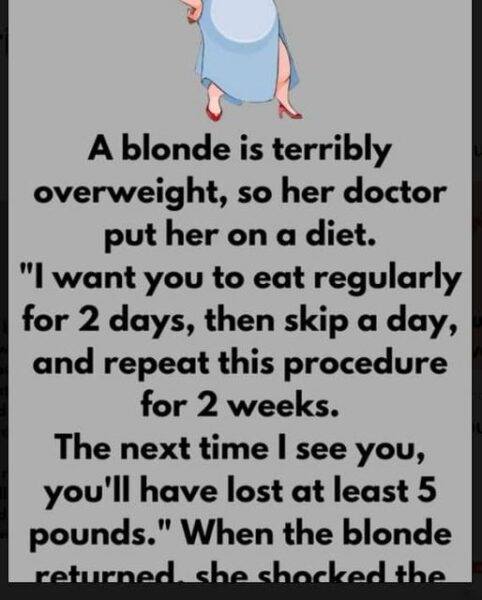
    A blonde had been struggling with her weight for months, and nothing she tried seemed to work. Eventually, she decided to visit her doctor, hoping for a simple, straightforward solution. After checking her numbers and listening to her concerns, the doctor came up with a plan that sounded easy enough to follow. “Here’s what I want you to do,” he said. “Eat normally for two days, then skip the third day entirely. No food. Then repeat the same pattern for two full weeks. If you stick to this schedule, you should lose at least five pounds by the time I see you again.”

    The blonde nodded with determination. It didn’t sound too complicated. Two days of eating, one day of nothing — how hard could it be? She left the doctor’s office convinced that this was finally the diet that would fix everything.

    Two weeks later, she returned for her follow-up appointment. She walked into the office looking exhausted, drained, and moving like she hadn’t slept properly in days. The doctor immediately noticed something was off. “You look terrible,” he said. “Did you follow the diet exactly like I told you?”

    The blonde sighed deeply and almost collapsed into the chair. “Doctor… I did exactly what you said. I ate for two days, then I skipped the third. I repeated it again and again, just like you asked.” She wiped her forehead dramatically and continued. “But those two weeks almost killed me! I barely survived those three days I had to skip.”

    Confused, the doctor frowned. “Hold on… three days? I said skip one day after every two days of eating.”

    Her eyes widened like she had just remembered something important. “Wait… what? You said one day?” She paused, thinking back. “Oh my god, doctor, I thought you meant skip every third day of the week. So I skipped Wednesday, Thursday, and Friday… every week.”

    The doctor stared at her in disbelief, trying hard not to laugh. “You skipped three consecutive days without eating… for two weeks?”

    She nodded proudly, despite looking like she had been through a war. “Yes, doctor. And trust me… losing weight was the easy part. Surviving was the hard one.”

    The doctor shook his head, half amused and half horrified. “Well, no wonder you lost weight. You weren’t dieting… you were fasting like a monk.”

    The blonde shrugged. “At least it worked, right? But please, next time you put me on a diet, make sure it doesn’t involve me passing out on the sofa three times a week.”

    And with that, the doctor realized one very important rule:
    never underestimate how literally someone can follow instructions — especially when they’re highly motivated to lose a few pounds.

  • But then a different thought surfaced: What if I dressed up and took myself out instead?

    But then a different thought surfaced: What if I dressed up and took myself out instead?

    But then a different thought surfaced: What if I dressed up and took myself out instead?

    So I did. I reached for earrings usually reserved for weddings, misted on perfume like armor, and walked downtown to a restaurant I’d been admiring for months.

    A Table for One
    The restaurant shimmered like a greenhouse after dark—tall windows, cascading plants, candlelight dancing across white linen. The air buzzed with soft conversation, forks chiming against porcelain.

    “Reservation for one,” I said, steady and unapologetic.

    The host smiled—no hesitation, no pity—and guided me to a window-side table. Outside, the city moved gently: headlights weaving, a florist’s display glowing across the street, a couple walking their dog in quiet rhythm. The table was angled perfectly. I could watch the world without feeling watched. My shoulders eased.

    The server arrived with water and a basket of bread I’d read about in reviews. I ordered a glass of Albariño, a fennel and orange salad, and the halibut that diners had called “life-changing.” Hyperbole, maybe—but curiosity won.

    I pulled out a book but didn’t open it. Instead, I listened. A couple debated the suburbs. A woman at the bar laughed with a bartender who remembered her drink. In the kitchen, chefs moved like choreographers, plates emerging like polished gems.

    The Request
    Just as I began to settle in, the server returned, his expression uneasy. “I’m so sorry,” he said gently. “Would you mind moving closer to the kitchen? A family’s arriving, and we’d like to combine your table with the one next to it.”

    The subtext was clear: a solo diner takes up less space, and space is currency. The instinct to yield—to smile and say “No problem!”—rose quickly. I knew that reflex well.

    But something in me held firm.

    “Thank you for asking,” I said evenly. “I’d prefer to stay here.”

    A flicker of tension crossed his face, then softened. “Of course,” he replied. “Absolutely. Thank you.” He walked away, gripping the menu a little too tightly.

    Then came the doubt. Was I selfish? Did the family need more room? But before the spiral took hold, the halibut arrived—perfectly seared, layered with lemon and herbs like a quiet symphony. One bite steadied me.

    An Unexpected Thank-You
    “Excuse me?”

    I looked up, expecting the server. Instead, a woman in her forties stood beside me—navy wrap dress, lipstick carefully applied over visible fatigue. Behind her stood a family: twin girls in cardigans, a teenager with hair over his eyes, a man adjusting his cuffs.

    “I’m the mother of the family that needed the extra table,” she said. I braced for reproach.

    But her smile was warm. “I didn’t come to ask you to move. I came to thank you for not moving.”

    I blinked, surprised.

    “It’s awkward sometimes,” she said. “I’ve been where you are—dining alone, asked to make space as if you take up less. I wanted my kids to see that your presence matters. That a party of one is still a party.”

    Her words softened something in me. She wasn’t correcting me—she was affirming me.

    “I used to eat alone a lot after my divorce,” she added. “People don’t realize how easily singles get pushed aside. I want my kids to understand: we don’t ask others to shrink.”

    Her kindness felt like a gift placed gently on the table. “Thank you,” I managed.

    “Enjoy your dinner,” she said, nodding at my plate. “You chose well.” Then she returned to her family, the girls waving shyly as if we’d shared something unspoken.

    Small Moments of Belonging
    I ate slower after that—not out of defiance, but gratitude. The fennel salad lifted my spirits. The fish was charred just to the edge. Candlelight turned my water glass into a shimmering lake.

    Later, the twins sketched with crayons. One held up a drawing: yellow circles for light, a window, and a stick figure—me—smiling at the table. “It’s you,” she said proudly. I placed a hand over my heart. “It’s perfect.”

    The manager approached, cautious. “Thank you for your patience,” she said. I smiled. “I didn’t move. But thank you for asking, not assuming.” She placed a lemon tart on the table—on the house. “For perspective.” We laughed together.

    As I savored the tart’s citrus brightness, an older man dining alone raised his espresso in a silent toast. I nodded back. Two solo diners, quietly acknowledging each other.

    A Sentence to Keep
    When the family left, the mother stopped again. “Thank you,” she said. “I hope I didn’t overstep.”

    “You didn’t,” I replied. “You gave me a sentence to keep: a party of one is still a party.”

    Her smile said she understood. The children called “Goodnight!” and paraded out the door.

    Even the host, as I left, seemed part of the lesson. “Reservation for one?” I’d said earlier. Now he added, “My mom eats out alone a lot. I think about her.”

    Carrying It Forward
    Walking home, the city lights felt softer. I thought about the family, the drawing, the lemon tart, the words I’d been gifted. Back in my apartment, I taped the crayon picture to my mirror, beside postcards and reminders. It turned the glass into a window—reflecting not just me, but the truth I’d practiced that night: belonging doesn’t require company.

    I’d gone out to feed myself. I came home nourished in ways I hadn’t expected. Holding my place at the table wasn’t selfish—it was necessary. Eating alone didn’t make me less. It made me human. Worthy of space. Hungry for dinner. Entitled to a seat by the window, no apology required.

    The next morning, I brewed coffee, toasted bread, and let sunlight spill across my table. I knew I’d return to that restaurant—not to prove anything, but because the halibut was exquisite, the tart was bright, and the table by the window had become a quiet affirmation: a small, steady yes.

    Why Dining Alone Matters
    Dining alone isn’t about loneliness—it’s about presence. It’s about claiming space, savoring food without apology, and remembering that one person at a table is just as worthy as four. That night reminded me: solitude can nourish, dignity lives in small choices, and yes—a party of one is still a party.

  • She approaches the counter and says to the pharmacist in a low, serious voice,

    She approaches the counter and says to the pharmacist in a low, serious voice,

    She approaches the counter and says to the pharmacist in a low, serious voice,

    “I need a poison. Something strong, fast-acting…

    and untraceable. It has to look like my husband died of natural causes.”

    The pharmacist blinks in shock, then quickly leans forward, whispering back,

    “Ma’am, I’m afraid I can’t help you with that.

    In fact, I have a legal obligation to report this conversation to the authorities.

    ” Without saying another word, the woman reaches into her purse,

    pulls out a folded photograph, and slides it across the counter.

    The pharmacist picks it up, unfolds it,

    and his eyes go wide—it’s a clear shot of her husband in bed… with the pharmacist’s own wife.

    There’s a long, pause. Then the pharmacist clears his throat and says,“

    Ah. I see you have a prescription.

    That changes everything.”

  • I worked at a health food store in the Chicago suburbs, and the worst shift was always at the juice bar.

    I worked at a health food store in the Chicago suburbs, and the worst shift was always at the juice bar.

    One day, a woman didn’t like her carrot juice, so she THREW IT IN MY FACE and snarled, “TRY AGAIN!”

    I didn’t. I called my manager—who APOLOGIZED TO HER and started making a new drink while I stood there, soaked and humiliated. She smirked like I was nothing. But I wasn’t anyone’s punching bag, so I got my revenge right there.

    As the manager was making the juice, I calmly reached for the little chalkboard on the counter

    It was the chalkboard where we usually wrote daily specials. Instead, I wiped it clean and wrote in big letters:

    “Reminder: Kindness Is Free. Please Treat Our Staff With Respect.”

    Then I placed it directly in front of the woman, smiling politely. Customers nearby glanced at it, then at her, and the shift in the room was immediate.

    No one said a word, but the message landed more loudly than anything I could have spoken. The woman’s smirk faltered as she realized everyone had witnessed her behavior.

    My manager paused when he saw the sign but didn’t erase it.

    Instead, he cleared his throat and gently handed her the remake. She took it silently, avoiding eye contact with everyone. For the first time since she arrived, she looked unsure of herself—not because I embarrassed her, but because she had embarrassed herself.

    As she turned to leave, one of the regulars whispered, “Good sign,” and gave me an encouraging nod that instantly lifted my spirits.

    After she left, my manager apologized to me privately.

    He admitted he froze under pressure and should have defended me. We agreed the sign would stay up permanently.

    And from that day on, not only did the juice bar feel lighter, but customers treated the staff with noticeably more care. My “revenge” wasn’t about getting back at someone—it was about reclaiming my dignity and reminding everyone that respect is part of good service, no matter what’s on the menu.

  • When I asked my in-laws to stay with my father for a week while my husband and I went on a short trip,

    When I asked my in-laws to stay with my father for a week while my husband and I went on a short trip,

    When I asked my in-laws to stay with my father for a week while my husband and I went on a short trip, I thought it would be simple. My dad didn’t need medical care—just company and someone nearby for safety. He’s quiet, gentle, and self-sufficient, the kind of man who enjoys his routines: morning tea by the window, reading in the afternoon, a walk at dusk. I figured my in-laws would keep him company, share some meals, maybe watch a movie or two. I couldn’t have been more wrong.

    What was supposed to be a peaceful arrangement turned into chaos within days. My father’s calm, orderly home was suddenly loud and disorganized. My mother-in-law rearranged his kitchen “for efficiency.” My father-in-law took over the living room, blasting sports commentary as if he were in a bar. They even criticized the way Dad kept his house—his old furniture, his vintage clock, and even his books. “This place feels like a museum,” my mother-in-law scoffed. “You really should get with the times.”

    Dad, being who he is, said nothing. He just smiled politely, offering them tea and space. But the breaking point came one evening when they crossed a line they couldn’t uncross. Over dinner, after a few glasses of wine, my father-in-law said, “You know, you don’t really need this big house anymore. You’d be better off in a nursing home.” My mother-in-law nodded in agreement. “It’s safer,” she added. “You’re too old to be living here alone. This place is wasted on you.”

    My father didn’t argue, didn’t even flinch. He simply smiled, set down his fork, and said quietly, “You might be right.” That was all. No anger. No sarcasm. Just calm acceptance. My in-laws looked smug, thinking they’d finally gotten through to him.

  • 


    When my five-year-old came home from a weekend at my sister Lily’s, he blurted out

    When my five-year-old came home from a weekend at my sister Lily’s, he blurted out, “Guess what me and my other dad did!”Continue Reading »

    I laughed—until I realized he wasn’t pretending. And when I learned Lily was in on it, my world tilted.Lily has always been my rock.

    After Eli was born, she showed up in the middle of the night with soup, cradled him through fevers, and gave me weekends to breathe

    . It became our rhythm: every Saturday, she’d whisk him off for adventures.

    But that day, his innocent words made my heart pound. Eli had never known his real father—

    Trent left before I knew I was pregnant. I never told him.

    So who was this “other dad”?When Eli confirmed Lily knew him, I followed them the next weekend.

    At the park, I saw them—Lily, Eli, and a man in a cap and sunglasses,

    laughing like a perfect family. My stomach twisted.

    Hours later, when they returned, I was waiting. And then I saw his face. Trent. Older, leaner—but him.

    Lily admitted she’d told Trent about Eli.

    He claimed he never knew I was pregnant. He just wanted to know his son. She thought she was protecting us, easing him into Eli’s life slowly.

    I felt betrayed, but when Eli asked if he could see Trent again, I couldn’t say no outright.

    That night, I called Trent. “I’m not forgiving you overnight,”

    I told him. “But I won’t keep Eli from you—if we go slow, together.” Trust may splinter, but sometimes, if you’re willing, it can still grow back.

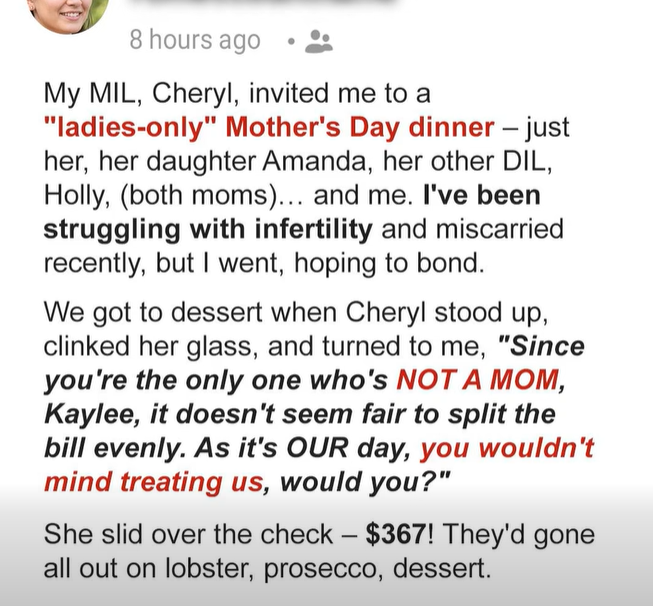
  • On Mother’s Day, my mother-in-law handed me a $367 dinner check and said,

    On Mother’s Day, my mother-in-law handed me a $367 dinner check and said,

    “This is your gift to the real moms at the table.” I smiled, paid my part—and gave her the shock of her life.

    I’m 35 and have been married to Ryan for nearly 10 years.

    After years of miscarriages and fertility treatments, motherhood felt like a dream slipping further away.

    Still, I went to Cheryl’s “ladies-only” Mother’s Day dinner—just me, my MIL, and my two sisters-in-law, both of whom are moms.

    After years of miscarriages and fertility treatments, motherhood felt like a dream slipping further away.

    Still, I went to Cheryl’s “ladies-only” Mother’s Day dinner—just me, my MIL, and my two sisters-in-law, both of whom are moms.