Category: News

  • SOTD – I Married My Late Husband Best Friend, but on Our Wedding Night He Said, There is Something in the Safe You Need to Read

    SOTD – I Married My Late Husband Best Friend, but on Our Wedding Night He Said, There is Something in the Safe You Need to Read

    I’m forty-one, and I feel like I’ve lived two full lives. One with my first husband, Peter — the man I built a family with, the man I thought I’d grow old beside. And the second life, the one I never expected, with the man who stood next to him for decades: his best friend, Dan. I never imagined grief and love would collide this way, but life doesn’t care about tidy endings.

    Peter and I were married for twenty years. Not a dramatic, sweeping love story — just the real kind. The kind that survives burnt dinners, broken appliances, sick kids, long nights, and bills that never stop coming. He was terrible at fixing things around the house but always tried anyway. He made me laugh even when he was exhausted, and he held our family together without ever bragging about it.

    Six years ago, a drunk driver ran a red light and destroyed everything. A police officer said Peter’s name, and the world simply caved in. My daughter locked herself in the bathroom and cried until she passed out. My son retreated into silence. I spent nights in the kitchen staring at his empty coffee mug like it might magically refill itself. Grief turned time into static — soundless, shapeless, relentless.

    Through all of it, Dan was there.

    Dan wasn’t just Peter’s best friend; he was practically part of the family. They grew up three houses apart, hitchhiked to concerts in college, road-tripped across the country, and remained inseparable through marriages, kids, divorces, and stress. Dan had a messy co-parenting arrangement with his ex, but he never complained. He was steady, grounded, and loyal in a way you don’t see often anymore.

    After Peter died, Dan slipped into our lives quietly. He showed up with groceries, fixed the fence without being asked, read bedtime stories to my son when I couldn’t function, taught my daughter how to use a power drill for a school project. He didn’t hover or try to take charge. He just filled the empty spaces so they didn’t swallow us whole.

    Months after the funeral, I told him he didn’t need to keep doing so much. He shrugged and said, “Pete would’ve done it for me,” and went right back to tightening a loose cabinet hinge. That was Dan — always doing, never grandstanding.

    It took three years before anything shifted. It happened on an ordinary night when my kitchen sink started leaking. I called Dan without thinking. He showed up half asleep, hair a mess, toolbox in hand. He cracked a stupid joke from under the sink and I laughed — really laughed — for the first time since losing Peter. Something softened that night, something neither of us said out loud.

    We didn’t rush it. Slow coffee on quiet mornings. Movies when the house felt too empty. Long talks that didn’t feel like work. My daughter was the first to call it out. “Mom, he’s in love with you,” she said with all the bluntness of a teenager. I tried to deny it, but the truth was obvious.

    Eventually, Dan admitted it himself, sitting beside me on the porch at sunset.

    “I’m in love with you,” he said, eyes fixed on the horizon because he was scared to look at me. “I know it’s complicated. I know he was my best friend. If you tell me to step back, I will.”

    I didn’t step back. And loving him didn’t feel like erasing Peter — it felt like learning how to breathe again.

    We told the kids only when we were sure. My daughter hugged him like she’d been waiting for it. My son shook his hand, swallowed hard, and said Peter would want me to be happy. I braced myself for Peter’s mother — the woman who worshipped her son.

    When she came over and saw how nervous I was, she took my hands and said, “You’re with Daniel.” It wasn’t a question. Then she added, “Sweetheart, Peter would thank him for loving you. You’re not betraying anything. You’re surviving.”

    I cried so hard I couldn’t speak.

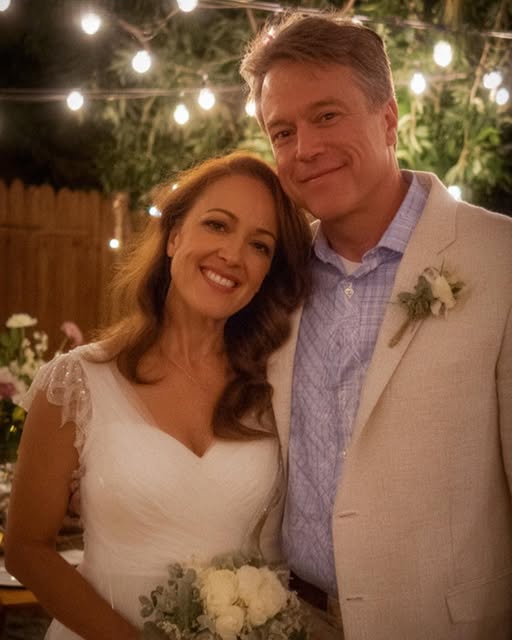
    Dan eventually proposed in the same kitchen where he once fixed my sink at midnight. A simple question. A simple yes. We married in the backyard under string lights while our kids gave speeches that made everyone laugh through tears. It felt peaceful. Right.

    Our wedding night, though, was not soft or simple.

    I walked into the bedroom and found Dan standing in front of the closet safe with the door open. His hands were trembling.

    “Dan?” I asked. “What’s wrong?”

    He pulled out an old, cracked phone — one of Peter’s. He’d found it a few weeks earlier while helping me clear the attic. I hadn’t charged it in years.

    “There’s something in here I need you to see,” he said.

    He opened a text thread. The messages were six, maybe seven years old. At first, it was just the usual banter between best friends — football scores, jokes, memes, random updates. Then I saw the message that made my stomach drop.

    Dan had written: Sometimes I look at what you have and wonder if I’ll ever get that lucky. You and Isabel just work.

    And Peter had responded: Don’t. Promise me you’ll never try anything with her. Ever.

    My chest tightened.

    Dan looked devastated. “I was going through hell back then. My marriage was falling apart. I said something dumb — jealousy, loneliness, whatever it was. And Pete shut it down. I forgot the whole thing existed until I powered this phone on. And I didn’t know how to tell you. I don’t ever want you thinking I took advantage of your grief.”

    He sat heavily on the bed.

    “If you think I crossed a line… if you think I betrayed him… tell me. I’ll walk away. I need you to trust why we’re here.”

    I sat beside him and held his shaking hands.

    “Dan,” I said, “you didn’t steal me. You didn’t wait for anything. You didn’t plan any of this. Life just broke open, and we helped each other survive. Peter didn’t know he’d be gone so young. He didn’t know the future. But if he could see us now — the way you take care of me, the way you love the kids — he’d be grateful.”

    Dan let out a breath like he’d been drowning for weeks.

    We didn’t have a dramatic movie kiss. We held each other quietly, letting guilt and fear drain away until only the truth remained — we weren’t replacing Peter. We were carrying forward what he left behind: loyalty, love, and a life worth continuing.

    That was two months ago. Our life now is steady, warm, imperfect in human ways. The kids are okay. The house feels like a home again.

    Loving Dan doesn’t erase the love I had for Peter. It doesn’t rewrite the past or reduce the grief. It simply means I’m still capable of living. Of growing. Of choosing happiness.

    Peter is part of my story.

    Dan is my next chapter.

    And those two truths can exist side-by-side without breaking me.
  • SOTD – The Perfume I Threw Away Held a Secret I Discovered Too Late

    SOTD – The Perfume I Threw Away Held a Secret I Discovered Too Late

    I bought my husband the watch he’d been dreaming about for years — a sleek, ridiculously expensive piece he’d never buy for himself. It was our 10th anniversary, a milestone I wanted to honor properly. I imagined he’d open it, smile that crooked smile of his, and pull me into one of those hugs that made the entire world feel steady.

    He did smile. He did hug me. And then he handed me my gift — a small plastic bottle of perfume that looked like something from a discount bin at the checkout counter.

    I wish I could say I hid my disappointment, but I didn’t. I forced a smile that even I didn’t believe. Later that night, when he wasn’t looking, I put the bottle in a drawer and shut it with more force than necessary. For days, just seeing it irritated me. I had spent months saving for his gift, and he had picked up something that looked like an afterthought.

    Three weeks later, he died.

    A heart attack — sudden, vicious, no warning. One minute he was teasing me about my terrible singing in the car, and the next he was gone. The world didn’t just crack — it collapsed. The house felt wrong. The bed felt too big. The silence became a physical weight pressing down on my chest.

    Grief does strange things to memory. I found myself replaying our anniversary night over and over, not because of the gift he gave, but because of the way I had acted. The way I had let disappointment take up space where love should have been. I kept thinking about the look in his eyes that night, the tenderness I barely acknowledged. I would’ve given anything to go back to that moment and throw my arms around him and tell him the gift didn’t matter. That he mattered.

    And that’s what hurt the most — all the small things I took for granted. His laugh from the kitchen, his terrible whistling, the way he reminded me to drink water like I was one of the kids he had to keep alive. I would’ve welcomed a cheap perfume every year for the rest of my life if it meant one more morning waking up beside him.

    Months passed. Grief came in waves — unpredictable, sharp, sometimes unbearable. But life doesn’t ask permission before moving forward. Eventually, I found myself doing things I hadn’t touched since the day he died — reorganizing drawers, cleaning shelves, dealing with the clutter that had gone untouched.

    That’s when it happened.

    I was dusting the dresser and accidentally knocked the forgotten perfume bottle onto the floor. It tumbled, hit the hardwood, and the cap popped off. Something tiny — a folded piece of paper — slipped out and landed near my foot.

    For a moment, I froze.

    I didn’t expect anything. Maybe a tag, maybe a price sticker. But when I picked it up, I recognized his handwriting immediately — rushed, messy letters, the kind he used when he was trying to write quickly before he forgot a thought.

    My heart stuttered as I unfolded it.

    “I know this perfume is temporary,” the note began. “But next month I’ll surprise you with the necklace you’ve been dreaming about. Thank you for believing in me even when I don’t say it enough. You are my forever gift.”

    I sank onto the floor, clutching the paper so tightly it shook. The tears came fast — raw, loud, the kind that leave you gasping for air. I pressed the note to my chest, wishing I could fold myself into it, wishing I could reach back through time and tell him I was sorry. That I saw him. That I understood.

    He hadn’t bought me a cheap perfume out of carelessness. He had chosen something small, knowing it wasn’t the real gift, because he was saving for something bigger. Something thoughtful. Something he knew I wanted. The perfume bottle had been a placeholder — and I had thrown it aside without giving him the benefit of the doubt he always gave me.

    He had been planning a surprise.

    He had been thinking ahead.

    He had been loving me in the quiet way he always did — steady, sincere, without showmanship.

    And I had missed it.

    I sat there for a long time, holding that bottle like it was made of gold. The perfume itself didn’t matter — it never had. What mattered was the intention tucked inside it, the message he left without knowing it would become the last gift he ever gave me.

    That night, I put the bottle on my bedside table. Not because I needed a reminder of the mistake I made, but because I needed a reminder of him — his softness, his effort, his heart. The kind of love that works quietly in the background, unnoticed until the silence makes you realize how loud it truly was.

    I sprayed the perfume once. It didn’t smell expensive. It wasn’t remarkable. But it smelled like something he chose for me, something he touched, something he carried home thinking it was just step one of a bigger surprise. And somehow, that made it beautiful.

    Grief teaches you things you don’t want to learn. It teaches you that moments matter more than gifts. That ordinary days are the ones you’ll ache for. That sometimes love is packaged in ways you don’t immediately recognize — unpolished, imperfect, humble.

    I used to think the perfume was cheap. I was wrong. It was priceless, because it held the last words he meant for me to find.

    Now, every night before bed, I touch the bottle lightly, the same way I once touched his shoulder in passing. Not to mourn what I lost, but to honor what I had — a love so genuine that even its simplest gesture carried something deeper than I realized.

    Sometimes the real gift isn’t what’s inside the box. It’s the heart that put it there.

    And sometimes, tragically, we only understand the value of that heart when it’s no longer here to beat beside us.

  • The $200 That Changed Everything!

    The $200 That Changed Everything!

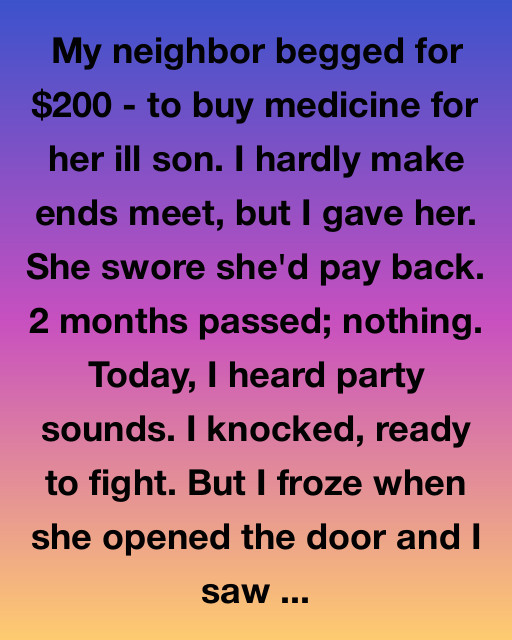
    My neighbor showed up at my door one evening with red eyes and trembling hands, asking if she could borrow $200. Her little boy needed medicine, she said, and she was short. I’m barely making it myself—counting bills, praying my card doesn’t fail at checkout—but I handed her the money anyway. She promised she’d pay me back soon.

    Weeks dragged by. Then months. Nothing. No knock, no envelope, not even a text. Just silence.

    And then, one night, I heard music through our thin apartment walls. Laughter, kids yelling, chairs scraping. A party. My stomach twisted. She couldn’t pay me back, but she could host a celebration? Really?

    I marched over, rehearsing a speech in my head about trust and respect—how people like us can’t afford to get burned. But when she opened the door, flushed and startled, everything I had planned evaporated.

    She stepped aside.

    Her living room was packed with kids. Droopy balloons hung from the walls. A crooked cake sat on the table with shaky icing that read: “WELCOME HOME, CALEB” and underneath, “YOU’RE GOING HOME!”

    It hit me immediately: the frail boy in the corner, smiling, hair growing back in uneven tufts, clutching a paper cup like it was the best night of his life. He’d been in the hospital for months. He’d been fighting cancer.

    Every ounce of anger I carried deflated on the spot.

    The money I’d lent wasn’t a scam. It paid for whatever the insurance didn’t. For meds. For chemo. For keeping her kid alive. The party wasn’t indulgence—it was relief.

    She must’ve seen my face change. “I meant to pay you back,” she said, voice shaking. “I just… every time I saved a little, something else happened. His counts dropped. He needed more treatment. I wasn’t thinking about anything except the next appointment.”

    I had no smart reply. Just guilt and heat crawling up my neck.

    Then Caleb walked over and hugged me like I was family. “Thank you for helping my mom,” he murmured.

    I felt myself shrink to a fraction of my size.

    Later, she knocked on my door again, holding a slice of cake wrapped in foil and a small envelope. “It’s not the full amount,” she said softly. “But it’s something. I’ll bring the rest next week.”

    There were a few bills inside—more than I expected. We ended up sitting together on the shared concrete steps, listening to the muffled sounds of kids playing outside. She admitted she’d stayed away out of shame, afraid to face me while she was drowning.

    Over the following weeks, she made good on the rest in small amounts—twenty here, forty there—always apologizing even though she didn’t need to anymore. By then, the money wasn’t the point. We started talking, really talking. About bills. About exhaustion. About the fear that claws at you when life keeps swinging.

    We learned we were more alike than we realized. Both single parents. Both scraping by. Both held together with stubbornness and caffeine. She cleaned offices at night and grabbed any shift she could on weekends. I worked three jobs and still felt like I was running on fumes.

    Eventually, we began helping each other without thinking twice. I’d watch Caleb when she picked up extra work. When I had leftover soup, I’d bring some over; she’d return my bowl wrapped neatly in a towel. She’d give me rides on mornings my bus pass was empty. She fixed the busted latch on my screen door like it was nothing. She had no money to offer, but she gave effort, kindness, time—all the currency that matters more.

    The building started feeling less like a stack of struggling strangers and more like a shared lifeline.

    Then one quiet night, after Caleb had gone to bed, she stopped by with a nervous look. “I want to start my own cleaning business,” she said. She already had a few regular clients who kept recommending her. “Would you… help me with the website stuff? You’re good with computers.”

    “Good with computers” was a stretch, but I had built a simple food truck site once. Good enough.

    For three weekends we sat hunched over my glitchy laptop, drinking terrible coffee, fighting the spinning loading icons like they were demons. She named the business “Second Chance Cleaning.” “For Caleb,” she said. “For both of us. For anyone who needs a fresh start.”

    We kept her story honest and straightforward on the site. Added photos. A simple booking form. Nothing fancy, but solid.

    At first, the phone barely rang. She hustled anyway. Handing out flyers. Asking for referrals. Showing up early and leaving late. Within a few months, demand exploded. She brought on two other single moms from the complex. They rotated childcare and shifts. Suddenly the building felt… connected. Like a quiet community working behind the scenes to keep each other afloat.

    One client, Mrs. Alvarez, a sharp older widow, noticed the organized scheduling and invoices. “Who handles all your paperwork?” she asked.

    “My neighbor,” she said proudly.

    A week later, Mrs. Alvarez asked me to stop by. “I hear you’re my mystery helper,” she joked. Then she offered me part-time administrative work managing her rentals. It paid more than two of my other jobs combined. I said yes so fast my voice cracked.

    Life didn’t magically turn easy, but it shifted. I could breathe a little. I replaced my dying laptop with a used but reliable one. Caleb got a secondhand bike and rode it like it was made of gold. I fixed the leaky faucet I’d ignored for a year.

    Then a young couple moved in across the street, exhausted and overwhelmed with a newborn. I did for them what my neighbor had done for me—helped where I could. An hour of babysitting. A warm meal. A list of local resources. One night the wife told me, with tired sincerity, “We wouldn’t have made it without you.”

    Funny how these things ripple.

    Nearly a year after I’d loaned her that shaky $200, my neighbor called me, voice trembling with excitement. She’d been nominated for a women-owned business grant—and she’d won. Fifteen thousand dollars.

    She reinvested it into her business: new equipment, better supplies, transportation, extra help. And then she came to my door holding an envelope.

    Inside was a check for $2,000.

    I stared at it, stunned. “You already paid me back,” I said.

    “This isn’t repayment,” she said firmly. “This is partnership. I want you to build simple websites for people like us—people starting from scratch. We can help them get seen. We can help them grow. Together.”

    I didn’t know what to say. That $200 I’d given with shaking hands—wondering if I’d make rent—had come back to me a hundred times over. Not just in cash, but in community. In work. In friendship. In the way my world quietly transformed.

    I almost lost all of it because I assumed the worst.

    Here’s the truth: people disappear for reasons you can’t see. Shame. Fear. Survival. Sometimes what looks like betrayal is just someone barely hanging on.

    Give what you can. Protect yourself, but don’t harden to the point nothing can get through—not help, not grace, not the unexpected things that grow from tiny, shaky acts of kindness.

    Sometimes the return just takes the long way around.

  • SOTD – They were mother and son inside that car they found both dea! See more

    SOTD – They were mother and son inside that car they found both dea! See more

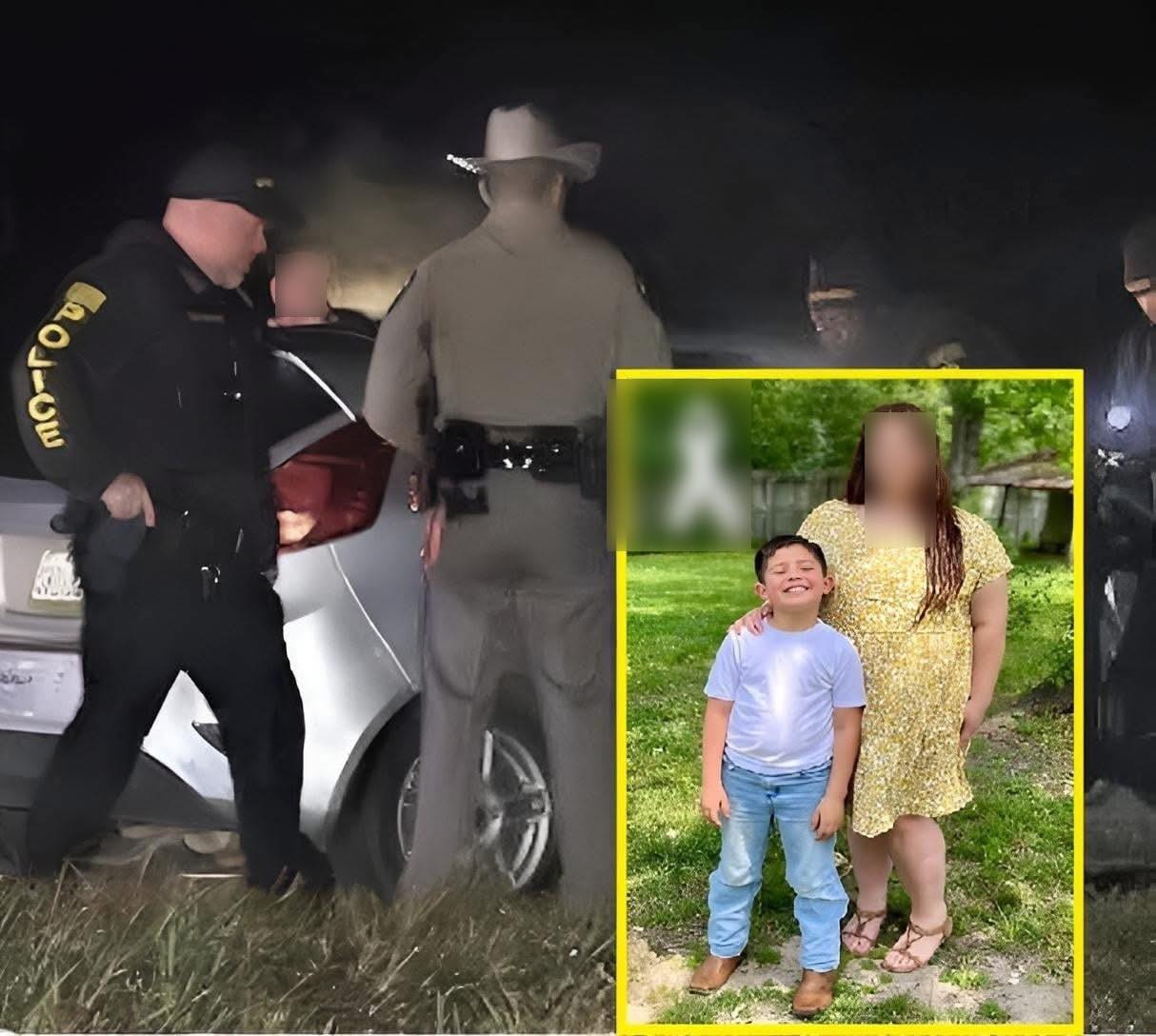
    The news spread quietly at first, the way tragedies often do—soft whispers, a few confused messages, a neighbor saying they’d seen flashing lights down the road. By the time the story reached the rest of the community, the details were already impossible to ignore. A mother and her young son had been found dead inside a parked car. No crime scene tape, no violent struggle, no obvious reason why a normal-looking vehicle sitting beneath a streetlamp could hold something so devastating.

    It started with a passerby—a man walking his dog in the early morning chill. He noticed the car idling in the same spot it had been the night before. Something about the stillness inside struck him. The windows were fogged from the inside, and the silhouettes didn’t move. When he approached, he realized something was horribly wrong. He called the police without hesitation.

    When the authorities arrived, they confirmed the worst. The woman and her son were already gone. The responders worked quickly but with that heavy, quiet professionalism that settles over scenes no one ever wants to witness. The child was still strapped in his seat. The mother’s head rested back against the headrest, her face pale and peaceful, like she had fallen asleep mid-thought.

    At first glance, there were no signs of forced entry or struggle. No weapons. No damage to the car. Nothing that pointed to a violent act. It wasn’t the kind of scene that screamed danger—just heartbreak. Investigators taped off the area, interviewed the neighbors who gathered with blankets wrapped around their shoulders, and began piecing together the fragments of the family’s final hours.

    People from nearby homes stood outside, whispering to each other, trying to make sense of what they were seeing. Some recognized the car right away. It belonged to a woman who lived only a few blocks away. She was a single mother, young and exhausted-looking, but always polite. Always present at school events. Always walking her son to the bus stop with his hand in hers.

    Neighbors later told police that she had been struggling for a while. Not one big dramatic problem—just the grinding accumulation of stress, bills, mental strain, and emotional weight that so many carry but don’t know how to share. Some had noticed she seemed more withdrawn lately. Others mentioned she had been out of work and bouncing between temporary jobs. A few recalled seeing her crying in her car more than once but didn’t know how to approach her. They didn’t want to intrude. They didn’t want to embarrass her. And so, like people often do, they said nothing and hoped she was okay.

    Those close to her—friends, relatives, coworkers—described her as a dedicated mother. She adored her son. They were inseparable, always seen walking together, always laughing at something only the two of them understood. He was a bright kid with a wide grin, the kind who waved at neighbors and offered shy hellos. She was the kind of mom who showed up tired but determined, doing everything she could to give him a stable life.

    The suddenness of their loss hit the community with a shock that didn’t fade after a day or two. It lingered. People kept replaying the what-if scenarios in their heads. What if someone had checked on her sooner? What if she had reached out? What if someone had noticed the signs and stepped in? The tragedy exposed the invisible battles she had been fighting—battles plenty of others fight in silence every day.

    Authorities ordered autopsies for both mother and child. They needed answers, not speculation. While early indications pointed away from foul play, investigators refused to rule out possibilities until the medical examiners completed their work. There were murmurs about carbon monoxide poisoning. Others wondered if it was a medical emergency, one that incapacitated the mother first and left the child helpless. The waiting for official results only deepened the community’s sense of helplessness.

    Within hours of the news spreading, the place where the car had been found transformed into a small memorial. Candles lined the sidewalk. Flowers piled up against the trunk of a nearby tree. Stuffed animals—little bears, soft rabbits, plastic action figures—appeared as neighbors struggled to find a way to honor the boy who used to wave at them from across the street. Some people wrote notes and tucked them under the candles: “Rest in peace.” “You were loved.” “We’re sorry we didn’t see your pain.” Others stood quietly with bowed heads, thinking of their own children or their own struggles, wondering how many silent battles they had missed in the people around them.

    The more people shared memories, the clearer the picture became. The mother wasn’t careless. She wasn’t indifferent. She was overwhelmed—drowning under the weight of responsibilities, fear, loneliness, and whatever private demons she never felt safe enough to talk about. And her son, innocent and trusting, stayed by her side until the very end.

    As the days passed, conversations shifted from shock to reflection. Residents began checking on each other more often—knocking on doors, asking real questions, paying attention to the quiet ones who usually kept to themselves. The tragedy served as a stark reminder that pain doesn’t always announce itself. Sometimes it hides behind a forced smile or a curt wave. Sometimes it sits in a parked car on a quiet street while the world passes by.

    Investigators continued working, determined to uncover every detail that might explain what happened. Friends and family cooperated, sharing messages, phone logs, and whatever small clues they had. They wanted the truth, even if it hurt. They wanted to make sure nothing like this happened again—to her, to her son, or to any family like theirs.

    While they waited for answers, the community leaned on each other. A local church organized a fundraiser to help cover funeral costs. Neighbors delivered meals to the relatives who arrived from out of town. A support group formed almost overnight for parents struggling with depression, anxiety, or financial stress—people afraid of slipping through cracks the way she had.

    Slowly, the focus shifted from the horror of the discovery to the humanity of the lives lost. The mother was remembered not by the tragic way she died but by the way she lived—loving her son fiercely, doing everything she could with what she had, and pushing forward even when the world felt unbearably heavy. The boy was remembered for his warmth, his curiosity, and the simple joy he brought to everyone around him.

    Their deaths left a wound in the community, but also a lesson that people carried with them long after the headlines faded: reach out, ask the uncomfortable questions, check on the quiet ones, and never assume that someone is fine just because they say they are. Behind closed doors, behind polite smiles, behind a parked car on a lonely street, people fight battles that can’t be seen.

    May they both rest in peace. And may their story remind us to look out for one another with more patience, more compassion, and more courage than before.

  • Bikers Took My Disabled Sons To Disney After Other Parents Said We Did Ruin Everyones Day!

    Bikers Took My Disabled Sons To Disney After Other Parents Said We Did Ruin Everyones Day!

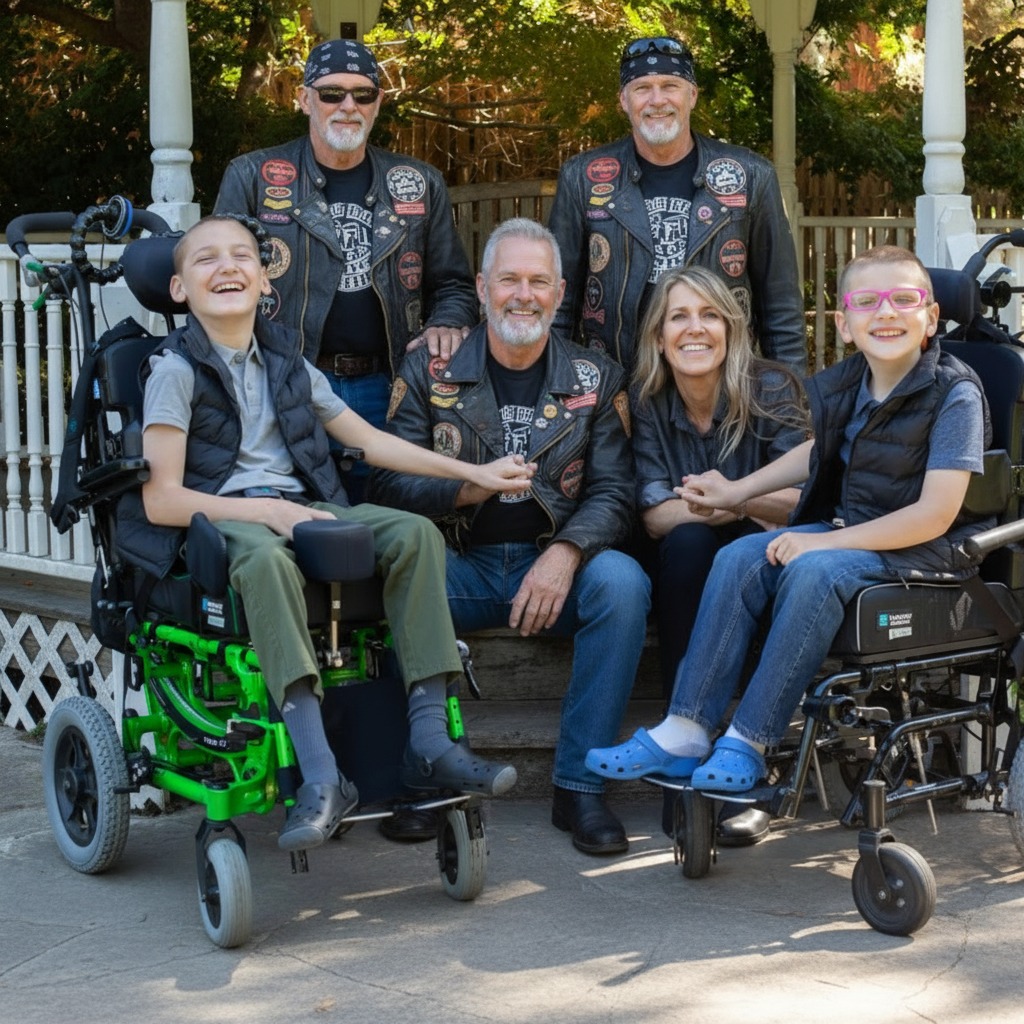
    Lucas and Mason had been dreaming about Adventure World for two years. Two years of watching friends post photos, two years of listening to classmates talk about rides and fireworks while my boys sat quietly in their wheelchairs, pretending it didn’t bother them. I’d saved every spare dollar—skipping coffee, selling old clothes, couponing everything—because I wanted them to have one perfect day. When I finally bought the tickets, arranged the accessible transport, and circled Saturday, October 14th on the calendar, they started counting down like it was Christmas.

    Lucas, eleven, has cerebral palsy. Every morning, he practiced his smile in the mirror. “I want to look happy in the pictures, Mom.” Mason, nine, has muscular dystrophy. He made a list of every ride he wanted to try, including the ones he knew he’d only be able to watch from the sidelines. “Watching is still fun,” he said, though I knew he was trying to protect me from feeling guilty.

    The night before our trip, I posted in a local parents’ Facebook group asking if anyone else was going. I thought maybe the boys could meet some kids their age. Instead, the responses were a punch to the gut.

    “Please reconsider. Wheelchairs slow down the lines.”

    “My daughter’s birthday party is that day. This will upset her.”

    “Not trying to be rude, but special-needs kids should pick special-needs days.”

    One woman privately messaged me: “My son is afraid of wheelchairs. Can you choose a different weekend?”

    I read the messages alone in the bathroom, gripping the counter while tears blurred my vision. I showed them to my husband David. He slammed his fist into the bedroom wall, then sat on the bed and cried with his face in his hands. We had no idea how to tell our sons that other parents thought they’d ruin everyone’s day.

    So we didn’t. We lied. Told the boys the park closed unexpectedly for maintenance. Lucas’s face fell. Mason rolled quietly into his room and shut the door. I could hear muffled crying through the wall.

    That’s when David did something desperate. He called Tommy, a friend he hadn’t spoken to since high school. Tommy was part of a motorcycle club—big men, leather vests, loud bikes, and soft hearts. They raised money for hospitals and did charity rides, but we barely knew him anymore. Still, David called.

    “I need help,” he said. “My boys… they just wanted one good day.”

    Whatever Tommy said back broke David completely. He cried harder but managed to whisper, “Thank you.”

    Three hours later, three motorcycles rumbled into our driveway. Tommy climbed off first. Behind him were Bear—aptly named—and Marcus, a man with kind eyes behind a rough exterior. They were the type of men the Facebook parents would’ve fled from on sight.

    Tommy went straight to the window where Lucas and Mason were watching. “Hey boys,” he said, smiling. “Your dad says you’re ready for Adventure World.”

    “Our mom said it’s closed,” Lucas answered.

    Tommy glanced at me. “It’s not closed. And we’re all going. If anyone has a problem with your wheelchairs, they’ll have to deal with us.”

    Bear knelt beside Mason. “You know what’s cool about theme parks?” he said. “The best view is from wheelchair height. Trust me.”

    Marcus showed Lucas a picture of his daughter Emma. “She’s in a wheelchair too. She loves Adventure World. Says they treat ‘kids with wheels’ like VIPs.”

    Lucas grinned. “Kids with wheels. I like that.”

    We loaded the boys’ chairs into our van. The bikers rode ahead of us, roaring through every intersection like an honor guard. At red lights, Tommy would turn around and give the boys a thumbs-up. They loved it.

    At the entrance, people stared. A family with two disabled kids flanked by three bikers looked like a walking stereotype waiting to be misjudged. Tommy paid for everyone before we could argue. “Let us do this,” he said. “Your boys deserve it.”

    The first test came at the carousel. A mother, loud enough to be heard, muttered, “This is why we should’ve gone somewhere else today.”

    Bear walked over—calm, towering, impossible to ignore. The woman shrank back, clutching her kids. But Bear just smiled gently.

    “Ma’am, this young man is Lucas. He’s been waiting two years for this day. Your kids are lovely. They’re welcome to ride next to him.”

    Her daughter stepped forward. “Mommy, can I? His wheelchair is green!” And just like that, the ice cracked. The kids rode together, laughing, and when the ride ended, the little girl hugged Lucas.

    When Mason wanted to ride the spinning teacups, the teenage operator hesitated. “I’m not sure if—”

    Marcus cut in smoothly. “I’m a physical therapist. I’ll help him transfer safely.” (He wasn’t. He fixed motorcycles. But he carried Mason like he was carrying his own child.) Tommy rode with Mason, keeping him steady. Mason laughed so hard he nearly hiccuped.

    At lunch, people gawked, but not at the wheelchairs—at the bikers. A security guard even approached. “We’ve had complaints—”

    “About what?” Bear asked. His voice wasn’t threatening, just steady. The guard looked at Lucas and Mason, covered in ketchup and smiling from ear to ear, and backed off immediately. “Enjoy your day,” he said.

    The moment that shattered me came at the log flume. Mason’s wheelchair couldn’t go up the long ramp, and he couldn’t climb the steps. He whispered, “I’ll wait here. It’s okay.” But it wasn’t okay. Not for any of us.

    Bear scooped Mason up without hesitation. “You’re riding this, buddy.” He carried him up every step, other guests stepping aside, some applauding quietly, some wiping their eyes. Mason wrapped his arms around Bear’s neck and murmured thank-yous over and over.

    They rode the flume together. The splash at the bottom sent Mason into hysterical giggles. The souvenir photo showed Bear holding him securely, both of them drenched, both laughing like they’d found treasure. Bear bought five copies.

    By sunset, the boys were exhausted and glowing. They’d ridden more rides in one day than they’d had in the last two years. When we reached the parking lot, a woman approached. A mother from the Facebook group. One of the ones who had told us to stay home.

    “I was wrong,” she said quietly. “Your boys have every right to be here. I’m sorry.”

    Before I could respond, Tommy stepped beside me. “Ma’am, these boys don’t just have a right to be here—they earned this joy. They fight battles every single day other kids never have to think about.”

    She nodded and walked away, humbled.

    On the drive home, both boys fell asleep clutching their souvenirs. Lucas whispered before dozing off, “Mom… today was my best day ever.”

    That night, Tommy texted: “Next month—water park. Already arranged accessible options. We’re not done.”

    And he meant it. His motorcycle club turned that one day into a mission. They started “Wheels and Wings,” monthly theme park trips for children with disabilities. Forty-seven bikers now volunteer.

    A week later, Lucas asked Tommy, “Can I be a biker too someday? Even in a wheelchair?”

    Tommy ruffled his hair. “Kid, you already are. The vest is the least important part.”

    They’re giving Lucas his own vest next month—“Rolling Guardian” embroidered on the back. Mason’s designing patches for his.

    Those three bikers didn’t just take my sons to a theme park. They carved out a space in the world where my boys felt powerful, welcome, and seen. A world they deserve just as much as anyone else.

    My sons didn’t ruin anyone’s day.

    They made it unforgettable.

  • The Courtroom Collapse! Charlie Kirk Shooter Receives Death Sentence

    The Courtroom Collapse! Charlie Kirk Shooter Receives Death Sentence

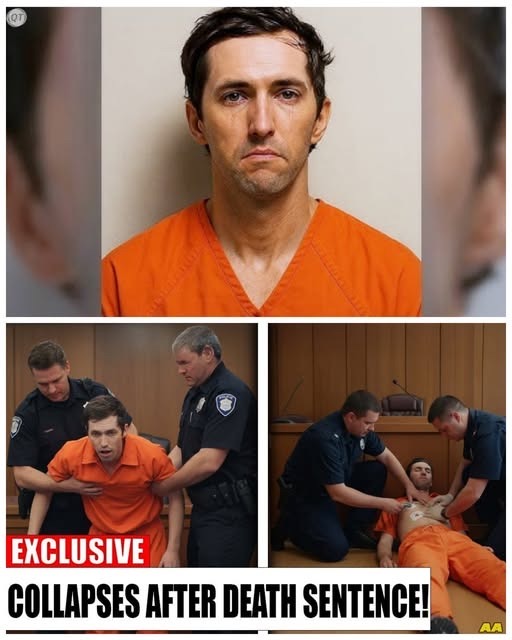
    The courtroom felt colder than usual that morning — not because of the air conditioning, but because every person inside carried a quiet dread that settled deep in their bones. Even the walls seemed to hold their breath as the final minutes of the trial ticked toward an ending no one could soften or delay.

    At the center of the room stood the defendant, the man whose case had dominated headlines and torn a community down the middle. Throughout the trial he’d carried himself with a strange mixture of defiance and denial, as if refusing to acknowledge what everyone else already accepted. But as the judge prepared to read the verdict, that veneer cracked. His posture stiffened. His fingers twitched. His jaw clenched in tiny spasms he couldn’t control.

    And then the words landed.

    “Death sentence.”

    The judge said it plainly, but the impact hit like a hammer. The words echoed through the courtroom, heavy and final, leaving no room for interpretation or hope. For a heartbeat, the man just stood there, staring at the judge as if the sentence were a language he didn’t understand. Then reality slammed into him all at once. His knees buckled, his breath hitched, and he collapsed to the floor.

    Gasps tore through the room. Spectators jerked upright in their seats. Even some members of the jury flinched, shaken by the rawness of the moment. For months they’d seen him as a headline, a defendant, a symbol of violence and consequence. But as he lay on the cold floor, trembling under the weight of his fate, he became something else entirely — a human being confronting the irreversible.

    The fall looked almost surreal, like something out of a tragic play. A man who’d once radiated control was suddenly stripped to nothing but fear and fragility. The tension in the room deepened, stretching taut across every face, every breath, every inch of air.

    For the first time in the entire trial, the courtroom felt painfully intimate.

    Those closest to the front could see the confusion and shock flooding his expression. His eyes darted around as if looking for an exit that no longer existed. His hands shook uncontrollably. He looked smaller now, not physically, but in the way a person shrinks when they understand a truth too heavy to bear.

    Inside his mind, thoughts collided in a frantic storm — regret, terror, disbelief, memories he’d spent months trying to bury. The verdict forced him to confront the darkest corners of his own actions, the fallout, the consequences, and the finality of the road he had chosen.

    The judge, usually unreadable, hesitated before continuing. Even he seemed caught by the emotional gravity of what had just unfolded. Not pity — judges rarely allow themselves that — but a quiet recognition of the human weight behind the legal process.

    One juror later described the moment as “the first time the courtroom stopped being about law and became about life.” Another said she could feel the verdict physically, as if its finality settled on everyone, not just the man on the floor.

    Psychologists often talk about the shock of a death sentence. The human mind struggles to reconcile the idea of a future that ends by decree. Even people who expect such a sentence rarely process it until the words are spoken aloud. The body reacts before the mind does — shaking, collapsing, losing control. It’s a primal response to an unimaginable reality.

    That was exactly what played out on the courtroom floor.

    And around him, people couldn’t look away. Some watched in anger, believing the punishment justified. Others watched in discomfort, confronted with the emotional wreckage of a man whose choices had destroyed lives — including his own. But everyone understood they were witnessing something far more complicated than a line in a news article.

    The courtroom became a stage for every conflicting emotion imaginable — justice, sorrow, consequence, fear. Not sympathy for the defendant, but an acknowledgment that tragedies ripple outward. No crime is a single moment. No verdict affects only one person. Families of victims and families of offenders all carry scars, all face futures they did not choose.

    As he lay there, trying to swallow the truth of what had just happened, the silence felt suffocating. It wasn’t the silence of peace, but the silence that comes when everyone recognizes the finality of a moment. A silence that said: This is the end. There is no appeal to the past, no undoing, no escape.

    Court officers approached cautiously, unsure if he would faint, lash out, or simply crumble further. But he didn’t resist. He didn’t speak. He just lay on the floor, chest rising in shallow, panicked breaths. He looked like a man watching everything he’d ever known fall away in real time.

    Observers whispered later that it was the first time they’d seen true fear on his face. Not the fear of being caught, or the fear of losing a case — but the fear of mortality itself. The fear of the one outcome no human being can negotiate or bargain with.

    In that moment, the courtroom became a mirror — forcing everyone to look at the uncomfortable intersection of justice and humanity. Justice demands accountability. But humanity reminds us that even the condemned are still people, shaped by choices and failures, capable of breaking, capable of fear.

    Nothing about the scene excused what he had done. Nothing softened the consequences. But for the people watching, the collapse offered a stark reminder of the psychological weight of final judgment — the way guilt, fear, and consequence collide in a person’s mind when every possibility ahead ends in one unyielding truth.

    Eventually, officers lifted him to his feet, still trembling, still dazed. The room remained silent as he was escorted out — no cheers, no jeers, no triumph. Just the quiet understanding that they had all witnessed the moment a human being was forced to confront the end of his own story.

    Long after the trial ended, people kept replaying the scene in their minds — the collapse, the silence, the sheer emotional force of that verdict. Not out of sympathy, but because it revealed a truth that law textbooks and news reports never capture.

    Behind every verdict is a human being facing the consequences of choices that cannot be undone.

    Behind every headline is a life shattered long before the gavel falls.

    And inside that courtroom, for a brief moment, justice and human vulnerability stood side by side — uncompromising, undeniable, unforgettable.

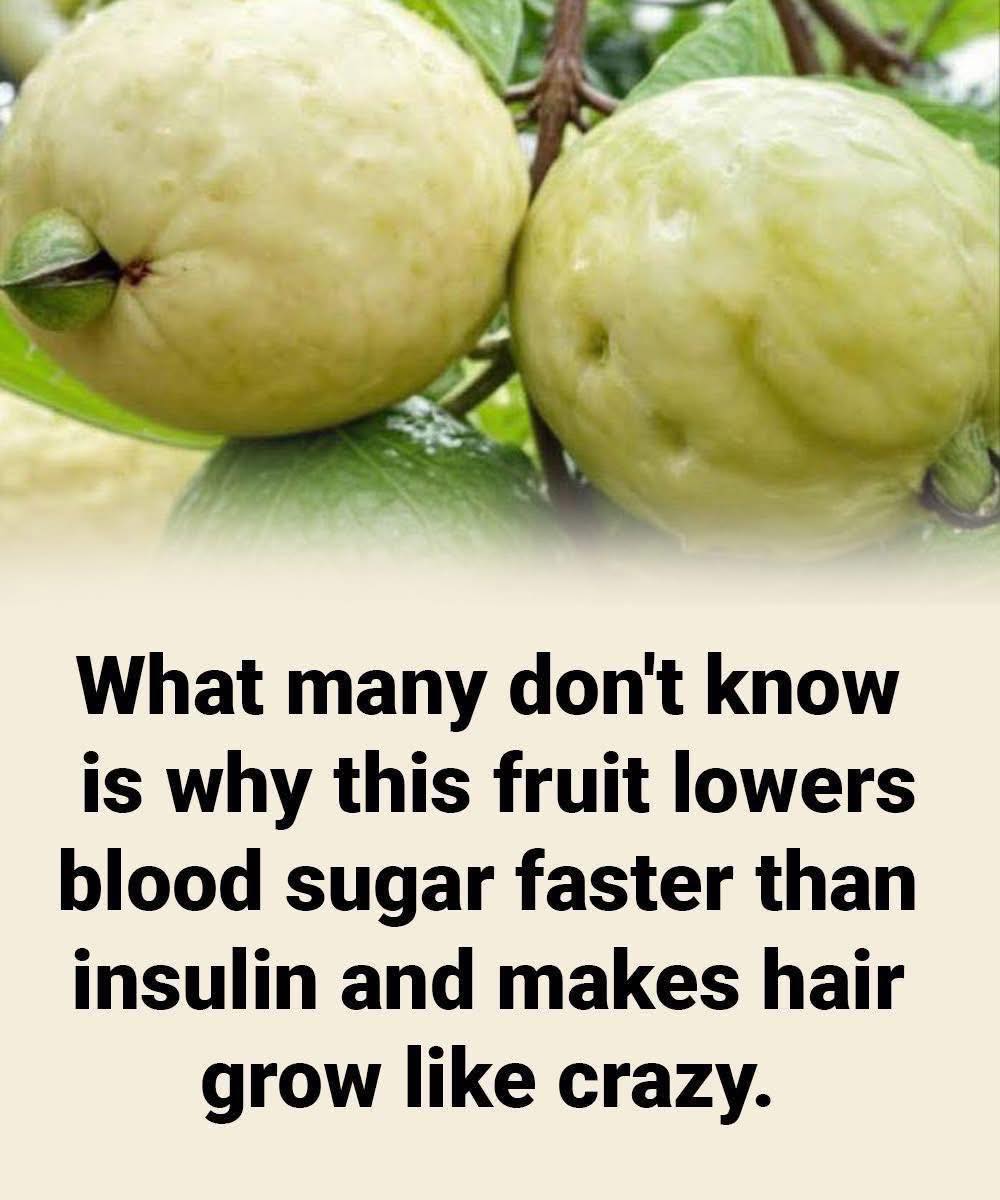
  • Discover the power of this miracle fruit to lower blood sugar!

    Discover the power of this miracle fruit to lower blood sugar!

    Guava might look like just another tropical fruit you pass over in the grocery store, but behind its rough skin and sweet aroma is a surprising nutritional profile that makes it one of the more underrated allies for people trying to manage their blood sugar. Whether you’re already living with diabetes, trying to reduce your risk, or simply aiming to eat in a way that keeps your energy steady instead of spiking and crashing, guava deserves a spot in the rotation.

    People have eaten guava for centuries — in street markets, home gardens, or straight off the tree — long before anyone talked about glycemic index charts. But modern research is beginning to explain why traditional cultures valued this fruit so highly for wellness, digestion, and blood sugar control. It isn’t a miracle cure, and it won’t replace medication or medical treatment, but it can support a healthier metabolic rhythm when used intelligently.

    One of the biggest advantages guava offers is its naturally low glycemic index. Foods with a lower GI are digested and absorbed more slowly, meaning they don’t dump sugar into the bloodstream all at once. Instead, they release energy at a steady pace. For someone trying to keep blood sugar spikes under control, that matters. A fruit that satisfies a sweet craving without unleashing a glucose roller coaster is a win.

    But the real star here isn’t just the GI — it’s the fiber. Guava is loaded with dietary fiber, especially soluble fiber, the kind that forms a gel-like substance when mixed with water. This gel slows digestion, slows sugar absorption, and gives the body time to handle glucose in smaller, more manageable amounts. This effect can help soften the blood sugar surge that usually follows a meal. Anyone trying to balance glucose levels knows how important that is.

    Fiber doesn’t just help with blood sugar, though. It improves gut health, promotes smoother digestion, and keeps you fuller for longer. That feeling of fullness may prevent overeating or reaching for sugary snacks later in the day. Weight management is a major factor in diabetes prevention and control, so a fruit that fills you up without loading you with empty calories is a strategic choice.

    Beyond fiber, guava brings a strong lineup of micronutrients and antioxidants to the table. It’s one of the richest natural sources of vitamin C, outranking even oranges. Vitamin C plays a role in reducing inflammation — something often elevated in people with metabolic disorders. Potassium supports proper nerve function and helps maintain fluid balance, which is especially important for people monitoring blood pressure along with blood sugar. Then there are the flavonoids, such as quercetin, which researchers are studying for their potential influence on insulin sensitivity.

    In short, guava isn’t just sweet — it’s stacked.

    Interestingly, many traditional medicines use not only the fruit but also the leaves. Guava leaf tea is still a common remedy in parts of Asia, Latin America, and Africa. Studies suggest these leaves may help lower post-meal glucose levels by inhibiting certain enzymes that convert carbohydrates into glucose. Slowing that conversion gives insulin a fighting chance, especially after carb-heavy meals. Some people drink guava leaf tea daily; others use it occasionally, especially after eating something they know their body handles poorly. The tea isn’t a replacement for medical care, but it’s an example of a traditional practice getting modern scientific attention.

    If you want to incorporate guava into your diet for better blood sugar stability, the most straightforward method is to eat the whole fruit. Choose ripe guavas, wash them well, and eat them with the skin on if you’re sure they’re pesticide-free — the skin contains extra fiber and nutrients. The seeds are edible too, though some people prefer to chew them lightly or blend them into smoothies.

    Juices and canned guavas should be approached with caution. Many commercial guava juices are packed with added sugar, and the canning process often includes syrup that turns a healthy fruit into a glucose bomb. Stick to fresh, whole guava whenever possible. If you enjoy tea, boiling dried or fresh guava leaves for about ten minutes makes a mild, earthy drink that some people find helpful after meals.

    Portion control still matters. Natural sugar is still sugar. One guava or a small handful of guava slices is enough to gain the benefits without overloading your system. As with any food, balance is key.

    Even though guava has a lot going for it, it should not be mistaken for a substitute for medication, blood sugar monitoring, or medical advice. Think of it as part of a toolbox — not the whole toolbox. Diet, physical activity, sleep, stress management, hydration, and medical care all weave together to keep blood sugar stable. Guava is one thread in that larger pattern.

    What makes guava stand out is that it’s practical, affordable in many regions, and easy to use. It requires no complicated preparation, no expensive supplements, and no extreme dietary shifts. It’s a fruit you can toss into your bag, slice into a salad, blend into a smoothie, or enjoy on its own. For people trying to make sustainable changes, simplicity matters.

    There’s a psychological aspect too. Managing blood sugar often involves cutting back — less sugar, fewer carbs, fewer processed snacks. It can feel restrictive. Guava, on the other hand, feels like a “yes” food. Sweet, satisfying, nutritionally dense — but still gentle on blood sugar. It lets people enjoy something delicious while staying aligned with their health goals. That sense of permission can make a big difference in long-term consistency.

    And consistency, more than anything else, is what moves the needle on metabolic health.

    In a world full of overhyped superfoods and miracle claims, guava stands out for a simple reason: it doesn’t need exaggeration. The data, the tradition, and the lived experience all point in the same direction. It’s a fruit that supports digestion, stabilizes energy, offers valuable nutrients, and plays well with blood sugar. No flashy marketing required.

    If you’ve walked past guavas at the market without giving them a second thought, it might be time to take another look. Whether you eat them fresh, brew the leaves into tea, or fold them into a larger healthy eating plan, guavas offer benefits that are both practical and meaningful. They won’t cure anything on their own, but they can help your body maintain steadier glucose rhythms — and sometimes, that quiet, steady support is exactly what the body needs.

    Guava won’t change your life overnight. But used consistently, it might help your body feel a little more balanced, a little more grounded, and a little more in control — one bite at a time.

  • Breaking – The Vatican shakes! It came to light the se!

    Breaking – The Vatican shakes! It came to light the se!

    At first, the whispers drifting through Rome sounded like every other piece of Vatican gossip — vague, implausible, and easy to dismiss. Nothing in the Holy City stays quiet for long, but most rumors die before they even reach the gates of St. Peter’s. This one didn’t.

    By the time morning mass bells rang across the cobblestones, the tone inside the Vatican had shifted. Something old, hidden, and heavy had been disturbed. Officials walked faster in the corridors. Doors were shut more firmly. The small city-state pulsed with a tension no one wanted to name.

    The discovery hadn’t happened in a chapel or library. It began in the sub-basement of the Apostolic Archive, a section closed to nearly everyone. Most Catholics don’t even know it exists. It’s a vault built in the 19th century, reinforced to protect documents from fire, flood, and war. A restoration crew had been brought in to repair humidity damage in a forgotten corridor. Under dim work lights, while chiseling out soft, crumbling plaster, they accidentally broke through a sealed partition.

    Behind it lay a narrow stone passage leading to a chamber no living archivist had ever seen.

    It was smaller than a monk’s sleeping cell — rough walls, an arched ceiling, dust so thick it softened the air like fog. In the center stood a pedestal, and on it, a wooden chest sealed with wax and secured by three iron locks. The hinges were frozen with rust. The restorers froze too, suddenly aware they had found something not meant to be found casually in a construction shift.

    Father Lorenzo Moretti, the archivist supervising the renovations, was summoned immediately. He studied the chest for a long moment, then quietly requested authorization to open it. Permission was granted before midnight. The locks were cut. The lid groaned open.

    Inside were hundreds of sheets of vellum bound with cord, each marked with the papal seal of 1484.

    That date set every alarm bell ringing.

    1484 was the year Pope Innocent VIII issued a decree that ignited the Inquisition’s pursuit of witchcraft across Europe. But these documents weren’t drafts of that decree. They were something stranger — a mix of early drafts, personal letters, astronomical notes, and fragments of correspondence between the pope, a group of scholars in Bologna, and a Dominican mathematician whose name had been violently erased from every surviving reference.

    The letters hinted at ideas the Church of the time would have deemed dangerous. They referenced “a sign in the heavens,” “the trembling of the firmament,” and “truths too vast for doctrine.”

    Before dawn, the chest and all documents were removed under strict secrecy. But nothing inside Vatican walls stays perfectly sealed. Someone with access digitized portions of the letters and leaked them. Within days, they reached people who recognized their value — or their explosive potential.

    The first journalist to receive the files was Sofia Rinaldi, a veteran Vatican correspondent. “I assumed it was a prank,” she said later. “The language, the script, the tone — it all felt too dramatic. But when I showed them to a medievalist friend, he went pale. He said, ‘If these are authentic, they change entire assumptions about how the Church saw the cosmos.’”

    Preliminary translations painted a picture that was part history, part mystery. They described a celestial phenomenon seen in the winter of 1483 — a flare or burst of light visible across southern Europe for three nights. The unnamed Dominican mathematician, referred to only as “The Friar,” claimed to have charted its movement. According to him, the phenomenon matched the location of the star described in the Gospel of Matthew — the one said to guide the Magi.

    He called it Signum Revertens — the Returning Sign.

    The implication was bold: the same star, or something like it, had appeared again.

    The correspondence between the pope and the mathematician escalated quickly. Early letters carried curiosity. Later ones showed fear. In one message, the pope wrote: “If what you observe is true, then the heavens repeat themselves, and our authority must shift to meet them.” The Friar responded: “Not shift, Holy Father — align.”

    Whether the letters described a natural event, a misinterpretation, or something else entirely, their authenticity was hard to dismiss. The ink composition matched known samples from the era. The vellum dated correctly. Linguists recognized the chancery style.

    When excerpts leaked, Vatican Press issued a measured response, calling the documents “not verified.” Behind the scenes, cardinals debated strategy, archivists were silenced, and media inquiries were stonewalled.

    Meanwhile, amateur astronomers dove into historical sky records. They found independent accounts of an unusual luminous object recorded in 1483 — possibly a supernova or bright transient. Theories multiplied. Some claimed the Church had suppressed knowledge of recurring celestial events. Others insisted the letters meant nothing except that medieval scholars misunderstood astronomy. Conspiracy forums had a field day.

    Inside Vatican offices, tension simmered. A few insiders argued that the leak was engineered to embarrass the Church. Others acknowledged, privately, that the documents raised questions worth examining. A Jesuit astronomer — anonymously — said, “If these letters are genuine, they reveal that the Church has long struggled not with science, but with the implications of cosmic scale. The stars challenge certainty.”

    The Pope quietly convened a closed symposium at Castel Gandolfo with historians, theologians, and astrophysicists. Nothing from those sessions reached the public, but rumors described heated debates. One attendee was overheard saying, “We spent an entire night asking whether revelation ended two thousand years ago — or whether the universe still speaks.”

    Within weeks, the chamber in the archives was sealed again. The chest was locked away under a classification code no one outside the Curia recognized.

    Officially, the Church said further analysis was underway. Unofficially, those who had handled the documents described a strange shift in the Vatican’s atmosphere, as if centuries-old walls had absorbed the weight of the discovery. “It felt like the building itself was listening,” one archivist said.

    Astronomers tracking long-term patterns have since detected a faint, recurring flare in the same sector of the sky described in the Friar’s letters. They informally named it SN-Revertens, a nod to the term used in the correspondence. The Vatican has not acknowledged the coincidence.

    Whether the letters are authentic, misinterpreted, or deliberate forgeries, they’ve sparked something unexpected: curiosity. People who hadn’t looked up at the night sky in years were suddenly searching constellations, reading history, and asking questions.

    In the piazza outside St. Peter’s, groups gather after sunset, pointing toward the horizon where Draco coils above the rooftops. Tourists assume it’s just stargazing. Locals sense it’s something deeper.

    “The Vatican shakes,” an elderly priest said quietly one night as he watched the sky with them. “Not from fear, but because truth — whatever form it takes — always stirs the foundation.”

  • The Gift My Grandma Prepared When No One Was Listening!

    The Gift My Grandma Prepared When No One Was Listening!

    Some moments arrive so quietly you barely notice them. Nothing dramatic, nothing alarming — just a small ripple in an ordinary week. That’s exactly how it began the day my 68-year-old grandmother sent a simple message in our family group chat. It wasn’t the kind of plea that stops your heart. She didn’t write with urgency or desperation. Instead, she asked softly if anyone could spare a little money. No explanation, no pressure, just a polite request tucked between photos of someone’s lunch and reminders about a cousin’s birthday.

    Most relatives didn’t respond. Not because they didn’t care, but because life gets loud. People were working, driving, cooking, handling kids. The message sat there, swallowed by the scrolling feed of everyday noise. But it stuck with me. It lingered in the back of my mind in a way I couldn’t shake.

    Two days later, I sent her the small amount she’d asked for. Nothing big — an amount anyone could overlook without thinking twice. I texted her that I hoped she was okay. She sent back a short thank-you, warm as always, but quick. At the time, I didn’t think much of it. I just felt relieved I’d finally helped her.

    That night, she passed away in her sleep.

    The news hit like a blunt force. Every family death is heavy, but this one pressed on me in a strange way. While everyone else was mourning and piecing together what happened, something deeper gnawed at me: why had she needed the money? Why had she asked so quietly, almost embarrassed to even mention it? And why hadn’t any of us noticed something was off?

    A few days later, needing answers I couldn’t shake loose from my thoughts, I drove to her house. The front door still gave that familiar, high-pitched creak she never bothered to fix. The curtains were partly open, sunlight stretching across her living room the same way it always had. But the silence — that was new. Silence had weight now.

    I walked into her kitchen, and that’s where I found the truth waiting for me.

    On the table sat a few small groceries — bread, fruit, a carton of milk — arranged neatly the way she always placed things after shopping. Next to them sat a gift bag. Pale yellow, simple, with a ribbon she must have tied with trembling fingers. My name was written on the front in her careful, slanted handwriting.

    For a moment, I couldn’t move. I just stood there, staring at the bag, understanding and not understanding all at once. When I finally reached for it, my hands shook.

    Inside was a scarf. Soft, warm, hand-knitted with two different shades of blue — colors she knew I loved. She’d always knitted slowly, patiently, humming as she worked. I pressed it to my face, breathing in the faint smell of her house: lavender soap and the old cedar chest in her bedroom. Wrapped around the scarf was a note folded neatly in half.

    Her handwriting wavered more than it used to. Age had softened her lines, but the words were unmistakably hers.

    She thanked me for checking on her often, even when I was busy. She wrote that she knew everyone had their own problems and their own lives, and she never wanted to be “too much,” never wanted to inconvenience anyone. She said she’d only needed “a little help” to finish a surprise she had been making for me. She told me that winter was coming, and she hoped this scarf would keep me warm the way her hugs used to.

    I sat down on her couch and cried — not the loud kind, but the quiet, gut-deep kind that comes when you realize you missed something important. I kept thinking about that message she’d sent. That soft, polite request she didn’t want to repeat. And how none of us had asked her why.

    My grandmother had spent her entire life giving. She gave without fanfare, without expecting anything in return, without making grand gestures. Her love was expressed in small things — warm meals, gentle reminders, a hand on your shoulder when you were struggling. She wasn’t one to ask for help, not because she didn’t need it, but because she’d been raised to carry her burdens quietly.

    As I sat in her empty house, scarf against my chest, I realized the truth: even when she needed something, she was thinking of someone else. Even in her last days, when she must have felt tired or unwell, she wasn’t worried about herself. She was finishing a gift for me. She wanted to leave something behind that I could hold, something that carried her warmth long after she was gone.

    Her final act wasn’t about the money. It wasn’t about need. It was about love — the quiet, steady love she’d shown every day of her life.

    I thought about how often we overlook the people who speak gently. How easy it is to assume they’re fine because they’re not loud about their struggles. We forget that the softest voices are often the ones carrying the heaviest loads. We forget to check in, to pay attention, to ask questions. And then, sometimes, we’re too late.

    I folded her scarf carefully, the way she would have, and slipped her note into my pocket. Before I left, I looked around her home — the worn rocking chair, the framed photos of grandchildren, the half-finished puzzle on her side table. It struck me that her life was full of these small, unspoken gestures. A lifetime of giving quietly.

    Driving home, I kept touching the scarf on the passenger seat. It felt like she was still with me, not in the dramatic way people talk about, but in the way that really matters — through the small things she always did without anyone asking.

    Her last gift was more than a scarf. It was a reminder carved straight into my chest: check on the people who never complain. Listen to the ones who don’t ask twice. Pay attention to the quiet ones — the ones who love gently, who give endlessly, who don’t want to be a burden even when they’re hurting.

    Sometimes the greatest acts of love aren’t loud or obvious. Sometimes they show up as a soft scarf, knitted slowly by hands that won’t be there tomorrow.

    And sometimes the smallest act of kindness — a reply to a message, a small amount of help, a moment of attention — becomes the thing you carry for the rest of your life.

  • SHOCKING TWIST, Ryan Seacrest Is Getting Married – And You Wont Believe Who the Bride Is!

    SHOCKING TWIST, Ryan Seacrest Is Getting Married – And You Wont Believe Who the Bride Is!

    Hollywood loves a surprise, but every once in a while something drops so unexpectedly that even the most jaded insiders sit up straighter. This time, the shock came wrapped in whispers about one of the most private men in entertainment: Ryan Seacrest. The man who built an empire on charm, professionalism, and relentless work ethic suddenly became the center of a story he’s somehow avoided his entire career — a love story.

    For years, Ryan has lived in the spotlight without truly letting the spotlight touch him. He’s interviewed thousands, hosted some of the biggest shows in American television, built businesses, and reinvented himself more times than most celebrities dream of. But through all the flashing cameras and red carpets, he kept one thing completely protected: his personal life.

    Maybe that’s why the rumor hit so hard.

    It began quietly enough. Listeners of his radio show caught it first — a shift in his tone, a certain warmth underneath the usual polished delivery. Then, in an offhand moment, he dropped a line that set fans buzzing: “Something big is coming.” Kelly Ripa, quick as ever, teased him with a question about a proposal. Ryan dodged, grinning in that way that says more than words do, and listeners immediately latched onto the idea that something was happening behind the scenes.

    A few days later, the speculation exploded. Social media lit up with claims that Ryan had been spotted at Tiffany & Co. in Los Angeles, looking at engagement rings. No photos, no confirmed sightings — just the kind of detail that gets whispered, repeated, exaggerated, and eventually treated like fact. In Hollywood, rumors multiply faster than anything else.

    But this one felt different. This one stuck.

    The biggest question, of course, was simple: who’s the bride?

    Fans immediately tossed out possibilities — actresses, models, media personalities, past girlfriends. But according to people who claim to know more than they should, none of the guesses hit the mark. The woman at the center of the storm is reportedly someone miles away from the industry, someone Ryan has known far longer than the public might assume.

    One insider put it simply: “She’s not famous. She’s not chasing the spotlight. She’s someone who makes sense for him — someone calm, grounded, and real.”

    That phrase — quiet, grounded, real — widened the curiosity. It hinted that the relationship didn’t spring out of a whirlwind romance or a red carpet moment. It sounded like someone who knew Ryan before the world knew him. A friend from Atlanta? A connection from his early radio days? Someone who saw the man, not the brand?

    Whoever she is, the people around him say she understands him in a way very few have. She doesn’t need the attention, doesn’t want the tabloids, and doesn’t see him as a project or a ticket to fame. She’s simply his person — steady where the world around him is chaotic, private where his career is public, sincere where Hollywood can be brutally superficial.

    If the rumors are true, she’s the kind of partner Ryan has always quietly hoped for but never chased.

    Of course, with a mystery bride comes speculation about the wedding. And with someone as detail-obsessed as Ryan Seacrest, people expect a ceremony that is refined, elegant, and meticulously planned — but not over-the-top.

    Friends supposedly offered two competing visions. The first: a classic New York ceremony at The Plaza Hotel, something crisp and iconic, dripping in old-school glamour. The second: an intimate destination wedding in Santorini, overlooking the Aegean Sea, where the sun hits the cliffs in that impossible shade of gold.

    Either option fits him — traditional and timely, clean but full of intention, unforgettable without becoming a spectacle. And insiders say Ryan is ready to do something even more unthinkable for him: take actual time off. Shut down the work calendar. Step away from the shows. Maybe even disappear on a real honeymoon without cameras, interviews, or deadlines.

    People close to him say this moment feels like a shift — that Ryan, after decades of putting career first, finally wants something different. Not a break from the industry, but a new chapter that isn’t defined by ratings, premieres, or production schedules.

    A chapter about building something personal.

    A chapter about choosing love over momentum.

    It’s hard not to see the symbolism. Ryan Seacrest has spent his entire life in motion — early radio shifts, late-night production meetings, back-to-back hosting gigs, turning his name into a brand recognized everywhere. But even the most driven people reach a point where they stop and ask: what’s left for me outside the job?

    If the rumors are true, if the engagement is real, then Ryan’s answer is clear.

    A partner.

    A home.

    A life not measured by airtime, but by connection.

    Even the entertainment world — normally cynical about celebrity relationships — reacts differently to this story. There’s a sense that Ryan deserves this. He’s spent years elevating others, creating opportunities, giving platforms, and being the steady presence that keeps shows from spiraling. Behind the scenes, people describe him as generous, consistent, and deeply loyal. So when talk of marriage spreads, the reaction feels less like gossip and more like collective hope: let the man finally have something that belongs only to him.

    For now, everything remains unconfirmed. Ryan hasn’t named the woman. No ring photo has surfaced. No date announcement, no statement from his team. Just a rumor with enough consistency to feel like the prelude to a real revelation.

    And maybe that’s exactly how he wants it. Maybe, after decades of orchestrated publicity, he wants one part of his life to unfold quietly, without cameras or commentary. Maybe he wants this story to grow not from headlines, but from the simple truth that he has finally found his match.

    If the whispers are right, then 2025 isn’t just another busy year for Ryan Seacrest — it’s the year he stops running long enough to choose happiness. The year he builds something private in a world obsessed with public moments. The year he stops being the host of everyone else’s story and finally steps fully into his own.

    Whatever happens next — Plaza Hotel, Santorini, or someplace secret — this chapter won’t be about celebrity or career. It’ll be about love. About timing. About a man who has given so much to the world finally allowing himself something in return.

    And honestly? It’s about time.