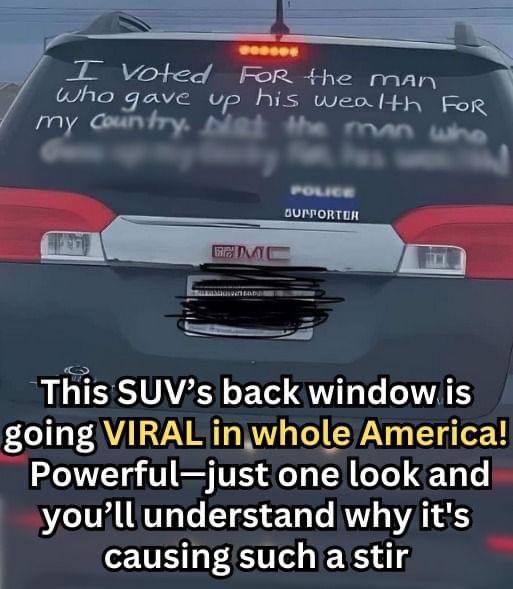
The highway is usually a place of anonymity, a streaming river of steel and glass where we coexist in a state of mutual indifference. We stare at taillights and license plates, our minds drifting through podcasts or mental to-do lists, rarely considering the interior lives of the strangers in the lanes beside us. Most people use their rear windows to broadcast trivialities: a stick-figure family, a university decal, or a faded “Baby on Board” sign. But on a sweltering Tuesday afternoon, amidst the rhythmic hum of interstate traffic, a mud-splattered black SUV turned a mundane commute into a site of profound public reckoning.
The driver had bypassed the colorful stickers and the clever vanity plates. Instead, they had taken a white grease pencil and used the back window as a canvas for a manifesto of raw, jagged honesty. The message was written in a hurried, trembling hand, the letters large enough to be read from three car lengths back. It didn’t just demand attention; it commanded a silence that felt heavy enough to dampen the sound of the engines.
“TO THE PERSON I GAVE TWENTY YEARS TO: YOU DIDN’T JUST BREAK OUR VOWS. YOU BROKE THE VERSION OF ME THAT BELIEVED IN PEOPLE. ENJOY THE SILENCE YOU TRADED EVERYTHING FOR.”
As the SUV merged into the fast lane, a ripple effect traveled through the surrounding traffic. Drivers who were usually aggressive—the tailgaters and the lane-weavers—found themselves slowing down, maintaining a respectful distance as if the vehicle were a funeral procession or a fragile relic. There is something inherently startling about seeing private heartbreak dragged into the clinical glare of the public daylight. We are a society built on the polite concealment of our wounds, yet this driver had decided that the weight of their betrayal was too heavy to carry in secret.
The brilliance of the message lay in its ambiguity and its universality. You didn’t need to know the driver’s name, their gender, or the specific details of the infidelity to feel the visceral throb of the wound. Twenty years. Two decades of shared grocery lists, folded laundry, late-night conversations, and built-in assumptions about the future—all evaporated into a few lines of white ink on a piece of tempered glass. It forced every person behind that SUV to hold a mirror up to their own lives. We looked at the message and then looked at our own passengers, or the empty seats beside us, and felt the sudden, terrifying fragility of our own loyalties.
As the miles stretched on, the SUV became a focal point for a strange, silent community of commuters. In the cars following behind, you could see the shifts in body language. A woman in a silver sedan gripped her steering wheel a little tighter, her eyes fixed on the glass as if reading a prophecy. An older man in a pickup truck adjusted his rearview mirror, his expression softening into something resembling grief. We were all witnessing a person in the exact moment they decided that “moving on” required a public shedding of their old skin.
The act was undeniably risky. In an era of viral outrage and digital mockery, broadcasting your deepest trauma to a thousand strangers is an act of radical vulnerability. It was a refusal to be a victim in the shadows. By writing those words, the driver was reclaiming the narrative of their life. They were saying: I am not ashamed of my hurt; you should be ashamed of the reason for it. It was a bold interrogation of the concept of loyalty. It asked everyone on that road a piercing question: What do you do when the person who was supposed to be your sanctuary becomes the person you need sanctuary from?
There is a specific kind of pain that comes from a long-term betrayal. It isn’t just the loss of a partner; it is the retroactive poisoning of your own memories. When twenty years are revealed to be built on a foundation of deceit, you don’t just lose your future—you lose your past. You find yourself wandering through old photographs and mental archives, wondering which smiles were real and which promises were decoys. The driver’s message captured that erasure perfectly. The “silence” they mentioned wasn’t just the absence of noise in a house; it was the hollow, echoing void left behind when a life’s worth of trust is excavated in a single moment.
As the sun began to dip toward the horizon, casting long, golden shadows across the asphalt, the SUV finally signaled for an exit. For a brief moment, the light hit the back window just right, making the white grease pencil glow with an almost ethereal intensity. It looked like a neon sign in the wilderness, a warning and a testament all at once.
The vehicles that had been following it—the silver sedan, the pickup truck, the dozens of others who had shared that mile of road—continued straight. But the atmosphere had changed. The anonymity of the highway had been punctured. We were no longer just a collection of machines moving from point A to point B; we were a collection of stories, many of them held together by the same fragile threads of trust that had snapped for the driver of the black SUV.
How many of us have wanted to do exactly what that driver did? How many of us have carried a secret so corrosive that we felt like we might explode if we didn’t scream it into the wind? We stay silent because we are told it is “dignified,” or because we fear the judgment of the world. But as the black SUV disappeared down the off-ramp, weaving into the local traffic of some unknown suburb, it left behind a powerful lesson in the necessity of truth.
Sometimes, healing doesn’t begin in a therapist’s office or a quiet room. Sometimes, it begins on the I-95 at sixty-five miles per hour. It begins when you stop hiding the wreckage and start acknowledging that the crash happened. The driver may have been heading toward an empty house, but they were driving there with a lighter load. They had broadcast their pain, and in doing so, they had forced the world to acknowledge their existence.
Long after the taillights of that SUV had faded into the dusk, the message remained etched in the minds of those who saw it. It served as a reminder that every car we pass is a vessel for a complicated, often painful journey. It reminded us that loyalty is not just a word, but a sacred debt—and that when that debt is defaulted upon, the fallout is rarely contained within the walls of a home. We drove on into the night, more aware of the people in the lanes beside us, wondering what messages we might write on our own windows if we only had the courage to be that honest.
Leave a Reply