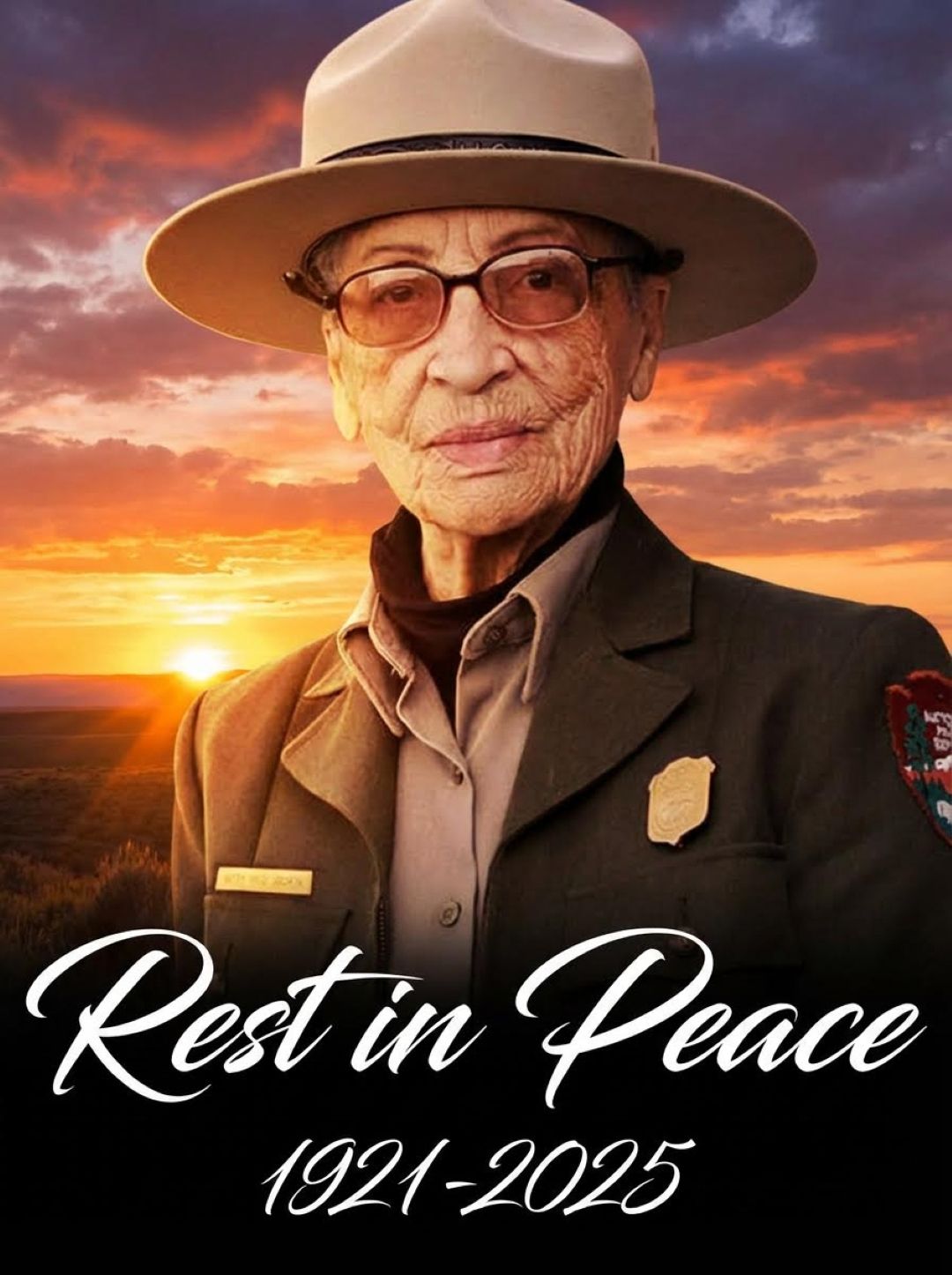
The story of Betty Reid Soskin is not merely a chronicle of longevity, but a profound testament to the power of the individual voice in the grand theater of American history. Passing away peacefully at the age of 104, Soskin left behind a world that looks fundamentally different because she lived in it. She was a woman who did not merely inhabit her century; she interrogated it, challenged its omissions, and eventually became its most eloquent translator. At an age when most have long since retreated into the quiet of retirement, Soskin embarked on her most significant chapter, proving that the most vital work of a lifetime can often begin in its twilight.
Soskin’s name became synonymous with the National Park Service, where she served as the oldest active ranger in the organization’s history until her retirement at the age of 100 in 2022. However, her impact was measured in more than just years of service or the iconic flat-brimmed hat she wore with such dignity. She was the moral heartbeat of the Rosie the Riveter/World War II Home Front National Historical Park in Richmond, California. When the park was being conceptualized, Soskin was the voice in the room who refused to allow the narrative to be sanitized. She understood that while the “Rosie” archetype was a powerful symbol of female empowerment, it was a story that, in its traditional telling, often bypassed the segregated realities and the systemic exclusion faced by African Americans during the war effort.
Because she had lived that history, she possessed the unique authority to correct it. Born in 1921 into a multicultural family with deep roots in Louisiana and California, Soskin’s early life was a microcosm of the American experience. During World War II, she worked as a file clerk for a segregated labor union, an experience that placed her at the intersection of national progress and local prejudice. She saw firsthand the friction of a country fighting for democracy abroad while struggling to realize it at home. It was this lived experience that she brought to the National Park Service in her eighties—a time when her peers were looking back, she was looking forward, determined to ensure that the “lost stories” of the home front were given a permanent home in the national consciousness.
Before she was a ranger, Soskin was a community builder and a cultural architect. In 1945, she and her husband, Mel Reid, co-founded Reid’s Records in Berkeley. What started as a small business became a legendary cultural cornerstone, a place where gospel music and community dialogue flourished for over seven decades. The store survived the shifting tides of the music industry and the gentrification of the neighborhood, standing as a monument to Black entrepreneurship and resilience. This chapter of her life reinforced her belief that history is not just found in textbooks; it is preserved in the spaces where people gather, share music, and tell their truths.
Her transition into public service and government roles in the following decades further honed her skills as an advocate for representation. Whether working for local legislators or serving on community boards, Soskin was consistently focused on the “invisible” citizen. She understood that power often resides in whose story gets told and whose is ignored. By the time she donned the ranger uniform, she wasn’t just a government employee; she was a seasoned warrior for the truth, armed with a century of perspective and a deep, abiding love for a country she wanted to see live up to its promises.
One of the most poignant moments of her public life occurred in 2015 when she was invited to the White House to participate in the National Christmas Tree Lighting ceremony. Standing beside President Barack Obama, Soskin represented the bridge between the struggles of the past and the possibilities of the future. For a woman who had come of age in a segregated America, seeing a Black president acknowledge her contributions was a moment she described as both surreal and profoundly humbling. It was a validation of her lifelong mission: that if you stay at the table long enough, you can eventually change the menu.
Even as she entered her second century, Soskin remained a vital participant in civic life. Her programs at the Richmond park were legendary, often selling out months in advance. Visitors didn’t just come to see a historical site; they came to hear a sage. She had a way of speaking that turned distant facts into visceral realities, forcing her audience to confront the complexities of the American identity with honesty rather than nostalgia. She taught us that a nation can only truly heal its wounds when it is brave enough to look at them clearly.
The passing of Betty Reid Soskin at 104 marks the end of a physical journey, but the echoes of her work are permanent. She reshaped the National Park Service’s approach to storytelling, moving it away from a “great man” theory of history and toward a more inclusive, democratic narrative that celebrates the contributions of the many. Her family, in their time of grief, has urged that her legacy be honored through continued investment in education and the preservation of diverse historical narratives. They understand that Betty’s work was never about herself; it was about the generations who would come after her, seeking to understand their place in the American story.
As we reflect on her century of life, we are reminded that history is a living, breathing thing. It is not static; it is a conversation between the past and the present. Betty Reid Soskin was a master of that conversation. She protected the stories that were in danger of being forgotten, corrected the ones that were being told wrong, and passed the torch to us with the quiet, firm expectation that we would keep the light burning.
Her life serves as a blueprint for how to grow old with purpose. She proved that the mind can remain sharp and the heart can remain open even as the body tires. She showed us that the most radical thing one can do in an age of misinformation is to tell the truth with integrity and grace. Betty Reid Soskin didn’t just witness American history; she helped write its most honest chapters. And in doing so, she ensured that the voices of the overlooked would never again be silenced in the parks and monuments of the land she loved. Her legacy is a reminder that while time moves on, the truth, once told, stands forever.
Leave a Reply